Hippopotamus: Can't Swim, "Blood Sweat," and Why River Horses Are Dangerous
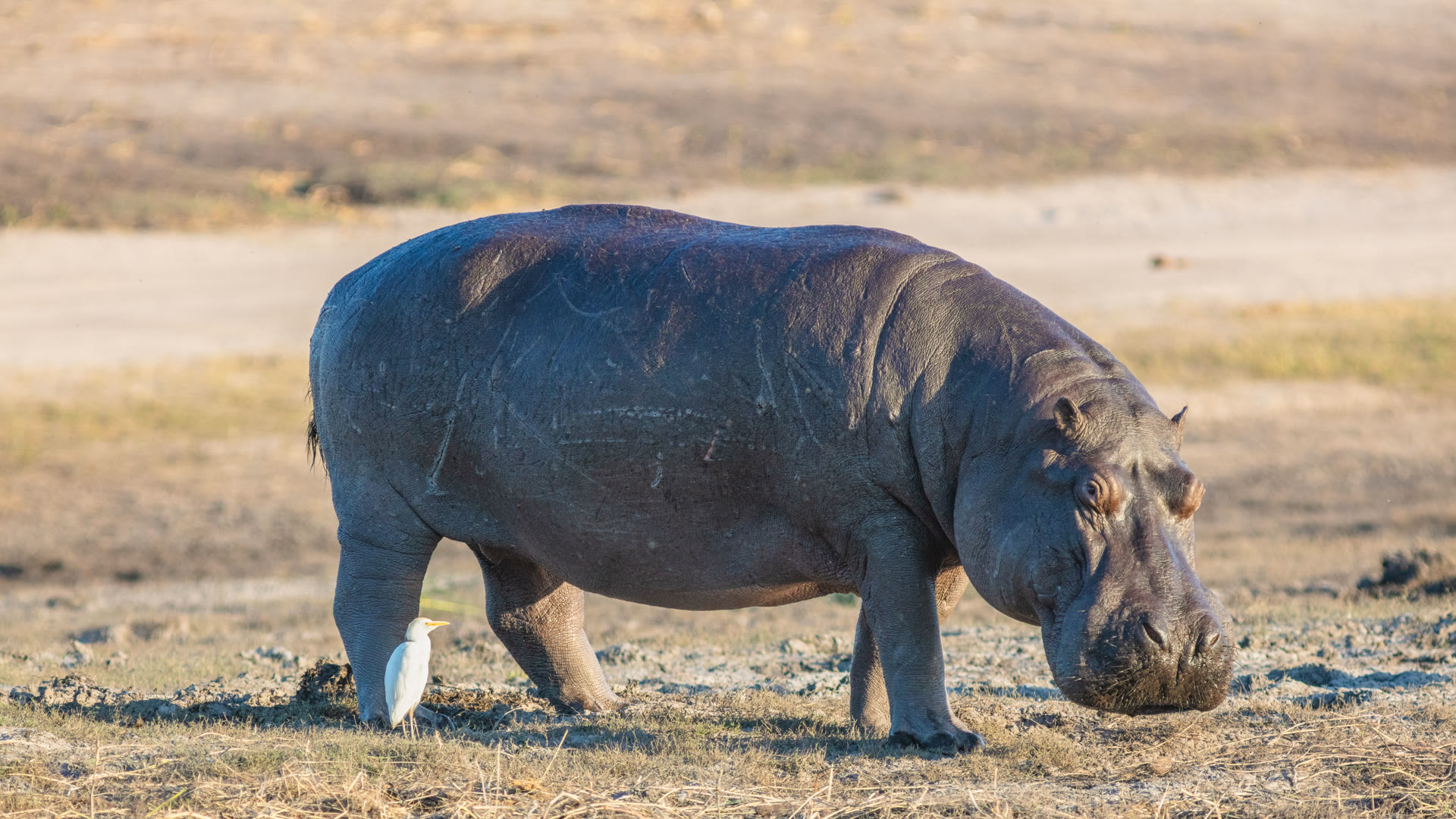
Species deep dive · hippopotamus
Search “can hippos swim,” “why are hippos so dangerous,” or “do hippos sweat blood,” and you get the same barrel-shaped silhouette half-submerged in a muddy African river. The Greek name hippopotamos means “river horse,” which is charming and slightly wrong on both counts: hippos are not horses, and despite all those hours in the water they cannot swim or float.
Hippopotamus amphibius is a semi-aquatic megaherbivore of sub-Saharan rivers, lakes, and swamps — IUCN Vulnerable, CITES Appendix II, with a wild population on the order of roughly 115,000–130,000. In Wilder TCG the Hippopotamus is a Cost 6 Mammalia Water Guardian: a chunky mid-to-late board presence that echoes a real animal whose threat displays, bottom-walking, and odd “blood sweat” sunscreen are more engineered than any cartoon river horse.
They don't swim — they walk the riverbed
San Diego Zoo Wildlife Alliance puts the paradox plainly: hippos are superbly adapted for water, yet their bodies are too dense to float. Eyes, ears, and nostrils sit high on the skull so an animal can see, hear, and breathe with almost everything submerged. Nostrils and ears seal when they go under; a clear nictitating membrane protects the eyes. Adults routinely hold a breath on the order of about five minutes (average submersion is shorter), and a subconscious reflex lets sleeping hippos bob up, inhale, and sink again without fully waking.
Locomotion underwater is a slow-motion gallop or punt along the bottom, toes lightly touching silt — closer to an underwater walk than a dog-paddle. On land they are no slouches either: short bursts around 30 km/h over a few hundred meters are enough to close a gap between a boat launch and deeper water. That combination — hard to see until they surface, fast enough to matter, unwilling to be cut off from the river — is the practical core of hippo danger, not cartoon “bloodlust.”
Pods by day, grazers by night
By day, hippos rest in pods often cited around 10–30 animals (larger aggregations occur where water is scarce). Dominant bulls patrol territories; females and calves cluster in the safer middle of the pool. At dusk they leave the water along familiar “hippo paths” to graze grasses and reeds for several hours. Wilder’s field guide cites roughly ~88 lb (~40 kg) of forage per night — about 1–1.5% of body weight, in line with Animal Diversity Web’s summary. They are strict herbivores; rare reports of scavenging are ecological footnotes, not a meat diet.
Adult size spans a wide envelope. Wilder lists lengths on the order of 10.8–16.5 ft and masses that can exceed 9,920+ lb in extreme bulls; ADW’s range of roughly 1,300–3,200+ kg for typical adults sits in the same megaherbivore league as Africa’s other river and savanna giants. Calves nurse underwater with nostrils closed — another reminder that “semi-aquatic” here means a life history rebuilt around the waterline.
The red fluid is not blood
For generations, people called the oily red film on a hippo’s skin “blood sweat.” It is neither. Hippos lack ordinary sweat glands; specialized mucous glands secrete a colorless fluid that oxidizes within minutes into orange-red hipposudoric and norhipposudoric acids. Research summarized by zoos and ADW frames these compounds as a combined sunscreen and mild antimicrobial coating for thin, vulnerable skin that would otherwise burn and crack in equatorial sun. Useful evolutionary chemistry — not a horror-movie hemorrhage.
Why encounters go badly
Hippos are not stalking humans as prey. Most serious conflicts happen when people (often in boats, or walking between a pod and deep water) enter a defended space, especially around calves or during crowded dry-season pools. Males yawn to flash tusk-like canines that can reach on the order of ~50 cm / ~20 inches; jaws gape toward 150 degrees. Popular travel and wildlife safety writing notes that across Africa hippos are frequently ranked among the deadliest large mammals to people — estimates of annual human deaths vary widely and should be treated as order-of-magnitude journalism, not a precise ledger. The behavioral takeaway is clearer than the body count: respect the water’s edge, give mothers space, and never assume a “lazy” log in the shallows is harmless.
Closest living relatives are not horses or pigs in the casual sense of the nickname — molecular and paleontological work places hippos nearest the whale and dolphin lineage among living mammals, a deep even-toed-ungulate story that makes the river horse feel less like a joke and more like a halfway chapter in the return to water.
On the Wilder card
In the Hippopotamus field guide entry you will find Water habitat tagging, Vulnerable conservation status, and Guardian flavor for a Cost 6 Mammalia presence — the game echo of a territorial river tank that bottom-walks, grazes by night, and wears chemical sunscreen instead of blood.
If you have never tried Wilder, guest play is free in the browser — open packs, build a deck, and put Africa’s river horse on the table:
Quick facts
- Scientific name: Hippopotamus amphibius
- Family: Hippopotamidae
- Hook: cannot swim or float (bottom-walks); red “blood sweat” is sunscreen chemistry; territorial defense + calves drive dangerous encounters
- Size: ~10.8–16.5 ft; extreme bulls 9,920+ lb (Wilder); typical adult mass often cited ~1.3–3.2+ tonnes
- Diet: nocturnal grazer — grasses and reeds, ~40 kg / ~88 lb per night
- Social: pods ~10–30; bulls territorial; calves nurse underwater
- Breath-hold: on the order of ~5 minutes for adults
- Status: IUCN Vulnerable; CITES Appendix II; ~115–130k wild (Hippo SG)
- Wilder family: Mammalia · Water · Cost 6 · Guardian
Photo credit
Hero photograph: Diego Delso, "Hipopótamo (Hippopotamus amphibius), parque nacional de Chobe, Botsuana, 2018-07-28, DD 82" (Wikimedia Commons,_parque_nacional_de_Chobe,_Botsuana,_2018-07-28,_DD_82.jpg)), CC BY-SA 4.0. Cropped for the Field Journal hero.
Sources
- Animal Diversity Web — Hippopotamus amphibius
- San Diego Zoo Wildlife Alliance — Hippo
- National Geographic — Hippopotamus facts
- IUCN Red List — Hippopotamus amphibius (Lewison & Pluháček)
- IUCN SSC Hippo Specialist Group — Common Hippopotamus
- Barklow 2004 — Amphibious communication with sound in Hippopotamus amphibius
- Wilder TCG — Hippopotamus field guide