Animals That Look Like Beavers: Nutria, Muskrat, Capybara, and How to Tell Them Apart
Species deep dive · american beaver
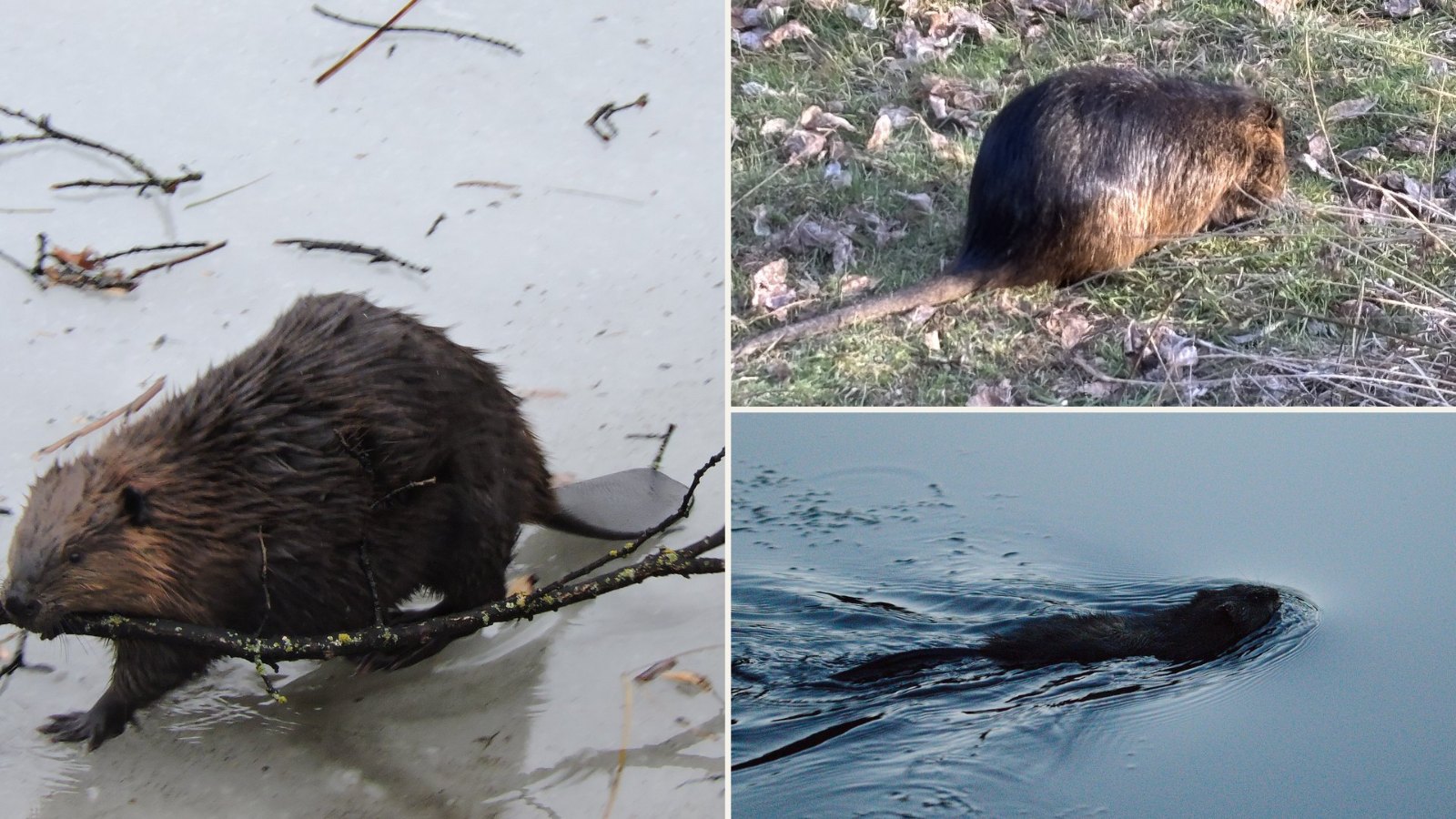
Saw a big brown rodent swimming and thought "beaver"? Look at the tail. A true beaver's tail is a broad, flat, scaly paddle, flattened top-to-bottom. A nutria has a long, round, rat-like tail. A muskrat has a thin tail flattened side-to-side that wiggles like a snake when it swims. That one clue settles most "is that a beaver?" sightings in North America.
The rest of the usual suspects are easier to rule out. A capybara is bigger than any beaver and has almost no tail. A groundhog lives in dry burrows on land, has white front teeth, and has a short, bristly tail. A mountain beaver isn't a beaver at all. A river otter is a slender, fish-eating carnivore. And the platypus only borrowed the "beaver tail" look for a body that also has a duck-like bill and lays eggs.
This guide covers the animals people most often mistake for beavers, what gives each one away, and where you would actually run into them. For the beaver itself (dams, lodges, iron-orange teeth, and why ecologists call it a keystone species), read our American beaver deep-dive.
Quick ID: beaver or lookalike?
- Tail wide and flat like a paddle, and it slaps the water when the animal is alarmed: beaver (American or Eurasian).
- Tail long and round, hanging still behind the swimmer; long white whiskers: nutria (coypu).
- Tail thin, flattened side-to-side, whipping back and forth as it swims; animal about the size of a squirrel: muskrat.
- No visible tail, pig-sized, grazing in groups, South America: capybara.
- Short, bristly tail, dry field or roadside burrow, white teeth: groundhog (woodchuck).
- Hardly any tail, hamster-like, digging in damp Pacific Northwest forest: mountain beaver.
- Long, furry tail thick at the base and tapering; sleek body; eats fish: river otter.
- *Duck-like bill and a flat but furry tail, eastern Australia:* platypus.
Beaver lookalikes compared
- *American beaver (Castor canadensis) — Size: 26–90 lb; 34–54 in total, including a 9–17 in tail (MDC). Tail: Broad, flat, scaly paddle, flattened top-to-bottom. Whiskers/teeth: Black whiskers; orange incisors. Home: Lodges or bank dens with underwater entrances. Builds dams:* Yes (not always).
- *Eurasian beaver (Castor fiber) — Size: 12.5–38 kg; body 74–90 cm plus a 28.5–35 cm tail (Mammal Society). Tail: Flat, scaly paddle. Whiskers/teeth: Orange, iron-reinforced incisors. Home: Bank burrows; lodges where it can't dig. Builds dams:* Sometimes.
- *Nutria / coypu (Myocastor coypus) — Size: 15–25 lb (MDC); most wild adults not much over 8 lb (Evans 1970). Tail: Long, round, sparsely haired; trails still. Whiskers/teeth: Long white whiskers, often a white muzzle; yellow-to-orange incisors. Home: Bank burrows; floating vegetation platforms. Builds dams:* No.
- *Muskrat (Ondatra zibethicus) — Size: 1½–4 lb; 16–25 in total, including a 7–11 in tail (MDC). Tail: Thin, scaly, flattened side-to-side; moves like a snake while swimming. Whiskers/teeth: Fine black whiskers. Home: Houses made of plants in shallow water, or bank burrows. Builds dams:* No.
- *Capybara (Hydrochoerus hydrochaeris) — Size: Up to ~1.3 m long and over 60 kg (NHM). Tail: Almost none. Whiskers/teeth: Blunt snout; continuously growing incisors, like all rodents (NHM). Home: Riverbanks and wetlands in South America. Builds dams:* No.
- *Groundhog / woodchuck (Marmota monax) — Size: 5–10 lb (rarely 12–15); 20–26 in, including a 6 in tail (PGC). Tail: Short, bristly. Whiskers/teeth: White incisors. Home: Dry burrows on well-drained slopes. Builds dams:* No.
- *Mountain beaver (Aplodontia rufa) — Size: ~12 in, ~2 lb (NPS). Tail: Very short stub. Whiskers/teeth: Big whiskers, large digging claws. Home: Burrow networks in moist Pacific NW forest. Builds dams:* No.
- *North American river otter (Lontra canadensis) — Size: 10–30 lb; 35½–53 in total (MDC). Tail: Long, furred, thick at the base and tapering. Whiskers/teeth: Silvery muzzle; a carnivore's teeth, not chisels. Home: Riverbanks; often reuses other animals' burrows. Builds dams:* No.
- *Platypus (Ornithorhynchus anatinus) — Size: Males 400–630 mm, 0.8–3 kg (Australian Museum). Tail: Broad, flat, covered in fur. Whiskers/teeth: Duck-like bill instead of rodent teeth. Home: Burrows in stream banks, eastern Australia. Builds dams:* No.
Sizes are ranges from the sources named in each entry. Individual animals, sexes, and regions vary.
Nutria vs beaver: the most common mix-up
The nutria, or coypu (Myocastor coypus), is the lookalike behind many "beaver" photos from the Gulf Coast, the Pacific Northwest, and other wetlands where it has been introduced. It is native to southern South America. The U.S. Geological Survey lists Argentina, Bolivia, Brazil, Chile, Paraguay, and Uruguay. It was brought to the United States for fur farming. USGS records the first introduction in 1899 in California, and escaped or deliberately released animals later founded wild populations in Louisiana, California, and beyond.
How to tell a nutria from a beaver:
- Tail: Round in cross-section, scaly and sparsely haired. In the water it trails smoothly behind the animal, because nutria swim with their feet (Missouri Department of Conservation). A beaver's tail is wide and flat. California Department of Fish and Wildlife notes that nutria in cold climates can lose part of the tail to frostbite, so a stubby tail doesn't rule one out.
- Whiskers: Nutria have long white whiskers, which MDC puts at 3–5 inches. You can see them from a distance, and the muzzle is often white too. Beavers and muskrats have dark whiskers.
- Size and shape: CDFW describes an adult nutria as about one-third the size of an adult beaver, with an arched, hunched back on land. MDC gives 15–25 lb. A classic 1970 federal wildlife report by James Evans (U.S. Bureau of Sport Fisheries and Wildlife, now archived by USGS) found that most wild adults on the Gulf Coast weighed not much over 8 lb. It concluded that wild nutria almost certainly never reach the 40 lb reported by some trappers.
- Teeth: Both animals have orange front teeth, so tooth colour won't separate a nutria from a beaver. It does separate a nutria from a muskrat.
- Hind feet: Webbing joins only the inner four toes of the hind foot. The fifth toe is free (USGS). A beaver's hind foot is fully webbed.
- Signs: No dams, no felled trees, no wood chips. Texas A&M AgriLife points out that beavers leave chips at feeding sites and nutria and muskrats do not. Nutria dig bank burrows and build flat platforms of floating vegetation.
Nutria matter because they're invasive. MDC notes they eat about 25 percent of their body weight a day. Because they also eat the roots of wetland plants, they can cause erosion and turn productive marsh into open water. California asks the public to report any sighting straight to CDFW.
Muskrat vs beaver: the squirrel-sized swimmer
The muskrat (Ondatra zibethicus) is a native North American rodent. It's much smaller than a beaver: 1½–4 lb, according to MDC. The U.S. Fish & Wildlife Service compares a muskrat to a gray squirrel and a beaver to a medium-sized dog.
- Tail: Long, scaly, and flattened side-to-side (MDC calls it "vertically flattened"). It sweeps quickly in a snakelike pattern while the muskrat swims. A beaver's tail is flattened top-to-bottom.
- Head and ears: USFWS notes that a muskrat's head is large for its body, and its ears are hidden in fur. Beavers have a relatively small head on a long body, and their ears are easy to see.
- Homes: Muskrats build dome-shaped houses from marsh plants such as cattails, or dig into banks, with the entrance usually underwater. A beaver lodge is made of sticks and mud. Muskrats don't build dams.
- Food: Mostly marsh plants, but MDC notes that Ozark stream muskrats also eat freshwater clams, snails, crayfish, fish, and frogs. Beavers eat only plants.
Is a capybara a beaver?
No. The capybara (Hydrochoerus hydrochaeris) is a rodent, like the beaver, but National Geographic notes it's closely related to guinea pigs and rock cavies, not to beavers. It's also the largest living rodent. Smithsonian's National Zoo ranks the North American beaver second, behind the capybara. London's Natural History Museum gives adult capybaras up to about 1.3 metres long and over 60 kg. The smaller lesser capybara reaches about 28 kg.
The quick tells: Britannica describes capybaras as having "almost no tail." They're stocky and pig-shaped, graze grass in groups (NHM cites herds of about 10–20), and have eyes, ears, and nostrils set high on the head so they can watch from the water. Their native range is South America. The USGS nonindigenous species database lists escaped capybaras in Florida, with scattered records elsewhere. It notes that a population may have established in north-central Florida's Santa Fe River drainage, though none have been seen there since 2011.
Groundhog (woodchuck): the dry-land impostor
Virginia Tech's nutria identification guide specifically warns that nutria are confused with the groundhog, which it calls "wholly terrestrial" and which has a much smaller tail. The Pennsylvania Game Commission describes the woodchuck (Marmota monax) as a member of the squirrel family, 20–26 inches long including a bristly 6-inch tail, and usually 5–10 lb. It has white front teeth, not orange, and digs burrows in well-drained slopes that "rarely get flooded." It doesn't need open water at all. If the animal is in a pasture, a garden, or a highway verge and runs into a dirt-mounded hole, it's a groundhog.
Mountain beaver: the "beaver" that isn't
The mountain beaver (Aplodontia rufa), also called the boomer or sewellel, lives only in the western parts of southern British Columbia, Washington, Oregon, and northern California. The National Park Service at Redwood National and State Parks explains that California miners named it for cutting limbs and gnawing bark the way beavers do. It isn't related to beavers. It's the only living member of its family, Aplodontiidae, and is often called the world's most primitive living rodent.
It's about 12 inches long and roughly 2 lb, with a tiny stub of a tail (NPS). Washington Department of Fish & Wildlife describes it as resembling "large, overgrown hamsters or tailless muskrats." It digs burrow networks in damp, ferny forest and doesn't build dams. Washington State University Extension notes that mountain beavers seem particularly drawn to rhododendrons. If something is clipping yours from a burrow in the Pacific Northwest, meet the mountain beaver.
River otter: the carnivore in the beaver's pond
North American river otters share beaver ponds and often move into beaver, muskrat, or woodchuck burrows (MDC). They're mustelids, part of the weasel family, and not rodents at all. USFWS notes that mustelids eat meat and have a long, slender, "slinky" build.
- Tail: Long, thick at the base, and tapering to a point, and covered in fur. It isn't a paddle.
- Body: Streamlined, with a silvery muzzle and throat (MDC). Adults weigh 10–30 lb and measure 35½–53 inches in total.
- Swimming: USFWS notes that a swimming otter keeps most of its body underwater and leaves a U-shaped wake from its broad nose. Otters catch most of their food in the water, and MDC notes they can stay under for 3–4 minutes. If the tail you glimpse is long and furry rather than a flat paddle, it's an otter.
Platypus: bill, tail, and the beaver confusion
The platypus gets called "beaver-tailed" for a reason. The Australian Museum describes a streamlined body with a "broad, flat tail," but that tail is covered in dense fur, not scales, and stores fat reserves. The rest of the animal couldn't be less beaver-like: a sensitive duck-like bill, venomous ankle spurs on males, and egg-laying (the platypus is a monotreme, like echidnas). It lives only in the freshwater streams of eastern Australia and Tasmania, so if you're outside Australia, it isn't a platypus. For electroreception, venom, and eggs, see our platypus deep-dive and the Platypus field guide entry.
American vs Eurasian beaver
Europe and northern Asia have their own true beaver, Castor fiber. The Mammal Society gives a body length of 74–90 cm plus a 28.5–35 cm flat, scaly tail, and a weight of 12.5–38 kg. It has the same bright orange, iron-reinforced incisors as the American beaver. NatureScot puts the range from Western Europe to the Chinese–Mongolian border and estimates about 1 million animals worldwide. Eurasian beavers usually live in bank burrows and build lodges and dams only where they need to.
In the field, the two species look almost identical. Your location is the practical ID: in Europe it's Castor fiber, and in North America it's Castor canadensis. The Eurasian beaver was hunted out of Britain by the end of the 18th century (Mammal Society). Reintroductions since have brought wild beavers back to rivers in Scotland and England, where they're protected.
Where you are narrows it down
- North America, freshwater: beaver, muskrat, river otter, and in some regions invasive nutria.
- North America, dry land: groundhog. In the damp Pacific Northwest, mountain beaver.
- Europe and northern Asia: Eurasian beaver, and the Eurasian otter along the same rivers.
- South America: capybara, and nutria in their native range.
- Australia: platypus. There are no wild beavers.
On the Wilder card
The American Beaver field guide entry is a Mammalia · Water · Cost 2 card, the game version of the paddle-tailed dam builder this guide keeps coming back to. Its river neighbour, the Platypus, is also Mammalia · Water · Cost 2.
If you've never tried Wilder, guest play is free in the browser. Open packs, build a deck, and put the real beaver on the table:
Quick facts
- Fastest single clue: the tail. Flat and wide means beaver; round means nutria; thin and flattened side-to-side means muskrat; furry and tapering means otter; almost none means capybara or mountain beaver.
- White whiskers: nutria. Beavers and muskrats have dark whiskers (CDFW).
- Orange teeth: beavers and nutria. Groundhogs have white incisors (PGC).
- Dams and felled trees with wood chips: beavers only. Nutria and muskrats don't build dams (Texas A&M AgriLife).
- Largest rodent: capybara (NHM). The American beaver is North America's largest rodent (ADW).
- Not a beaver despite the name: mountain beaver (Aplodontia rufa), family Aplodontiidae (NPS, WDFW).
- Wilder family: American Beaver — Mammalia · Water · Cost 2
Hero photos: American beaver, NPS Photo (public domain); nutria by Gracedbourke (CC0); muskrat by Ryan Hodnett (CC BY-SA 4.0), via Wikimedia Commons. Composite by Wilder.
Sources
- Missouri Department of Conservation — American Beaver
- Missouri Department of Conservation — Common Muskrat
- Missouri Department of Conservation — Nutria (Coypu)
- Missouri Department of Conservation — North American River Otter
- California Department of Fish and Wildlife — California's Invaders: Nutria
- California Department of Fish and Wildlife — Identifying Nutria (ID sheet)
- USGS Nonindigenous Aquatic Species — nutria (Myocastor coypus)
- USGS Nonindigenous Aquatic Species — capybara (Hydrochoerus hydrochaeris)
- Evans (1970) About Nutria and Their Control — Resource Publication 86 (USGS archive)
- U.S. Fish & Wildlife Service — Beavers, Otters, Muskrats, Minks, Oh My!
- Virginia Tech Conservation Management Institute — How to Identify a Nutria
- Texas A&M AgriLife Extension — Identifying and Managing Aquatic Rodents in Texas
- Pennsylvania Game Commission — Woodchuck
- National Park Service (Redwood NSP) — Mountain Beaver
- Washington Department of Fish & Wildlife — Mountain beaver
- Washington State University Extension — PNW Gardener's Handbook ch. 20
- Natural History Museum (London) — Capybaras: get to know the world's largest rodent
- National Geographic — Capybara facts
- Britannica — Capybara
- Australian Museum — Platypus
- The Mammal Society — Eurasian beaver
- NatureScot — Eurasian beaver
- Animal Diversity Web — Castor canadensis
- Smithsonian's National Zoo — Beaver
- Wilder TCG — American Beaver field guide
- Wilder TCG — Platypus field guide