Platypus: Electroreception, Venom Spurs, and Egg-Laying Mammals
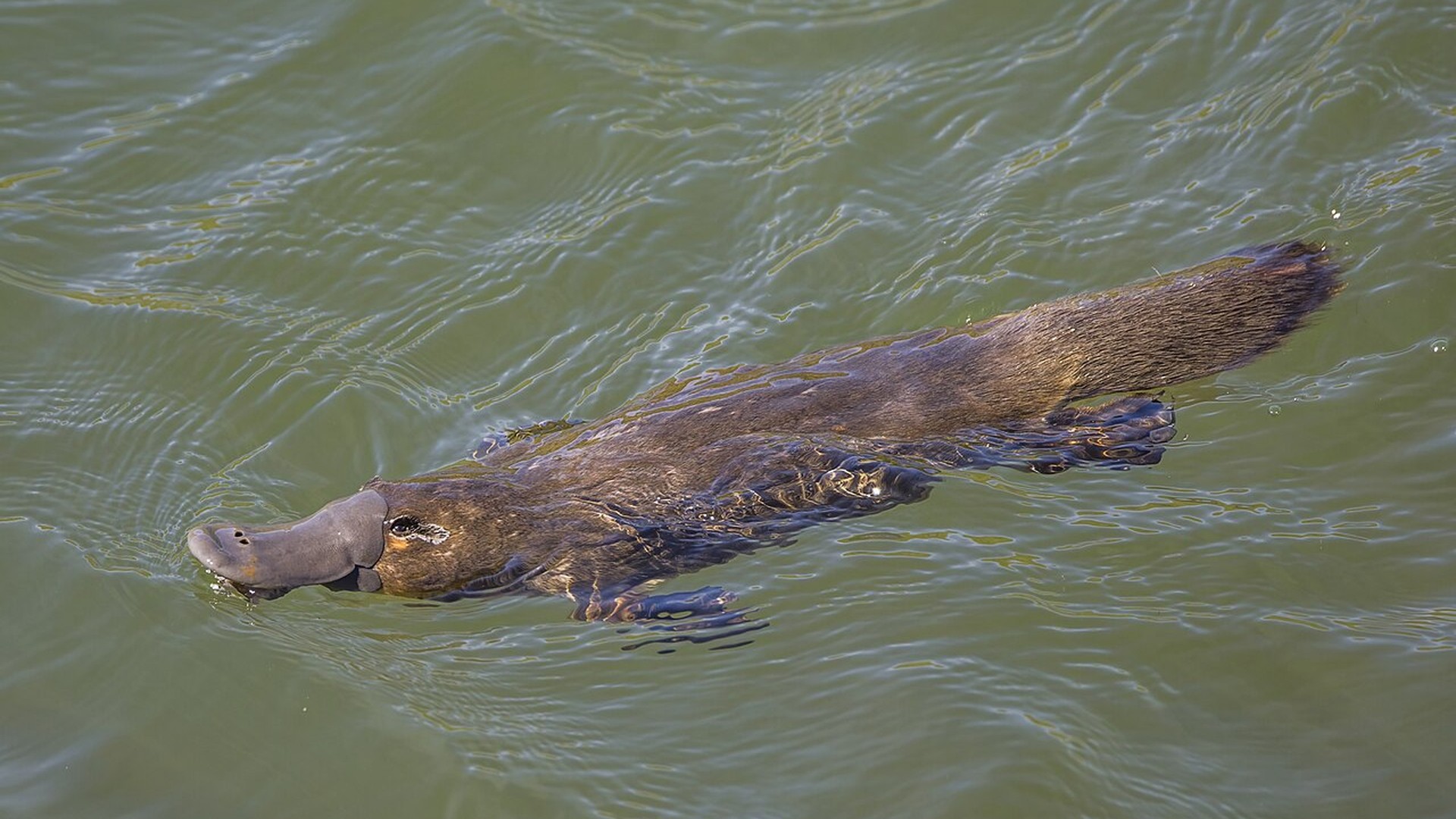
Species deep dive · platypus
Search "is the platypus venomous" or "do platypuses lay eggs" and you hit the same bewilderment European naturalists felt in the 1790s: a duck-billed, beaver-tailed mammal that closes its eyes underwater, hunts by electricity, lays leathery eggs, and — if male — packs venomous ankle spurs. Ornithorhynchus anatinus is not a mash-up. It is Australia's living monotreme specialist, and one of the few mammals that still answers "egg-laying" with a straight face.
In Wilder TCG the Platypus is a Mammalia Water creature (Cost 2). The card is shorthand for a real freshwater hunter whose bill is a sensor suite and whose biology keeps rewriting what "mammal" is allowed to mean.
Monotreme of eastern rivers
Platypuses belong to Ornithorhynchidae — the sole living species in their family — within Monotremata, the egg-laying mammals. Living monotremes are the platypus plus the echidnas. They share a cloaca (one exit for waste and reproduction), milk without nipples, and a deep evolutionary split from marsupials and placental mammals.
O. anatinus is endemic to eastern Australia: Queensland through New South Wales and Victoria into Tasmania and King Island, with an introduced population on Kangaroo Island, South Australia. It is extinct from mainland South Australia's former Adelaide Hills / Mount Lofty range. Habitat is permanent freshwater — rivers, creeks, and ponds with earth banks for burrows, overhanging vegetation, and coarse substrates (cobble, gravel) that support invertebrate prey. Elevations span tropical lowlands to alpine streams.
Males are larger: Australian Museum cites typical lengths of roughly 40–63 cm (males) and 37–55 cm (females), with masses spanning roughly 0.6–3 kg. Dense waterproof fur insulates; the broad tail stores fat. Front feet are strongly webbed for propulsion; hind feet steer and dig. Eyes, ear openings, and nostrils close when diving — so underwater "vision" is not optical.
Electroreception: hunting with a closed face
While foraging, a platypus seals eyes, ears, and nostrils and sweeps its soft bill through the water. The bill packs mechanoreceptors (pressure/touch) and electroreceptors that detect tiny electrical fields from the muscle activity of prey. Classic work by Scheich and colleagues (1986, Nature) demonstrated electroreception and electrolocation in the platypus — experimental animals responded to weak electric signals associated with prey-like stimuli.
Foraging dives are short and repeated. Australian Museum summarizes underwater stays of about 30–140 seconds: the animal gathers benthic invertebrates into cheek pouches, then surfaces to grind them with horny plates (adults lack functional teeth). Diet centers on insect larvae, plus shrimp, water beetles, worms, mussels, snails, and occasional surface insects. Night and twilight dominate activity; days are mostly spent in bank burrows.
Eggs, milk patches, and a long nursery
Yes — platypuses lay eggs. After mating (timing shifts with latitude; often late winter into spring in southern populations), the female constructs or reworks a long nesting burrow and gathers moist nesting material. She typically lays 1–3 eggs (commonly two). Gestation is on the order of about three weeks (Australian Museum cites ~21 days); incubation pressed against the belly with the tail lasts roughly ~10 days. Hatchlings are tiny and altricial.
Females have mammary glands but no nipples. Milk is secreted onto specialized abdominal milk patches (areolar skin), and young suckle from the fur-wetted milk. Lactation lasts roughly 3–4 months before juveniles emerge. Many females do not breed every year or until several years of age; wild longevity can approach roughly two decades in favorable conditions.
Venomous — but only the males, and not for hunting
Adult males carry a keratinous spur (~12 mm) on each hind ankle, ducted to a venom gland in the upper leg. Venom production peaks in the breeding season. The ecological job appears to be male–male competition more than prey capture. For humans the sting is famous for excruciating pain, rapid swelling, and sometimes long-lasting hyperalgesia (heightened pain sensitivity for days to months). It is not considered lethal to healthy adult humans — but it is a medical event, not a party trick. Handle any wild platypus only if trained; if you must move an injured animal, Australian Museum advises gripping the rear half of the tail to keep clear of spurs.
Females and juveniles do not deliver this venomous kick the way breeding males do. "Venomous mammal" here means a seasonal male weapon, not a snake-style hunting bite.
Near Threatened — carefully
IUCN lists O. anatinus as Near Threatened (assessment by Woinarski & Burbidge, 2016). That is not "about to vanish tomorrow," and it is not "fine everywhere." The species still occupies a wide eastern range and many catchments, but local declines, extinctions in parts of South Australia's mainland, and mounting pressure from regulated rivers, drought and water extraction, bank erosion and sedimentation, pollution, bycatch in nets and traps, and predation by dogs, foxes, and cats justify elevated concern. Legal protection across Australian states stopped commercial fur hunting (historically important into the early 20th century); protection alone does not restore every degraded stream.
Syntheses such as Bino et al. (2019) stress knowledge gaps in abundance trends at catchment scale — another reason "Near Threatened" is a precautionary signal, not a single number for every river.
From billabong to Wilder card
In the Platypus field guide entry you will find taxonomy, habitat, and in-game stats. On the board it plays as a Water Mammalia presence — the game echo of an electro-sensing egg-layer whose real toolkit is bill, burrow, and (for males) a painful spur.
If you have never tried Wilder, guest play is free in the browser — open packs, build a deck, and put Australia's oddest freshwater mammal on the table:
Quick facts
- Scientific name: Ornithorhynchus anatinus (Shaw, 1799)
- Family: Ornithorhynchidae (platypus); order Monotremata
- Hook: electroreception in the bill; egg-laying + milk patches; male venomous ankle spurs
- Size: roughly 37–63 cm; ~0.6–3 kg (males larger)
- Diet: aquatic invertebrates (insect larvae, shrimp, worms, molluscs); cheek pouches + horny grinding plates
- Dive note: typically ~30–140 seconds underwater while foraging
- Reproduction: 1–3 leathery eggs; ~10-day incubation; lactation ~3–4 months; no nipples
- Venom: adult males only; breeding-season spur; severe human pain, not typically lethal
- Status: IUCN Near Threatened (2016); legally protected in Australian range states
- Wilder family: Mammalia · Water · Cost 2
Sources
- Australian Museum — Platypus
- Animal Diversity Web — Ornithorhynchus anatinus
- IUCN Red List — Ornithorhynchus anatinus
- Bino et al. (2019) Journal of Mammalogy — The platypus: evolutionary history, biology, and an uncertain future
- Scheich et al. (1986) Nature — Electroreception and electrolocation in platypus
- Wilder TCG — Platypus field guide