Aye-aye: Percussive Foraging, Long Finger, and Madagascar's Night Tapper
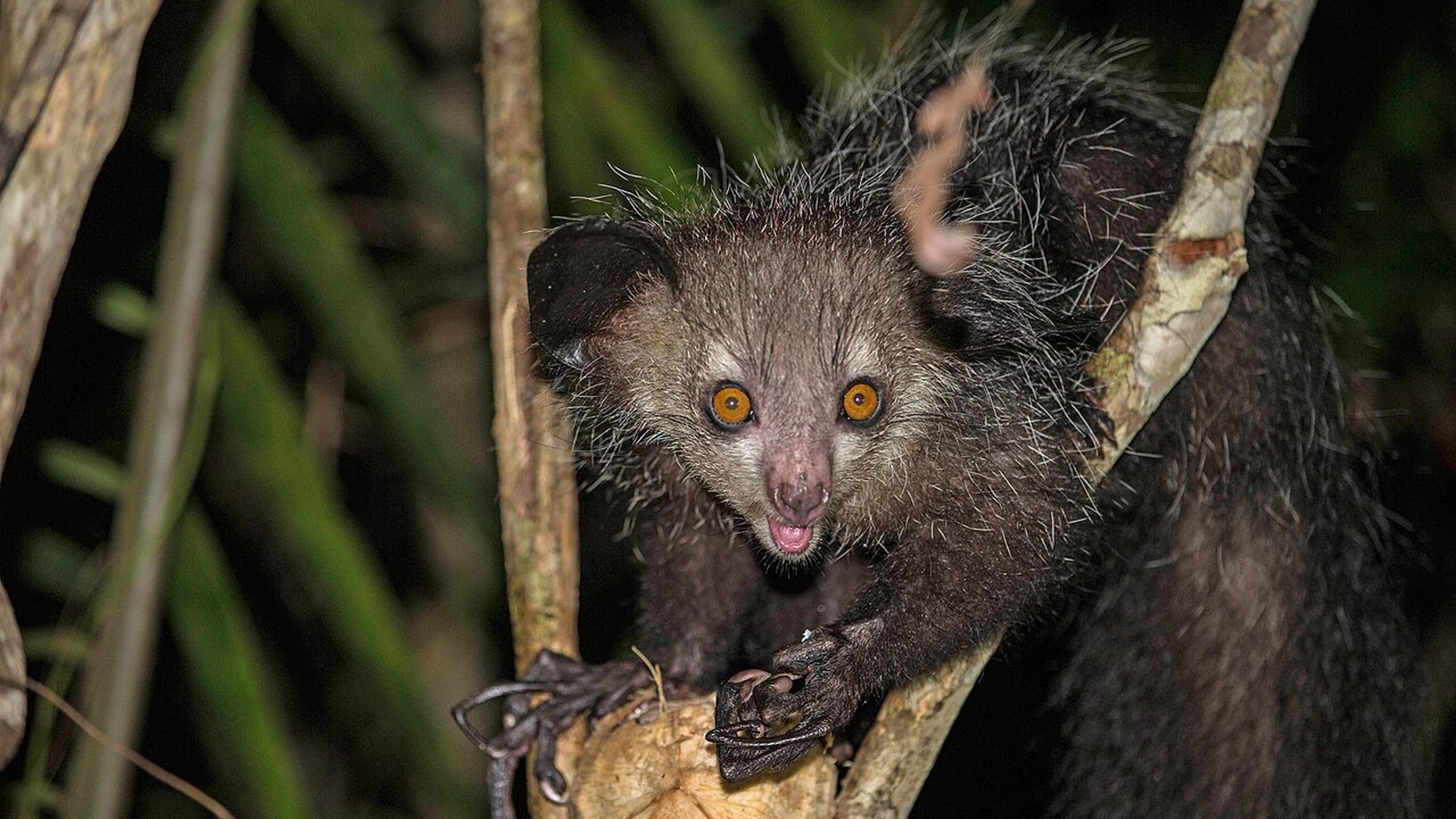
Species deep dive · aye aye
Search "aye-aye finger" or "how do aye-ayes find grubs" and you land on one of Madagascar's strangest living primates: a nocturnal lemur that taps wood like a tiny drummer, listens for hollow spaces, then gnaws an entrance and fishes out beetle larvae with a skinny, hyper-mobile middle finger. Daubentonia madagascariensis is the only living member of Daubentoniidae — a deep strepsirrhine lineage that reinvented extractive foraging from first principles.
In Wilder TCG the Aye-aye is a Mammalia Forest creature (Cost 2). The card is shorthand for a real canopy specialist whose toolkit is ears, ever-growing incisors, and that famous digit III.
Sole living daubentoniid
Aye-ayes belong to Primates → Strepsirrhini → Daubentoniidae. No close living cousins share the same body plan: continuously growing, rodent-like incisors (enamel on the front face only), a large diastema, huge naked ears, and highly specialized hand digits. The third digit is slender, elongated, and flexible; a recently described "pseudo-thumb" helps with grip around those spindly fingers.
D. madagascariensis is endemic to Madagascar, occurring in scattered pockets of eastern rainforests, northern and central-western deciduous woods, secondary growth, and even some plantations and mangroves. It is absent from the arid spiny forests of the far south. Days are spent in spherical leaf-and-twig nests high in the canopy; nights belong to travel, scent-marking, and foraging. Individuals are largely solitary, though loose foraging associations of a few animals occur and male home ranges (roughly 125–215 ha in classic field work) dwarf female ranges (~30–40 ha).
Adult head–body length is on the order of ~36–44 cm, with a long bushy tail that can exceed body length. Wilder field-guide size notes put body mass roughly in the ~2–3 kg class (about 4–6 lb). Coat color is dark brown to black with pale facial tones and striking ears.
Percussive foraging: tap, gnaw, extract
Aye-aye hunting is a three-act play:
- Tap-scanning — the elongated middle finger drums on bark and wood, generating acoustic cues (studies of this behavior report dominant tap frequencies on the order of ~6–15 kHz). Large ears and specialized audition help parse those returns.
- Gnaw — ever-growing incisors open a hole into the cavity once a promising subsurface space or structural break is detected.
- Extract — digit III probes, hooks, and pulls wood-boring larvae (especially cerambycid beetle grubs) into the mouth.
Classic work by Erickson framed this as tap-scanning plus extractive foraging — aye-ayes do not simply "hear grubs chewing"; they probe the architecture of wood communities and alter those microhabitats as they feed. Fruit, nuts (including ramy), nectar, and plant exudates round out a diet that needs both fats and protein across Madagascar's seasons. The same skinny finger can pierce fruit skins and scoop pulp when larvae are scarce.
This is the living answer to a common search question: yes, the long finger is a foraging tool, not a gimmick — percussion first, extraction second.
Nests, nights, and slow lives
Activity peaks from roughly dusk into the night. Nest sites rotate; the same nest may be reused by different individuals at different times. Reproduction is slow by lemur standards: gestation is long (~152–172 days in reviewed accounts), typically a single infant, and females may space births ~2–3 years apart while young take months to master adult-level locomotion and extractive skill. Captive longevity can exceed two decades.
That slow life history is why habitat loss bites so hard: replace a forest with a fragmented landscape and you do not get a quick rebound.
Endangered — carefully, and without cartoon folklore
IUCN lists the aye-aye as Endangered, reflecting suspected large declines driven by habitat loss and hunting pressure, with those drivers still active. Sightings are rare; presence is often inferred from distinctive gnaw marks and feeding traces, so abundance is easy to misread.
Cultural notes need care. In some communities, aye-ayes have been tied to omen stories and killed on sight; journalists often flatten that into a single "cursed animal" myth. Newer local-ecological-knowledge work also documents places where people recognize aye-ayes as larvae controllers in agroforestry — a reminder that attitudes are place-specific, not a single island-wide stereotype. Conservation that only repeats the omen line can miss allies who already see pest-control value.
Legal protection (including CITES Appendix I listing) and protected areas matter; so do corridors, plantation-edge tolerance, and reframing the species as a forest engineer rather than a mascot for misfortune.
From canopy tap to Wilder card
In the Aye-aye field guide entry you will find taxonomy, habitat, and in-game stats. On the board it plays as a Forest Mammalia presence — the game echo of Madagascar's nocturnal tap-scanner.
If you have never tried Wilder, guest play is free in the browser — open packs, build a deck, and put the island's oddest lemur on the table:
Quick facts
- Scientific name: Daubentonia madagascariensis
- Family: Daubentoniidae (sole living species); order Primates
- Hook: percussive tap-scanning + elongated middle finger + ever-growing incisors
- Size: head–body ~36–44 cm; roughly ~2–3 kg class; long bushy tail
- Diet: wood-boring larvae, fruits, nuts, nectar/exudates
- Activity: nocturnal; spherical canopy nests by day
- Reproduction: typically one young; long gestation; multi-year interbirth interval
- Status: IUCN Endangered; CITES Appendix I
- Wilder family: Mammalia · Forest · Cost 2
Sources
- Animal Diversity Web — Daubentonia madagascariensis
- IUCN Red List — Daubentonia madagascariensis
- Erickson (1991/1994) — Tap-scanning and extractive foraging
- Coleman et al. / acoustic ecology (PMC)
- Frontiers in Conservation Science (2025) — LEK and aye-aye pest-control perceptions
- Wilder TCG — Aye-aye field guide