Chimpanzee Tool Use: Termite Fishing, Nut Cracking, and Spears
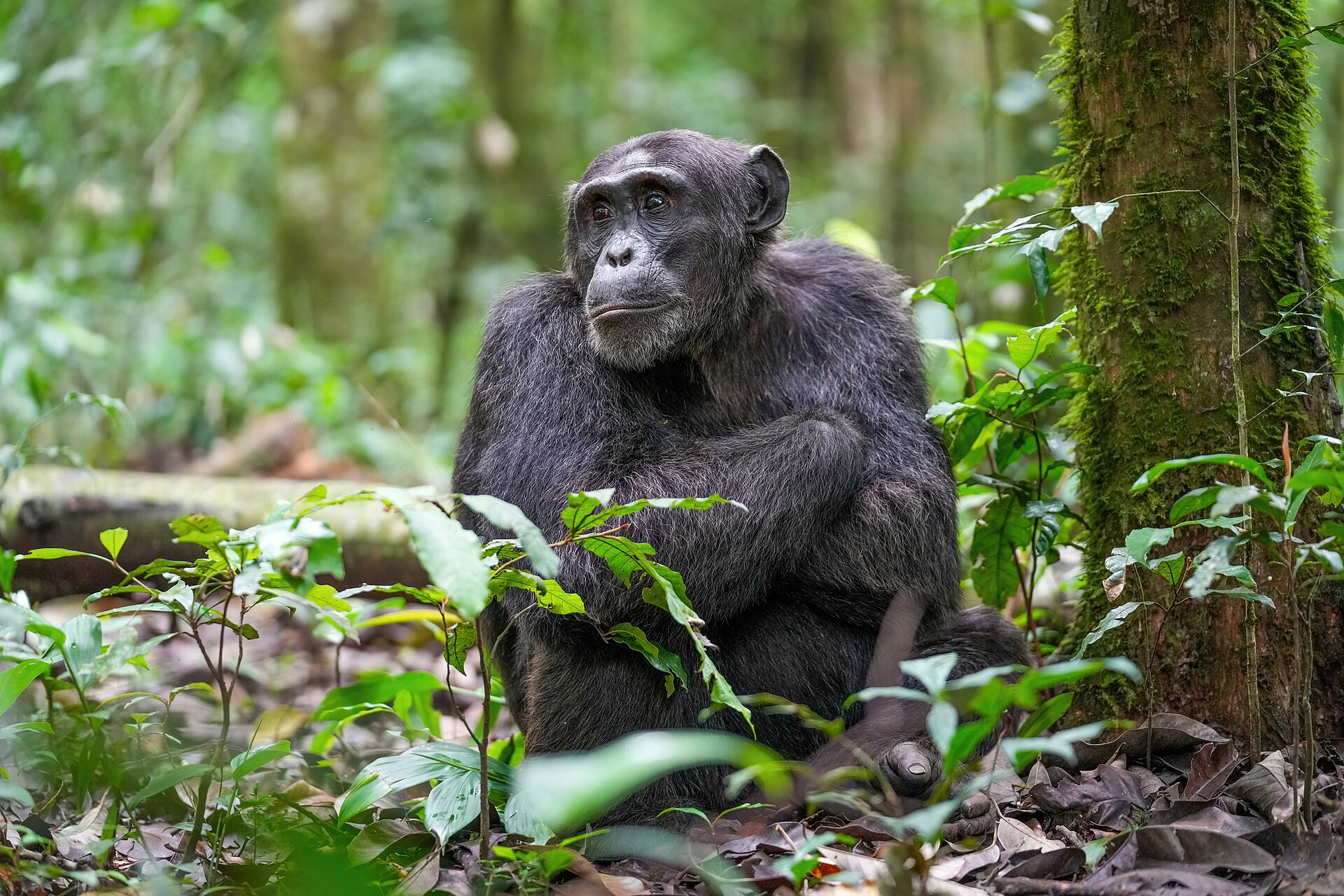
Species deep dive · chimpanzee
Chimpanzee Tool Use: Termite Fishing, Nut Cracking, and Spears
Search "chimpanzee" and you will hit the same two claims: closest living relatives of humans, and animals that make tools. Both are fair. Pan troglodytes is a great ape of equatorial Africa whose communities invent, refine, and teach techniques that differ from forest to forest — culture in the biological sense, not a metaphor.
In Wilder TCG the Chimpanzee is an Uncommon Mammalia creature with Herd. The card is shorthand for a social strategist whose real-world edge is not raw size — it is memory, coalitions, and a toolkit.
A brain that builds tools
Nearly every studied chimpanzee population uses tools. Workers (and foragers of every age) modify sticks, rocks, grass, and leaves to get food: fishing termites and ants from mounds, dipping for honey, cracking hard nuts with stone hammers and anvils, and soaking up drinking water with crumpled leaves.
Some communities go further. In parts of Senegal, chimpanzees have been observed sharpening sticks into spears and using them to jab small nocturnal primates (galagos) in tree hollows. Nut cracking and ant dipping are hard skills — young chimps take years to learn them well, which is why technique clusters by community rather than appearing uniformly across the species.
That geographic patchwork is one of the strongest arguments that chimpanzees transmit knowledge socially, not only by instinct.
Fission–fusion life in the canopy and on the ground
Chimpanzees live in communities that can number into the low hundreds, but day-to-day life is a fission–fusion society: individuals split into smaller foraging parties and rejoin as fruit, danger, and social politics shift. Males typically stay in their natal community and form a dominance hierarchy; many disputes are settled with displays and alliances rather than open fighting, though serious violence does occur.
They range across tropical rainforest, woodland, and mosaic savanna from Senegal east toward Tanzania and Uganda (bonobos, their sister species in the genus Pan, occupy the south bank of the Congo Basin). Night nests of bent branches and leaves are built fresh in the trees. Fruit — especially figs where available — anchors the diet; leaves, pith, insects, honey, and occasional meat from group hunts round it out. Adults commonly stand about 1–1.7 m and weigh on the order of 30–60 kg, with males usually heavier than females.
Four subspecies are widely recognized (P. t. verus, ellioti, troglodytes, schweinfurthii), with a fifth sometimes proposed. The western chimpanzee (P. t. verus) is assessed as Critically Endangered.
Endangered, still rewriting what "ape" means
IUCN lists the species as Endangered, with a rough global estimate often cited between 170,000 and 300,000 individuals. Habitat loss, bushmeat hunting, and disease are the main pressures. Field work since Jane Goodall's Gombe studies has kept rewriting the checklist of chimpanzee capacities — tool manufacture, coordinated hunting, long-term social memory — without turning them into cartoon humans.
They are apes with their own ecology. Treating that carefully matters as much as celebrating how familiar they feel.
From forest party to Wilder card
In the Chimpanzee field guide entry you will find taxonomy, habitat, and in-game stats. On the board, Herd echoes fission–fusion strength: the card gains when its family shows up in numbers, the way real communities leverage allies at a fruiting tree or a hunt.
If you have never tried Wilder, guest play is free in the browser — open packs, build a deck, and put a Chimpanzee on the table:
Quick facts
- Scientific name: Pan troglodytes (Blumenbach, 1775)
- Family: Hominidae (great apes)
- Size: ~1–1.7 m tall; tens of kilograms (males typically heavier)
- Diet: fruit-led omnivore — leaves, insects, honey, occasional meat
- Social system: male-bonded fission–fusion communities
- IUCN: Endangered (western subspecies Critically Endangered)
- Wilder family: Mammalia · Uncommon · Herd
Questions people ask
Is a chimpanzee stronger than a human?
Yes, but only by about 1.5 times for their size, not the several-fold edge often claimed. A 2017 PNAS study found chimp muscle produces about 1.35 times the force and power of human muscle of similar size, largely because about two-thirds of its fibres are fast-twitch (O'Neill et al. 2017).
How much DNA do humans share with chimpanzees?
About 98.8% when comparing single-base substitutions, a difference of roughly 1.2%; bonobos differ from us by the same amount. Counting stretches of DNA that were deleted, duplicated or inserted adds another 4–5% difference (Smithsonian Human Origins).
What is the difference between a chimpanzee and a bonobo?
Both belong to the genus Pan, but bonobos live only south of the Congo River in the DR Congo, are more slender with pink lips, and live in female-dominated groups with no observed lethal aggression in the wild. Chimpanzees live north of the river, are male-dominated, hunt cooperatively and can kill neighbours in territorial fights (Duke Evolutionary Anthropology).
Are chimpanzees monkeys?
No. Chimpanzees are great apes, like bonobos, gorillas and orangutans, and are genetically much closer to humans than to any monkey. The Smithsonian puts the DNA difference between great apes and humans on one side and rhesus monkeys on the other at about 7% (Smithsonian Human Origins). See our chimpanzee card.