Grizzly Bear: The Silver-Tipped Omnivore That Shapes the West
Species deep dive · grizzly bear
Grizzly Bear: The Silver-Tipped Omnivore That Shapes the West
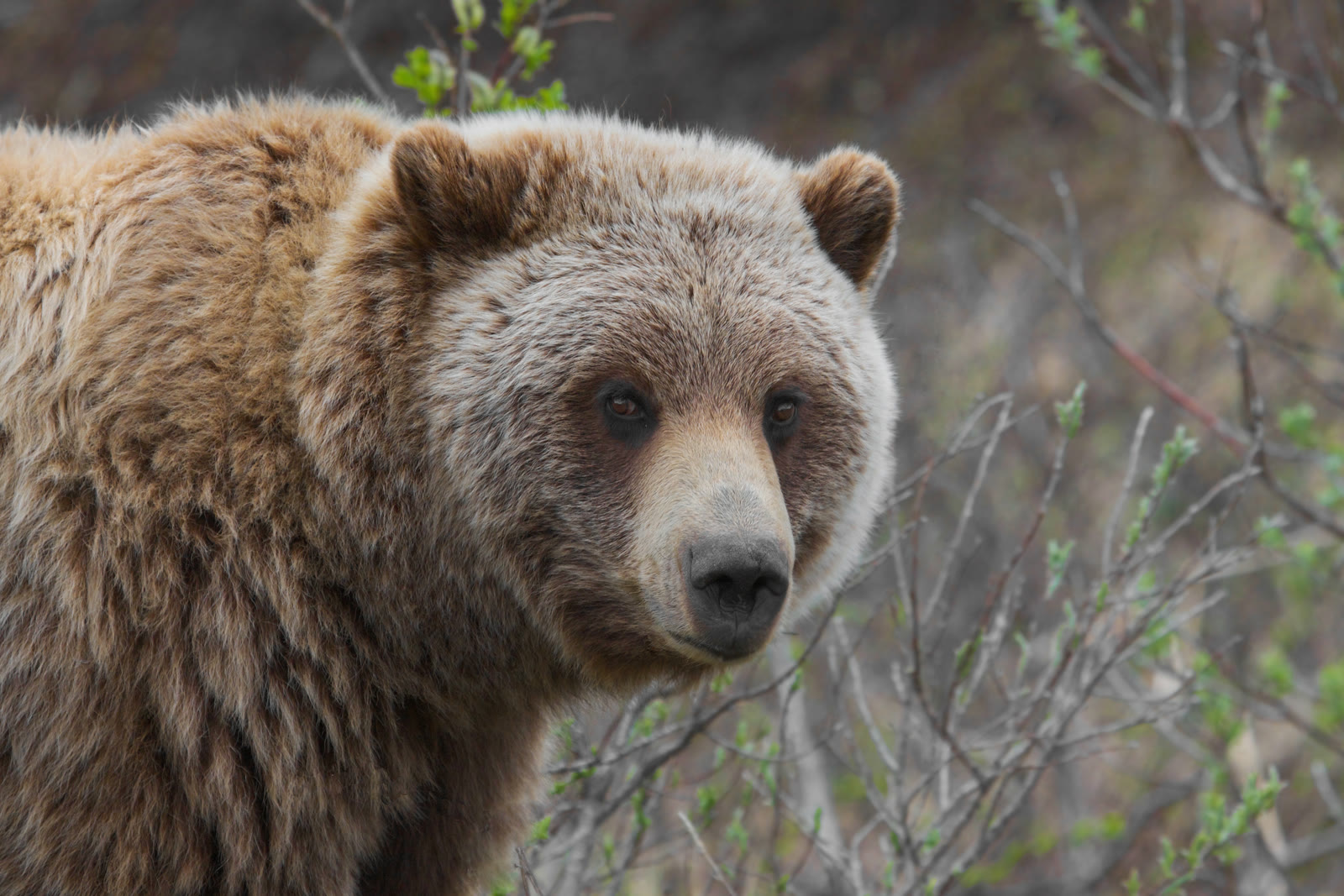
Search "grizzly bear" and you will get the silhouette first: shoulder hump, dish-shaped face, and fur tipped with pale guard hairs that look frosted in hard light. That "grizzled" coat is the name. The animal behind it is a North American brown bear — Ursus arctos horribilis — built less as a pure predator than as a seasonal omnivore that digs, fishes, and rearranges landscapes.
In Wilder TCG the Grizzly Bear is a Rare Mammalia creature with Feast. The card is shorthand for a heavyweight that gets stronger when it finds a meal — the board version of a hyperphagic autumn.
Silver tips, digging claws, surprising speed
Grizzlies are brown bears of western North America. Fur runs blond to nearly black; pale tips on the outer hairs create the classic silvered look ("silvertip" is an old field nickname). A muscular shoulder hump powers the forelimbs, and the claws are long and relatively straight — digging tools first, climbing tools second. Unlike American black bears, adult grizzlies rarely take to trees.
Size varies hard by sex, season, and food. Interior animals are often in the few-hundred-pound class; coastal and salmon-rich populations can grow far larger. Britannica cites large adults on the order of about 2.5 m long and roughly 410 kg. They look ponderous until they do not: short bursts around 56 km/h (about 35 mph) are reported. Eyesight is modest; smell is the long-range sense.
Females with cubs are famously defensive. Cub litters are small, and reproductive rates are among the lowest of North American terrestrial mammals — one reason recovered range fills in slowly.
An omnivore's calendar
Roots, bulbs, berries, ungulate calves, rodents, insects, carrion, and fish all rotate through the year. In places like coastal Alaska and interior salmon rivers, spawning fish can dominate late-season intake. Elsewhere, a summer may be more plant and insect than meat. That flexibility is the ecological story: grizzlies are diggers and scavengers as much as hunters, and their excavations turn soil, disperse seeds, and leave carcass nutrients for everything from ravens to beetles.
Winter is the pause. Grizzlies typically den for about five to seven months, living off fat stored in a frantic pre-den hyperphagia. (Timing and duration track latitude, food, and snow — not a single calendar date.)
Half a continent, then a hard cut
Historically, grizzlies ranged across much of western and central North America, including the Great Plains and California. Combined U.S. and Canadian range today is often summarized as roughly half of that historic footprint. The California grizzly is extinct (it remains on the state flag). Confirmed Arizona animals ended in the 1930s; Colorado's last clear records fade by the late 1970s.
Strongholds remain in Alaska and western Canada, with smaller Lower 48 populations centered on ecosystems such as the Northern Continental Divide and Greater Yellowstone. In the contiguous United States the species has long been managed under federal threatened-species protections in remaining recovery zones — status details shift with listing decisions, so treat any headline as time-stamped.
Reintroduction and corridor work are slow by design: few cubs, big home ranges, and a landscape full of roads, ranches, and people.
From den to Wilder card
In the Grizzly Bear field guide entry you will find taxonomy, habitat, and in-game stats. On the board, Feast mirrors the real seasonal binge — destroy the right prey and the bear grows. The flavor line does not oversell it: hundreds of kilograms of Pacific Northwest, and you should not run.
If you have never tried Wilder, guest play is free in the browser — open packs, build a deck, and put a Grizzly Bear on the table:
Quick facts
- Scientific name: Ursus arctos horribilis (Ord, 1815)
- Also called: North American brown bear; silvertip
- Signature traits: shoulder hump; long digging claws; pale-tipped "grizzled" fur
- Diet: seasonal omnivore (plants, invertebrates, ungulates, fish, carrion)
- Winter: dens roughly 5–7 months in much of the range
- Range note: roughly half of historic North American range remains occupied
- Wilder family: Mammalia · Rare · Feast
Photo credit
Hero photograph: Gregory "Slobirdr" Smith, "Grizzly Bear (Ursus arctos ssp.)" (Wikimedia Commons.jpg)), CC BY-SA 2.0. Cropped for the Field Journal hero.
Questions people ask
Is a silvertip bear the same as a grizzly bear?
Yes. "Silvertip" is an old common name for the grizzly, and Yellowstone National Park lists it alongside "grizzly bear" and "brown bear." It comes from the pale tips on the long outer guard hairs, which give the coat a frosted, silvery ("grizzled") look. Black bears generally don't have those light-tipped hairs.
How can you tell a grizzly bear from a black bear?
Don't go by color or size, since both vary. The National Park Service says to look for a combination: grizzlies have a distinct shoulder hump, a rump lower than the hump, a dished face, short rounded ears, and front claws about 2–4 inches long. Black bears have no hump, a straight face profile, taller ears, and shorter, curved claws under 2 inches.
Can grizzly bears climb trees?
Yes, though they're less suited to it than black bears. Yellowstone National Park notes that cubs and young bears are good climbers and adults can climb too, although their long digging claws are less efficient on trunks. That's why the NPS advises against climbing a tree to escape any bear.
What should you do if a grizzly bear charges or attacks?
The NPS advice is not to run. Talk calmly, stand your ground, and back away slowly if the bear stays put, since some charges are bluffs. If a grizzly makes contact, leave your pack on and play dead: lie flat on your stomach with your hands clasped behind your neck. If the attack keeps going, fight back hard. Carry bear spray and check each park's latest guidance.
How long do grizzly bears live?
Yellowstone National Park gives a life span of about 20–30 years for grizzlies in the wild. Many die much younger, and in the Greater Yellowstone Ecosystem, about 85% of known grizzly deaths are caused by people.