Blue Whale: Largest Animal, Lunge Feeding, and Deep Ocean Songs
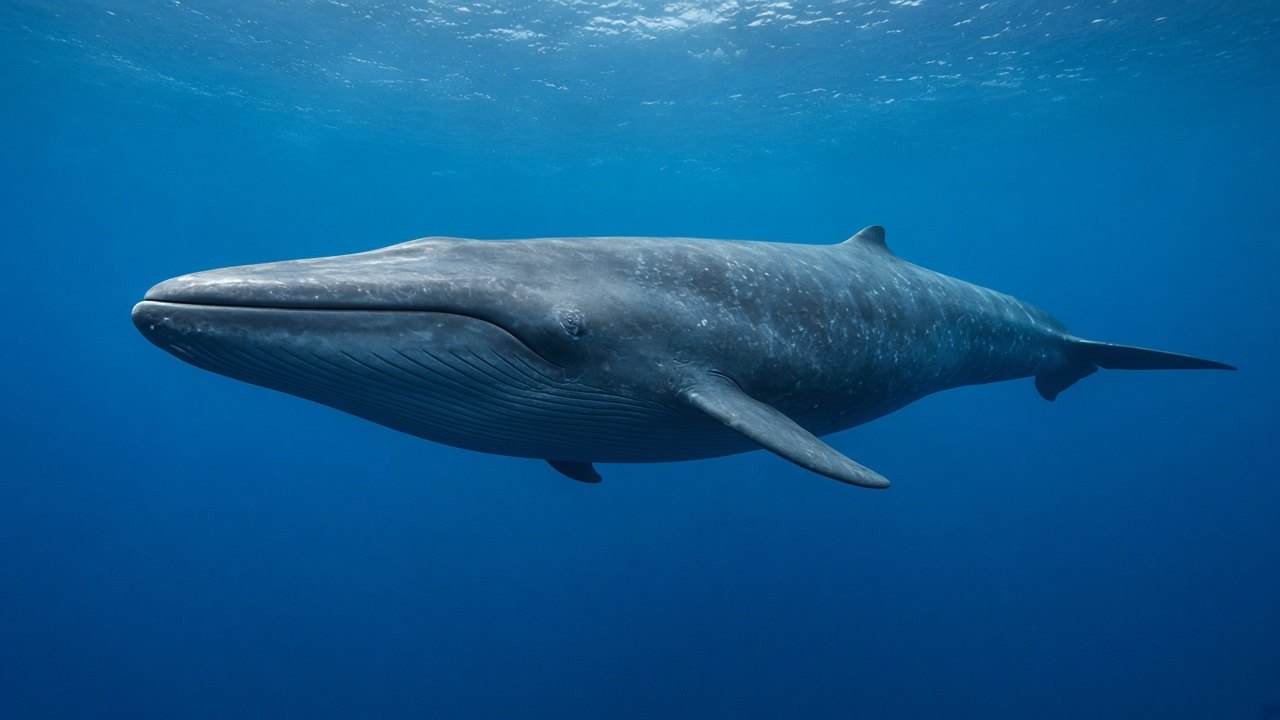
This is a generated illustration, not a photograph.
Species deep dive · blue whale
Search "largest animal on Earth," "how do blue whales eat," or "blue whale song" and you land on the same animal: Balaenoptera musculus — the blue whale. It is not merely the biggest living mammal. By every careful measure of length and mass, it is the largest animal known to have lived, a slate-mottled rorqual that turns dense krill patches into fuel with a single explosive gulp.
In Wilder TCG the Blue Whale is a Mammalia Water creature (Cost 8). The card is shorthand for a real pelagic giant whose throat pleats, baleen sieve, and ocean-crossing calls remake the scale of what a predator can be.
Rorqual of the open ocean
Blue whales belong to Balaenopteridae, the rorquals — baleen whales with expandable throat grooves. NOAA Fisheries places them in all oceans except the Arctic, with five currently recognized subspecies. Distribution tracks krill: summer feeding toward productive high-latitude waters, winter breeding and calving toward warmer lower latitudes, though some individuals appear to skip migration when food stays local.
Appearance is a long, relatively slender body mottled blue-gray; underwater the mottling can read as light blue. Animal Diversity Web notes yellowish diatom films on the belly — the old "sulphurbottom" nickname. A short dorsal fin sits far aft. Females are generally larger than males, a pattern shared with many other baleen whales.
Size needs careful numbers. NOAA reports Antarctic animals reaching about 110 feet and more than 330,000 pounds, while North Atlantic and North Pacific adults more often top out around 90 feet and over 100,000 pounds. Animal Diversity Web cites average head–body lengths near 25 m for males and 27 m for females, with a longest confirmed specimen near 33.5 m and a heaviest near 190,000 kg. Treat the extreme ends as verified maxima and subspecies differences — not every blue whale is a hundred-foot Antarctic giant.
Lunge feeding: a mouth that briefly becomes the ocean
Blue whales feed almost exclusively on krill (euphausiid crustaceans), with fish and copepods only occasional extras. NOAA notes that the largest individuals may take up to roughly six tons of krill in a busy day; ADW's older synthesis centers adult intake nearer three to four tons. Either way, the method is the same: lunge feeding.
The whale accelerates toward a dense school, opens a vast mouth, and inflates accordion-like throat pleats to engulf an enormous volume of prey-laden water — research on blue whale biomechanics shows engulfment capacity can rival or temporarily exceed body volume. Then the mouth closes, the tongue presses water out through baleen plates hanging from the upper jaw, and krill stay trapped. Goldbogen and colleagues (2011) showed that this high-cost strategy pays only when lunges hit extremely dense krill patches. Scale without prey density is just expensive swimming.
That filter-feeding lifestyle also ties blue whales into nutrient cycling: feeding and fecal plumes can fertilize surface waters, and a whale carcass that sinks becomes a deep-sea "whale fall." Those roles are real ecology, not marketing copy — but they do not require inventing precise carbon budgets for every individual.
Songs that travel farther than ships
Blue whales are usually solitary or in pairs, sometimes gathering where krill is thickest. Typical travel and feeding speeds sit near 5 mph, with short bursts over 20 mph. Their low-frequency pulses, groans, and moans rank among the loudest animal sounds on Earth. NOAA notes that under the right oceanographic conditions, calls may be detectable by other whales up to about 1,000 miles away — communication and, perhaps, long-range sensing in dark water, not a claim that every grunt is a navigational chart.
Lifespan estimates cluster around 80–90 years, often inferred from earplug growth layers in deceased animals. Gestation is roughly 10–12 months (NOAA) to 11–12 months (ADW); calves nurse for several months and mothers typically calve every two to three years. Newborns are already enormous by terrestrial standards — ADW places birth length near 7–8 m — yet still dependent on maternal milk and protection, including from rare but real calf-directed orca attacks.
Whaling collapse, legal protection, unfinished recovery
Industrial whaling in the twentieth century devastated blue whales. IUCN (2018) lists the species Endangered under criterion A1abd: a rough global mature population on the order of 5,000–15,000 today versus about 140,000 around 1926 — a reduction overlapping the boundary with Critically Endangered for past decline, with the Antarctic subspecies (B. m. intermedia) separately assessed as Critically Endangered. NOAA lists blue whales as Endangered under the U.S. Endangered Species Act and protected (and depleted) under the Marine Mammal Protection Act; commercial hunting has been internationally banned for decades, and some stocks show slow increase.
Modern threats are quieter than explosive harpoons but still lethal: vessel strikes, entanglement in fishing gear, underwater noise that can mask communication, and climate-linked shifts in krill. NOAA's viewing guidance is simple respect — stay at least 100 yards away. Recovery is real in places and incomplete everywhere.
On the Wilder card
In the Blue Whale field guide entry you will find taxonomy, habitat, and in-game stats. On the board it plays as a high-cost Water Mammalia presence — the game echo of Earth's largest filter feeder, whose real power is gulping krill by the ton and singing across basins.
If you have never tried Wilder, guest play is free in the browser — open packs, build a deck, and put the ocean's record-holder on the table:
Quick facts
- Scientific name: Balaenoptera musculus (Linnaeus, 1758)
- Family: Balaenopteridae (rorquals)
- Hook: largest animal ever; krill lunge feeding; very low-frequency long-range songs
- Size: commonly tens of meters; Antarctic maxima ~110 ft / >330,000 lb (NOAA); ADW averages ~25–27 m
- Diet: almost exclusively krill; largest animals up to ~6 tons/day (NOAA)
- Range: all oceans except the Arctic; migratory where food and breeding grounds diverge
- Status: IUCN Endangered; U.S. ESA Endangered; MMPA protected/depleted
- Wilder family: Mammalia · Water · Cost 8
Sources
- NOAA Fisheries — Blue Whale
- IUCN Red List — Balaenoptera musculus
- Animal Diversity Web — Balaenoptera musculus
- Goldbogen et al. (2011) Journal of Experimental Biology — blue whale lunge feeding energetics
- Goldbogen & Madsen (2021) — physiology/biomechanics review of blue whale scale
- Wilder TCG — Blue Whale field guide