Most Painful Stings in the World, Ranked: The Schmidt Pain Index Top 10
Showdown · bullet ant, warrior wasp, tarantula hawk wasp, argentine harvester ant, maricopa harvester ant, florida harvester ant, klugs velvet ant, megapolistes paper wasp, red headed paper wasp, red paper wasp, western honey bee
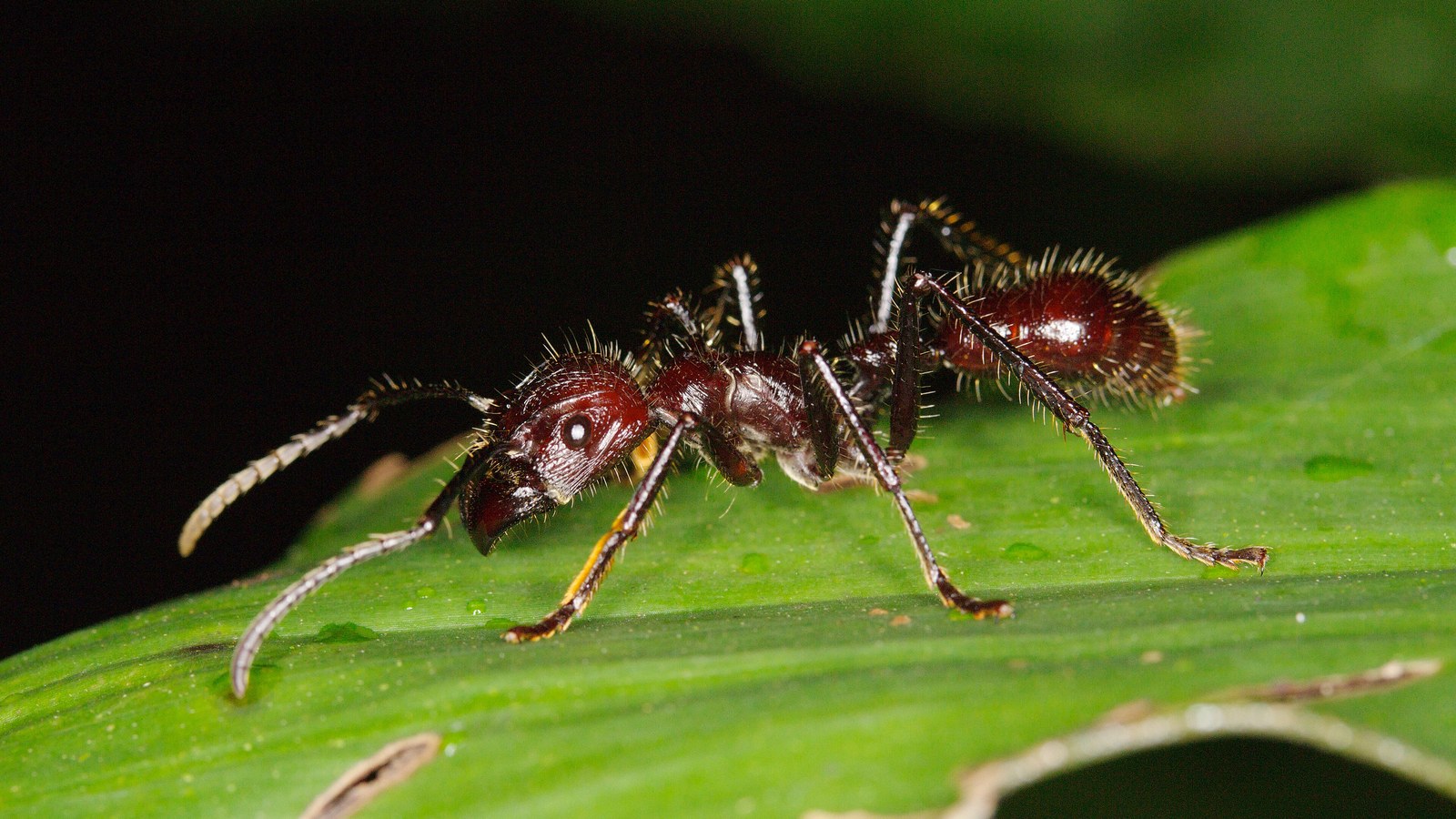
What is the most painful sting in the world? On the best-known scale we have, it is the bullet ant (Paraponera clavata). Entomologist Justin O. Schmidt, who was stung more than 1,000 times over his career, rated stinging insects from 1 to 4 with the honey bee as the reference point at 2. Only three kinds of insect reached 4 in his index: the bullet ant, the warrior wasp and the tarantula hawk. The bullet ant comes out on top because its pain lasts. As Smithsonian put it after interviewing Schmidt, the first jolt of a tarantula hawk or warrior wasp sting is just as bad, "but it's the staying power of the bullet ant's wallop that pushes it beyond the rest", with waves of pain lasting up to 36 hours.
Below is an honest top 10 built from Schmidt's published index. Every insect on it is a card in Wilder, so each name links to its field guide.
Watch the video: This Ant's Sting Broke the Schmidt Pain Index: Top 10 Worst Stings (5:34, on the Wilder TCG YouTube channel) counts down the same ten stings in the same order, from the red paper wasp to the bullet ant, with Schmidt's own descriptions.

- 0:00 Intro
- 0:18 How the Schmidt pain index works
- 0:38 #10 Red paper wasp red paper wasp
- 1:00 #9 Red-headed paper wasp red headed paper wasp
- 1:21 #8 Megapolistes paper wasp megapolistes paper wasp
- 1:39 #7 Klug's velvet ant klugs velvet ant
- 2:02 #6 Florida harvester ant florida harvester ant
- 2:19 #5 Maricopa harvester ant maricopa harvester ant
- 2:40 #4 Argentine harvester ant argentine harvester ant
- 3:13 #3 Tarantula hawk tarantula hawk wasp
- 3:35 #2 Warrior wasp warrior wasp
- 3:59 #1 Bullet ant bullet ant
- 4:33 Bonus: honey bee on the tongue western honey bee
- 4:43 Pain vs. venom
- 4:59 Every sting came from a female
How the ranking works
- The list: every sting Schmidt rated 3 or 4 in the pain index printed in his book The Sting of the Wild (Johns Hopkins University Press, 2016). That gives three 4s and seven 3s.
- The tiebreak: the scale has no decimals at the top, so within each level we rank by how long the pain lasts, where Schmidt recorded a duration. Two paper wasps have no published duration, so their order at #8 and #9 is a coin toss and we say so.
- Pain, not danger: the table also shows venom lethality in mice (LD50, from Schmidt's 2019 study of about 90 stinging insects). A lower number means a more lethal venom. Look at how little the two columns agree.
The 10 most painful insect stings, ranked
| Rank | Insect (Wilder card) | Scientific name | Schmidt pain (1–4) | How long the pain lasts | Venom LD50 in mice (mg/kg) |
|---|---|---|---|---|---|
| 1 | Bullet ant | Paraponera clavata | 4 | Waves for up to 36 hours | 1.4 |
| 2 | Warrior wasp | Synoeca septentrionalis | 4 | At least an hour | 3 |
| 3 | Tarantula hawk wasp | Pepsis grossa | 4 | About 5 minutes | 90 |
| 4 | Argentine harvester ant | Pogonomyrmex cunicularius | 3 | 12 hours or more | 0.088 |
| 5 | Maricopa harvester ant | Pogonomyrmex maricopa | 3 | 4–8 hours | 0.12 |
| 6 | Florida harvester ant | Pogonomyrmex badius | 3 | 4–8 hours (genus figure) | 0.12–0.7 (genus range) |
| 7 | Klug's velvet ant | Dasymutilla klugii | 3 | About 30 minutes | 70 |
| 8 | Megapolistes paper wasp | Polistes (Megapolistes) sp. | 3 | Not recorded | 7.7 (P. tepidus) |
| 9 | Red-headed paper wasp | Polistes erythrocephalus | 3 | Not recorded | 1.5 |
| 10 | Red paper wasp | Polistes canadensis | 3 | About a minute | 2.4 |
| Reference | Western honey bee | Apis mellifera | 2 (3 on the tongue) | 5–10 minutes (typical for a 2) | 2.8 |
Pain ratings and the harvester-ant durations are from Schmidt's book and his 2019 paper in Toxins. The bullet ant duration is from Smithsonian. The warrior wasp's "at least an hour" is from the 2019 paper. The tarantula hawk, velvet ant, red paper wasp and honey bee durations are Schmidt's 1990 figures as summarised in the index transcription. Mouse LD50 values are from Table 1 of the 2019 paper, except the Maricopa figure (0.12 mg/kg), which comes from the University of Florida Book of Insect Records. Schmidt named the New Guinea paper wasp only to its subgenus, Megapolistes. The Wilder card uses Polistes tepidus as a stand-in, and the LD50 shown is that species'.
The top three: all rated 4
1. Bullet ant. Schmidt's description is the most quoted line in entomology: "Pure, intense, brilliant pain. Like walking over flaming charcoal with a three-inch nail embedded in your heel." It was the only 4 in his original 1983 index, and he has said that if he ever made a 5, the bullet ant would be the only thing on it. Read the full story in our Journal piece on why the bullet ant tops the Schmidt pain index.
2. Warrior wasp. Schmidt's entry opens with one word, "Torture," and ends with "Why did I start this list?" His 2019 paper says these wasps' stings are "intensely painful for at least an hour". He also told National Geographic that a warrior wasp sting to the nose or lip might be worse than a bullet ant in some ways, because the swelling can last for days.
3. Tarantula hawk. "Blinding, fierce, shockingly electric. A running hair dryer has just been dropped into your bubble bath." It is just as intense as the other two but over in minutes. Schmidt's advice, as he told National Geographic, is to "lie down and scream" rather than stumble around and hurt yourself. Our tarantula hawk piece covers how females use that sting to paralyse tarantulas for their larvae.
The 3s: harvester ants, a velvet ant and paper wasps
The harvester ants (Pogonomyrmex) are the slow burners. Schmidt's 2019 paper says their venoms are the most toxic known from any Hymenoptera and cause "intense waves of deep, agonizing pain that lasts 4–8 h". His Maricopa entry describes "eight unrelenting hours of drilling into that ingrown toenail". The Argentine harvester ant's entry speaks of "a ferocious pang lasting 12 hours or more", and in his 2019 table its venom was the most lethal of all, at 0.088 mg/kg.
Klug's velvet ant is a wingless female wasp, not an ant. Schmidt called its sting "explosive and long lasting, you sound insane as you scream". The three paper wasps are short and sharp. The red paper wasp is "like spilling a beaker of hydrochloric acid on a paper cut", and the pain fades in about a minute.
Pain is not danger
Schmidt's 2019 study compared sting pain with venom lethality for 71 species and found no meaningful relationship (r² = 0.013). The tarantula hawk has one of the most painful stings known, but its venom needs about 90 mg/kg to kill half of a group of test mice, around 30 times more than a honey bee's 2.8 mg/kg. The Argentine harvester ant sits at the other extreme. In the paper, Schmidt treats pain as the body's warning system, which makes an attacker stop at once, while lethality measures real harm. The two clearly don't have to go together.
None of this measures the risk to someone who is allergic or is stung many times at once. That is a medical question, not a pain-scale one.
What about bites and spines?
There is no common pain scale for bites, spurs or fish spines, so we haven't forced them into the table. These Wilder animals have the strongest reputations, each covered in its own Journal piece:
- Reef stonefish: a jab from a dorsal spine is described as immediate, crushing pain that can spread up a limb. First aid is hot water and a hospital (our stonefish piece).
- Platypus: the breeding-season spur of adult males causes excruciating pain. In one case report in the Medical Journal of Australia, morphine-type painkillers were not enough and a nerve block was needed (our platypus piece).
- Southern black widow: its bite can bring on painful muscle cramping that usually eases over hours to a few days (our black widow piece).
How they play in Wilder
All ten of the top stingers carry the Venom keyword in Wilder: combat damage a Venom creature deals to another creature destroys it. Beyond that, the cards follow the biology:
- Bullet ant, Maricopa harvester ant and Florida harvester ant are cheap Cost 1 Insecta with Venom and Herd, colony insects that work in numbers. The Argentine harvester ant is a Rare Cost 2 version.
- Warrior wasp (Cost 3, ATK 3 / HP 2, Rare) and red-headed paper wasp (Cost 2) add Guardian, so enemies must attack them first. That is a good fit for wasps that pour out to defend the nest.
- Tarantula hawk wasp (Cost 4, ATK 4 / HP 3, Rare) has Paralytic Sting: for 2 Energy, pacify an enemy creature so it can't attack on its next turn.
- Klug's velvet ant (Cost 2, ATK 2 / HP 3) pairs Venom with Resilient, a nod to its famously tough, armoured body.
- The western honey bee is the odd one out. It's a Flock card whose Waggle Dance draws a card, because in the game, as in the scale, it is the reference rather than the threat.
Build a sting deck and see whether ten stings beat one big predator. Play Wilder free in your browser.
Photo credit
Hero photograph: Graham Wise, "Paraponera clavata (14336838450)", a bullet ant worker on a leaf (Wikimedia Commons), CC BY 2.0. Cropped for the Field Journal hero.

Questions people ask
What is the least painful sting on the Schmidt pain index?
Around a 1. Schmidt rated the red fire ant a 1: "Sharp, sudden, mildly alarming. Like walking across a shag carpet and reaching for the light switch" (NHM London). Level-1 pain usually lasts five minutes or less. The full table in The Sting of the Wild goes lower still, with a 0.5 for a Triepeolus cuckoo bee: "Did I just imagine that?" (index transcription).
Where is the most painful place on the body to be stung?
The nostril, at least for honey bees. Cornell researcher Michael Smith stung himself in 25 places and rated the nostril 9.0 out of 10, the upper lip 8.7 and the penis shaft 7.3. The skull, middle toe tip and upper arm hurt least, at 2.3 each (Smith 2014, PeerJ).
Is the Schmidt sting pain index scientific?
It is subjective but systematic. The ratings come from one researcher's own stings across at least 78 species, all scored against a single anchor: the honey bee sting at 2 (Smith 2014; Schmidt 2019). A separate field scale published by Christopher Starr in 1985 also runs from 1 to 4 with the honey bee at 2 (Starr 1985).
Who was Justin Schmidt?
An American entomologist nicknamed the "King of Sting". He was an adjunct scientist in the University of Arizona's Department of Entomology, wrote more than 185 publications and two books, including The Sting of the Wild, and died on 18 February 2023, aged 75 (University of Arizona).
Can male wasps, bees or ants sting you?
No. Every insect sting comes from a female. The stinger evolved from the ovipositor, an egg-laying tube, so males don't have one (Smithsonian). So a male tarantula hawk wasp visiting flowers can't sting you at all.
Sources
- Schmidt, J. O. (2016) The Sting of the Wild. Johns Hopkins University Press
- Schmidt, J. O. (2019) Pain and Lethality Induced by Insect Stings: An Exploratory and Correlational Study. Toxins 11(7):427
- Natural History Museum, London — The Schmidt sting pain index
- Smithsonian Magazine (2016) — This Guy Got Himself Stung 1,000 Times For Science
- National Geographic (2016) — This Is the Worst Insect Sting in the World
- National Geographic — The Worst Places to be Stung? Ask This Guy
- Wikipedia — Schmidt sting pain index (transcription of the book's index; summary of Schmidt 1990 durations)
- University of Florida Book of Insect Records, ch. 23: Most Toxic Insect Venom (Meyer 1996, archived)
- Smith, M. L. (2014) Honey bee sting pain index by body location. PeerJ 2:e338
- Starr, C. K. (1985) A simple pain scale for field comparison of hymenopteran stings. Journal of Entomological Science 20(2):225–232
- University of Arizona News (2023) — In Memoriam: Justin Schmidt
- Fenner, Williamson & Myers (1992) Platypus envenomation — a painful learning experience. Medical Journal of Australia
- Wilder TCG — card field guides (bullet ant, warrior wasp, tarantula hawk wasp, harvester ants, Klug's velvet ant, paper wasps, western honey bee)