Why Do Elk Bugle? Roosevelt Elk, the Rut and North America's Biggest Elk
Species deep dive · roosevelt elk
Why do elk bugle? To win the rut. During the mating season, which in Yellowstone runs from early September to mid-October, bull elk bugle to tell females they are available and fit, and to warn and challenge other bulls. A bugle starts with deep, resonant tones, climbs fast to a high-pitched squeal and drops into a series of grunts. When a rival answers, the two bulls may walk toward each other, crash antlers and shove. These fights are loud and exhausting but rarely cause serious injury. Most of the contest is a show: bulls display their antlers, necks and bodies, give off a strong musky smell, and bugle.
On the Pacific coast, this is the season of the Roosevelt Elk, the largest elk in North America. In Redwood National and State Parks its rut runs from late August through October, when bulls herd groups of cows into harems.
How a 300-kilo deer whistles
For an animal this big, the bugle is strangely high. A 2016 study in the Journal of Experimental Biology offered an explanation. Male wapiti (as North American elk are also called) average about 320 kg, and their bugles have two separate sound sources at the same time. The vocal folds vibrate at around 145 Hz, while a second, independent source averages about 1,426 Hz. That high note doesn't fit the size of the vocal folds. It is more likely an aerodynamic whistle, made as air rushes through a narrow squeeze just above the larynx. The authors suggest that the low part shows off body size up close, while the loud whistle carries over long distances.
Anatomy helps explain the high pitch too. Compared with European red deer, which roar low, elk have a narrower passage through the larynx and keep their vocal folds under much higher tension. A computer model of the elk larynx found that a high bugle takes a lot of muscle effort and lung pressure but can be at least 10 dB louder, and it may work as an honest signal of a bull's strength and stamina.
North America's biggest elk
Roosevelt elk are a subspecies, Cervus canadensis roosevelti (older sources call it Cervus elaphus roosevelti). According to Olympic National Park, cows weigh 272–317 kg (600–700 lb) and bulls up to about 500 kg (1,100 lb). Washington's wildlife department gives bulls a range of 700 to 1,200 lb. Compared with Rocky Mountain elk, they are slightly darker, often have shorter, thicker antlers, live in smaller herds and don't make big seasonal migrations.
They are rainforest animals. Washington's wildlife department says they do best where meadows, timber harvests or other openings let sunlight reach the forest floor, and they shelter in older forest with big trees during heavy rain, cold or heat. In the Hoh Rain Forest, herds of around 20 cows and calves stay put all year and eat mainly ferns, shrubs and lichens, along with meadow grasses. Olympic National Park has around 5,000 Roosevelt elk, the largest known population anywhere. In California they now survive only in Humboldt, Del Norte and western Siskiyou counties.
Named for a president
Before European settlement, Roosevelt elk ranged from northern California to Vancouver Island. Hunting cut their numbers sharply in the late 1800s and early 1900s. In 1909, President Theodore Roosevelt turned part of the Olympic Forest Reserve into Mount Olympus National Monument, partly to protect the elk's habitat. The animals, once called Olympic elk, now carry his name. In 1938, President Franklin Roosevelt signed the act that made the area Olympic National Park. The Olympic Peninsula also supplied Alaska's first successful elk transplant. In 1928, eight Roosevelt elk calves were captured there and moved to Afognak Island near Kodiak in 1929. Their descendants now live on Afognak and Raspberry islands.
Antlers on a deadline
Elk grow a new set of antlers every year, and they grow fast. In Yellowstone, growth takes about 90 days in yearlings and about 140 days in healthy mature bulls. About 70% of the growth happens in the second half of that period, when a mature bull's antlers grow about two-thirds of an inch a day. Prime bulls, eight to nine years old, have the best chance of mating. The rut costs them, though. Bulls get little rest or food during it and go into winter vulnerable to its hardships.
On the Wilder card
*Roosevelt Elk (Cervus canadensis) is a Cost 3 Mammalia Forest Common with Guardian (ATK 3 / HP 5) and the ability Antler Guard (2 Energy: give another friendly creature Guardian). Guardian means enemies must attack it before your other creatures or your Den, a fair game version of a bull standing between rivals and his herd. Antler Guard spreads that protection around the board. Its flavor text: "Antlers like a crown." In Olympic National Park, its main natural predators are bears and mountain lions, so pair it with the Mountain Lion (Journal) and the Grizzly Bear (Journal). For another North American deer in the deck, see the White-tailed Deer* (Journal).
Photo credit
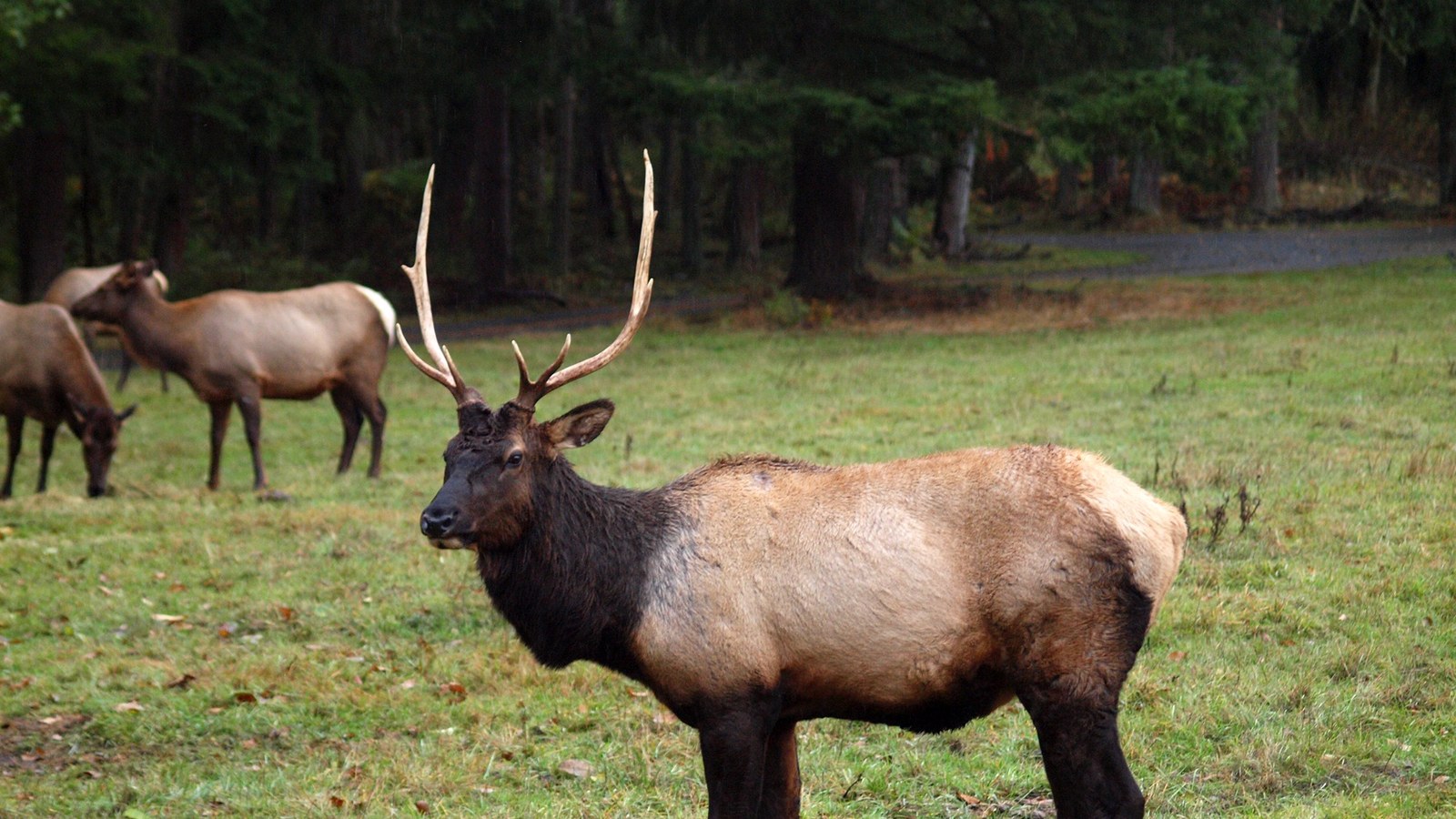
Hero photograph: Matthew Zalewski, "Roosevelt Elk 1", a bull during the mating season in western Washington (Wikimedia Commons), CC BY-SA 3.0. Cropped for the Field Journal hero.

Questions people ask
How close can you safely get to elk during the rut?
Keep well back, and farther than you think. Olympic National Park asks for at least 100 feet (about 30 m) from all elk. Redwood National and State Parks recommends at least 25 yards (75 feet), and more in spring and fall, because rutting bulls may stomp and charge both people and cars. If an elk charges, get behind or up a tree.
Do female elk bugle too?
Yes, sometimes. Rocky Mountain National Park notes that cows and younger bulls may also bugle, but they can't match the strength or range of the older bulls' calls.
When do elk shed their antlers?
Most bulls drop their antlers in March and April, and a new set starts growing soon after. The growing antlers are covered in velvet, which bulls scrape off from around early August, polishing and sharpening them in time for the rut (Yellowstone National Park).
Why are elk also called wapiti?
Because "elk" confused things. European settlers called the animal an elk, but in Europe "elk" means the moose. Wapiti is a Shawnee word meaning "white deer" or "white-rumped deer", after the pale rump patch. Most scientists now call North American elk Cervus canadensis (Yellowstone National Park).
Where is the best place to see Roosevelt elk?
The Hoh Rain Forest in Olympic National Park is a top spot, and September is the time to hear bugling there. In California, Redwood National and State Parks has seven herds, including around Gold Bluffs Beach, Prairie Creek Redwoods State Park, Elk Meadow and the Bald Hills, where the biggest herd numbers about 250.
Sources
- National Park Service — Elk, Yellowstone National Park
- National Park Service — Elk, Rocky Mountain National Park
- National Park Service — Roosevelt Elk, Olympic National Park
- National Park Service — Roosevelt Elk, Redwood National and State Parks
- Washington Department of Fish & Wildlife — Roosevelt elk
- Alaska Department of Fish and Game — Roosevelt Elk species profile
- Reby D. et al. (2016) Evidence of biphonation and source–filter interactions in the bugles of male North American wapiti (Cervus canadensis). Journal of Experimental Biology 219: 1224–1236
- Frey R. & Riede T. (2013) The anatomy of vocal divergence in North American elk and European red deer. Journal of Morphology 274: 307–319
- Titze I.R. & Riede T. (2010) A cervid vocal fold model suggests greater glottal efficiency in calling at high frequencies. PLoS Computational Biology 6: e1000897