White-tailed Deer: Flag Tail, Edge Habitat, and North America's Rebound
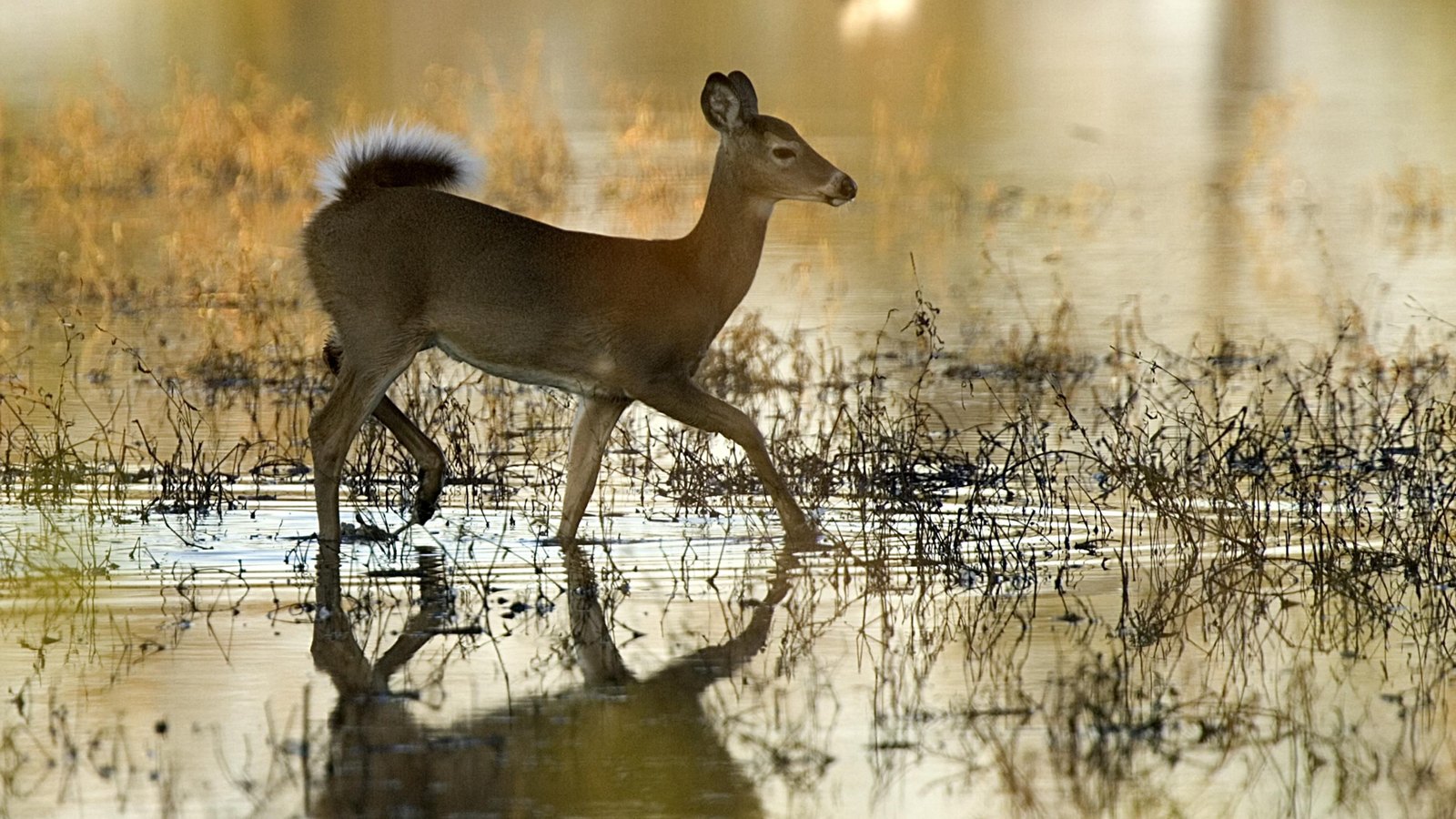
Species deep dive · white tailed deer
Search "white-tailed deer" and you get backyard photos, hunting debates, and a flashing white rump disappearing into brush. That flag is the point. Odocoileus virginianus is the Americas' most widespread deer — a selective browser that thrives where cover meets openings, from southern Canada deep into Central and South America.
In Wilder TCG the White-tailed Deer is a Common Mammalia creature with Herd. The card is shorthand for an edge specialist whose real strength is numbers, vigilance, and escape.
Taxonomy of a New World deer
Odocoileus virginianus (Zimmermann, 1780) sits in Cervidae, order Artiodactyla. English names include white-tailed deer and Virginia deer. Size swings hard with latitude and nutrition: large northern bucks can approach roughly a meter at the shoulder and well over 100 kg; Florida's Key deer is a dwarfed island form. Summer coats run reddish; winter coats duller gray-brown, with white underparts and that signature white underside of the tail.
Bucks grow antlers each year — spring growth under velvet, hard bone for the fall rut, then shed in winter. Does typically lack antlers. Wilder files the card under Mammalia as a Forest creature; the living animal is a cervid, not a forest "element" in the ecological sense — game taxonomy, not a habitat claim.
Flag, bounds, and edge life
The common name is an alarm signal. When startled, a whitetail often raises the tail so the white underside flares — a follow-me cue for other deer and a visual "I see you" to predators. They are built for tangled cover: short sprints above 30 mph, high vertical leaps, long horizontal bounds, and willing swims across lakes or rivers when insects or predators push them.
Ideal habitat is not continuous mature forest or bare prairie. It is edge: forest borders, brushy thickets next to fields, wetland margins, regenerating cuts, and increasingly suburbs and agricultural mosaics. Dense cover for hiding; openings for high-quality forage. Home ranges are often small. Does and fawns form the basic social unit; bucks may travel in loose bachelor groups outside the rut.
Selective browsing, not lawn mowing
Whitetails are concentrate selectors — they pick nutritious tips, forbs, mast, and browse rather than grinding low-quality bulk like a cow. Diets shift with season and region: buds and twigs, forbs, acorns and other mast, fruits, fungi, lichens, and cultivated crops when available. A 2011 range-wide diet review commonly cited by managers puts browse and forbs at the core of the annual menu, with mast and grass filling seasonal gaps.
That pickiness has ecology consequences. Heavy local densities create browse lines and can slow forest regeneration. The same animals spread seeds in droppings and feed wolves, coyotes, mountain lions, bears, and people. They also host ticks involved in Lyme disease cycles in parts of their range — a public-health footnote managers track, not a reason to invent medical claims about every encounter.
Collapse, rebound, and Least Concern with local headaches
Unrestricted hunting and habitat change crushed many North American populations by the early 1900s. Game laws, restocking, and a landscape of edges and farms brought a dramatic rebound. IUCN lists the species as Least Concern on the strength of a huge range and large population. Locally, "too many deer" is now a management problem: crop and garden damage, vehicle collisions, and overbrowsed woodlots. Chronic wasting disease (a prion disease of cervids) is a separate, serious regional concern for wildlife agencies — report carefully as a monitored threat, not a blanket species death sentence.
From underbrush to Wilder card
In the White-tailed Deer field guide you will find taxonomy, habitat, and in-game stats. On the board, Herd echoes a species that survives as a watchful group more than as a lone tank.
Play it in Wilder — then watch for that white flag the next time something moves at the tree line.
Quick facts
- Scientific name: Odocoileus virginianus (Zimmermann, 1780)
- Hook: white underside of the raised tail as a flight/alarm signal; edge-habitat specialist
- Size: highly variable; large bucks ~80–106 cm at shoulder; Key deer much smaller
- Diet: selective browser — browse, forbs, mast, fungi; crops where available
- Range: southern Canada through the U.S. into Central America and northern South America
- Social: doe–fawn units; bucks often alone or in small bachelor groups outside the rut
- IUCN: Least Concern (broad distribution; local overabundance and disease management)
- Wilder family: Mammalia · Common · Herd
Photo credit
Hero photograph: Steve Hillebrand, U.S. Fish and Wildlife Service, "White tailed doe with tail flagged for danger" (Wikimedia Commons), public domain (US federal government work). Cropped for the Field Journal hero.
