White Stork: Thermals, Rooftop Nests, and the Baby Folklore
Species deep dive · white stork
Search "white stork" and European folklore arrives first — the bird that brings babies. The living animal is stranger and better documented: Ciconia ciconia, a long-legged soaring migrant that nests on chimneys and pylons, clatters its bill like a machine gun, and detours around the Mediterranean because warm air does not rise over open water.
In Wilder TCG the White Stork is an Uncommon Aves creature with Ambush. The card is shorthand for a patient ground hunter that closes with a straight red bill — folklore optional.
Taxonomy of a typical stork
Ciconia ciconia (Linnaeus, 1758) belongs to Ciconiidae. Adults are mostly white with black flight feathers, long red legs, and a long pointed red bill. Length is about 100–115 cm; wingspan roughly 155–215 cm; mass about 2.3–4.5 kg. Two subspecies are usually recognized: nominate C. c. ciconia (Europe, northwest Africa, western Asia, plus a southern African breeding pocket) and slightly larger C. c. asiatica in central Asia.
Wilder files the card under Aves as a Grassland creature. The living bird forages open wetlands, meadows, and farmland — game habitat tags, not a claim that storks avoid marshes.
Why they refuse the Mediterranean shortcut
White storks are endurance soarers. On migration they spiral up on thermals, then glide. Flapping over long water crossings burns far more energy than thermal soaring, and thermals barely form over the sea. So European breeders funnel through land bridges: the Strait of Gibraltar on the western flyway, or the Bosphorus–Levant–Nile corridor on the eastern flyway, toward Sub-Saharan wintering grounds. Autumn journeys often finish faster than spring returns; flocks on the eastern route can number in the hundreds of thousands of birds across a season.
Migration science has deep roots here. Nineteenth-century Pfeilstörche — storks recovered in Europe with African arrows still lodged in them — were early hard evidence that European breeders wintered in Africa. Modern ringing and satellite tags map the same corridors in finer grain. In western Europe, a growing share of adults now winters on the Iberian Peninsula, helped by milder winters and predictable food at landfills — a live example of migratory behavior shifting under human subsidies, not a claim that African wintering has ended.
Bill-clatter, stick fortresses, and a quiet voice
Adults are nearly voiceless. Their signature sound is bill-clattering: rapid open-and-close strikes amplified by the throat pouch, used in greeting, courtship, and alarm. The up-down head display pairs with it at the nest.
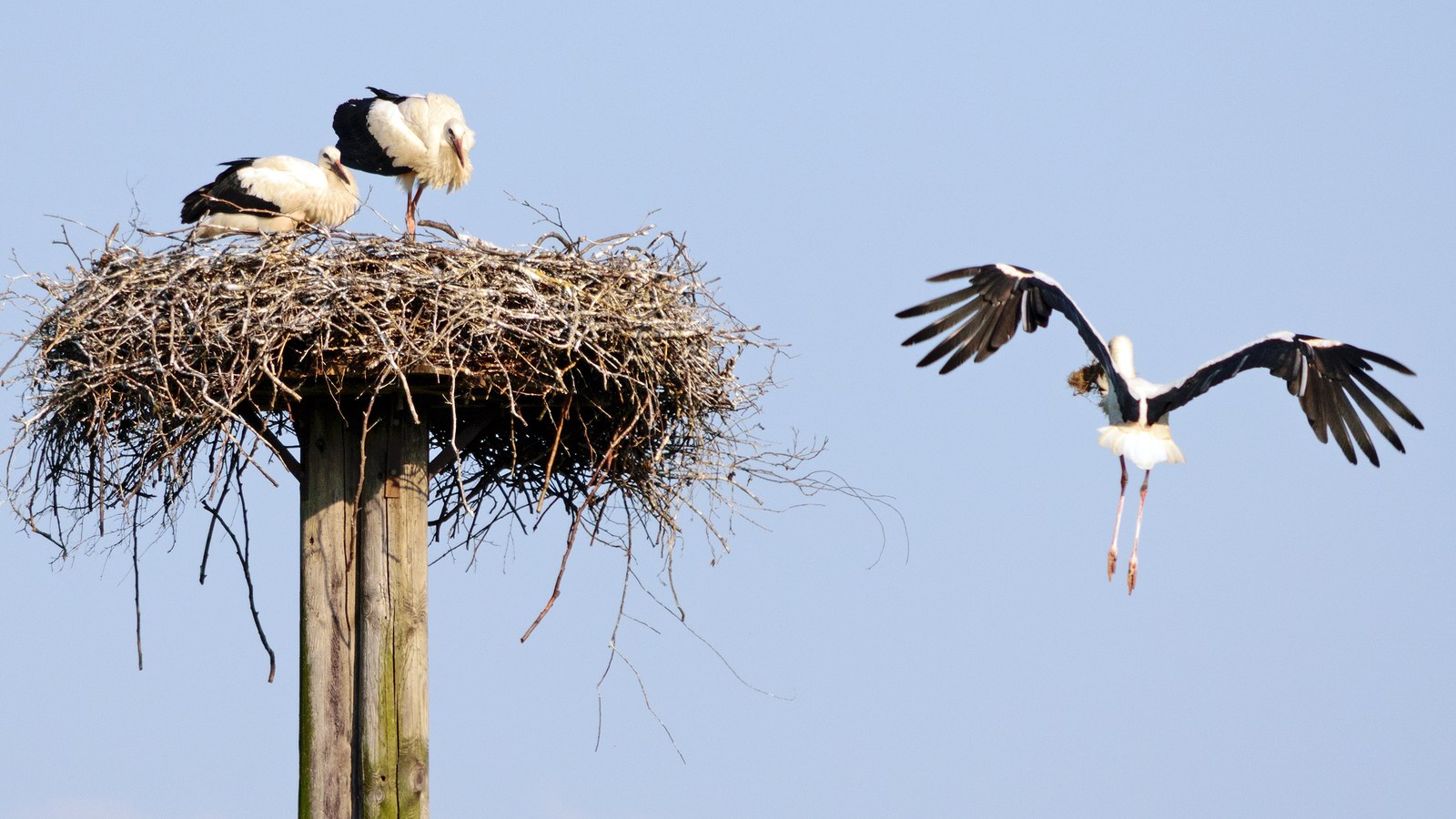
Nests are massive stick platforms — often 1–2 m deep and tens to hundreds of kilograms — reused for years on trees, buildings, churches, and purpose-built poles. Clutches are commonly around four eggs; incubation about 33–34 days; fledging roughly two months after hatching. Both parents feed. Nest platforms also host hitchhikers: sparrows, starlings, and sometimes kestrels or other cavity users around the structure.
Diet is opportunistic carnivory on the ground and in shallow water: earthworms, beetles and grasshoppers, amphibians, reptiles, small mammals, and fish. Red bill and leg color comes from dietary carotenoids — in parts of Spain, introduced red swamp crayfish have been linked to especially vivid nestling bills.
Least Concern after a hard European century
IUCN rates C. ciconia Least Concern. BirdLife estimates on the order of ~700,000 individuals globally, with a large European breeding share. That calm label hides history: industrial farming, wetland drainage, and persecution emptied western Europe of nesting storks through the 19th and 20th centuries. Reintroduction, nest platforms, legal protection, and wetland work helped populations return to countries such as the Netherlands, Switzerland, and — in 2020 — the United Kingdom for the first time in centuries under a reintroduction project.
Ongoing risks are still real: power-line collisions and electrocution (rooftop and pylon nesters live next to infrastructure), wetland loss, and hunting on some migration and wintering routes. Huge nests remain cultural good-luck symbols across much of Central and Eastern Europe; the baby-delivery tale popularized by Hans Christian Andersen grew from that intimate rooftop coexistence, not from ornithology.
From chimney nest to Wilder card
In the White Stork field guide you will find taxonomy, habitat, and in-game stats. On the board, Ambush nods at a forager that stalks open ground and strikes with a bill — the folklore is flavor text, not a keyword.
Play it in Wilder — then listen for clattering the next time a red-legged silhouette circles a village roof.
Quick facts
- Scientific name: Ciconia ciconia (Linnaeus, 1758)
- Hook: thermal soaring migration that avoids open-sea crossings; rooftop nests; bill-clatter
- Size: ~100–115 cm long; wingspan ~155–215 cm; ~2.3–4.5 kg
- Diet: earthworms, insects, amphibians, reptiles, small mammals, fish
- Range: breeds Europe–northwest Africa–western/central Asia; winters mainly Sub-Saharan Africa (some Iberia / India)
- Flyways: western via Gibraltar; eastern via Bosphorus and Levant
- IUCN: Least Concern (recoveries after historic European declines)
- Wilder family: Aves · Uncommon · Ambush
Photo credit
Hero photograph: Hydro, "Weißstorch im Anflug auf Nest (4)", white storks at a nest in Steinwedel, Lehrte, Germany (Wikimedia Commons), CC BY-SA 4.0. Cropped for the Field Journal hero.
