Do Piranhas Attack Humans? The Truth About Red-bellied Piranhas
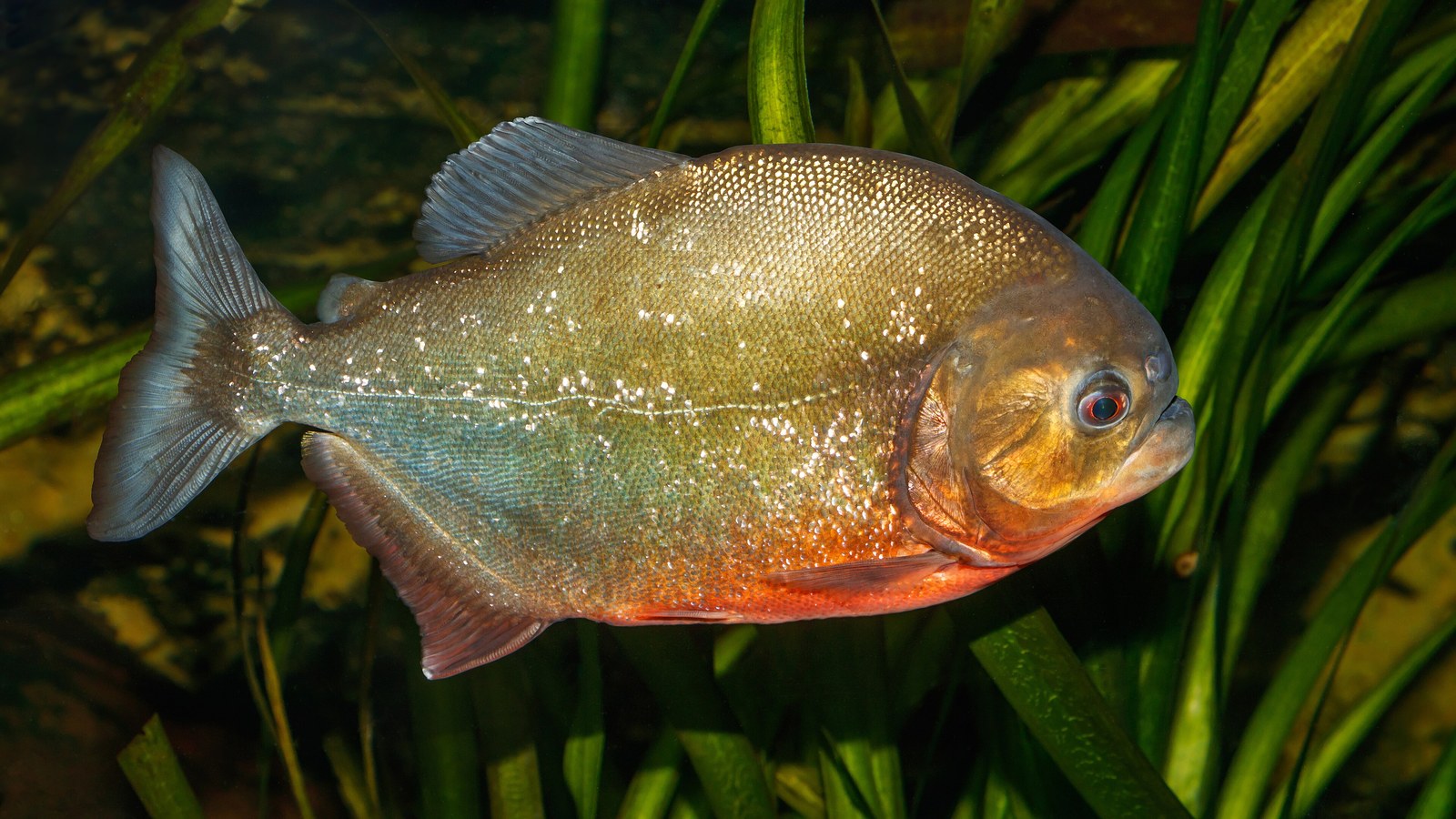
Species deep dive · red bellied piranha
Do piranhas attack humans? Rarely, and almost never the way films show it. Red-bellied piranhas do bite people now and then, but a typical bite is a single nip on a hand or foot, not a feeding frenzy. A 2025 review of Brazilian media reports found 711 piranha bite cases over ten years. 82% were mild single bites that took only skin, and most were linked to piranhas guarding nests in dams and lakes. Only one case involved a death: a person found dead with injuries compatible with piranha bites. The U.S. Geological Survey notes that many experts think the danger to humans is greatly exaggerated, and that the man-eater reputation may come from piranhas scavenging human corpses.
So the Red-bellied Piranha (Pygocentrus nattereri) is a real predator with real teeth. It is also a schooling fish that is mostly afraid of being eaten.
Why piranhas are in the news
This autumn, a suspected red-bellied piranha has caused alarm in Malaysia. An angler netted a piranha-like fish at Klau Dam in Pahang on 26 August 2026, and a second catch was reported nearby in September. Neither fish is available for examination. Malaysia's Department of Fisheries says photos and video match the genus Pygocentrus, but it cannot confirm the species, or even rule out a pacu, without a specimen. It is considering environmental DNA tests. Officials report no attacks on people, no unusual fish deaths and no evidence of a breeding population. Their bigger worry is ecological: what an introduced predator could do to native fish. Piranhas are a prohibited species in Malaysia, with fines of up to 100,000 ringgit.
Where the man-eater myth came from
A large share of the blame goes to Theodore Roosevelt. After his 1913–14 expedition in South America he called piranhas "the most ferocious fish in the world" in his bestseller Through the Brazilian Wilderness, and told of a school devouring a whole cow. According to Smithsonian, locals had netted the fish beforehand and kept them in a tank without food, then pushed a dead cow into the river and released them. Starved fish did the rest, and the story spread.
Shoals for safety, not hunting packs
Red-bellied piranhas usually travel in schools of 20 or more. Researchers at Brazil's Mamirauá Reserve tested why. Wild-caught piranhas breathed about 25% more slowly in shoals of eight than when alone, a sign of lower stress. After a model cormorant "attacked" them, fish in shoals of eight calmed down faster than fish in pairs. The study concluded that shoaling is mainly cover-seeking. In the flooded forest, piranhas are prey for river dolphins, caimans, birds and big fish, and the safest place is the middle of the crowd.
What red-bellied piranhas really eat
In the wild, a good part of their diet is fins nipped from the tails of larger fish, according to Smithsonian's National Zoo. They also take bits of flesh, small fish, insects, other invertebrates, plants and even ripe fruit such as figs. They are important scavengers too, cleaning up dead and decaying fish, birds and mammals. Adults feed mostly at dawn and dusk, while small piranhas forage by day.
Teeth that interlock and grow back
A piranha's snub-nosed face hides powerful jaw muscles and a short, stout lower jaw. It is lined with triangular, razor-sharp teeth that interlock with a matching row above, so a bite cuts like scissors. Thick lips usually cover them. When teeth wear out, piranhas don't replace them one at a time like sharks. They replace them in blocks, a quarter of the jaw at a time, alternating sides so the fish can keep eating. Their bite is strong for their size. A 2012 study measured the black piranha, a larger relative, biting with up to about 72 pounds of force, roughly three times its own body weight.
Piranhas bark
Fishermen have long known that red-bellied piranhas make noises when caught. A 2011 study in the Journal of Experimental Biology recorded three sounds, each with a different use. A rapid bark goes with a head-on staring display. A single drum-like thud comes during circling and fighting, and both of these are made by muscles that vibrate the swim bladder. If the rival still doesn't back down, the piranha snaps its jaws while chasing it.
When bites happen
The 2025 review points to people as part of the problem. Of the cases it could link to a cause, 30% happened during the breeding season and 26% were tied to food or fish waste dumped in rivers. Dams also help some piranha species thrive. In a 2003 study of a bite outbreak at a dammed river in southeast Brazil, the culprit was a different species, the speckled piranha, and the bites were mostly single defensive bites near nests. Red-bellied piranhas cause bites in the central Amazon and the Pantanal. Their spawning season runs from about October to February, when males dig small nests among grasses and other plants at the water's edge. Low water and scarce food in the dry season can also make piranhas bolder, and people unhooking piranhas from lines or nets get bitten too.
Size, range and status
- Size: a little over a foot (30.5 cm) long and up to about 4 lb (1.8 kg) at the National Zoo. FishBase lists a maximum published weight of 3.9 kg.
- Lifespan: 10 years or more.
- Range: lowland South America east of the Andes, including the Amazon and Paraná-Paraguay basins and coastal rivers of the Guianas and Brazil.
- Conservation: Least Concern on the IUCN Red List (assessed 2020). The species is common throughout its range.
How the piranha plays in Wilder
In Wilder TCG the Red-bellied Piranha is a Cost 2 Pisces Water Uncommon (ATK 2 / HP 2) with Swarm and Feast. These are the game's nods to a schooling fish and a scavenger that cleans up after a fight. Its flavor text plays the movie version: "One bite, then the river turns red." For the rest of the Amazon in your deck, add the Green Anaconda (Journal), the Hoatzin (Journal) and the Amazon Várzea Frog (Journal). For another fish with a scarier reputation than record, see the Great White Shark (Journal).
Play Wilder free in your browser. No signup needed.
Photo credit
Hero photograph: H. Zell, "Pygocentrus nattereri - Karlsruhe Zoo 01", a red-bellied piranha at Karlsruhe Zoo, Germany (Wikimedia Commons), CC BY-SA 3.0. Cropped for the Field Journal hero.

Questions people ask
Are piranhas and pacus the same fish?
No, but they are close relatives and easy to confuse. Pacus such as Colossoma and Piaractus live on a mostly meat-free diet and are often sold at fish markets as "vegetarian piranhas" (Smithsonian). USGS notes that pacus are frequently misidentified as piranhas when they turn up outside South America (USGS).
What does the word piranha mean?
"Tooth fish." The name comes from Tupí, an Indigenous language of Brazil (Smithsonian). It fits: the red-bellied piranha has a single row of triangular, interlocking teeth in each jaw (Smithsonian's National Zoo).
Can piranhas live in lakes in the United States?
Not for long, so far. USGS has records of red-bellied piranhas from 15 states since 1974, all thought to be aquarium releases. None has established a population, and the species has little chance of surviving cold periods. Import is banned in many southern states, including Florida and Texas (USGS).
How long do red-bellied piranhas live?
Ten years or more, according to Smithsonian's National Zoo, which keeps them in its Amazonia exhibit (National Zoo).
Sources
- Gomes, Martins & Haddad Júnior (2025) Media Information Compared to Scientific Studies Regarding Piranha Attacks in Brazil. Rev Soc Bras Med Trop 58:e0213-2025
- Haddad & Sazima (2003) Piranha attacks on humans in southeast Brazil: epidemiology, natural history, and clinical treatment, with description of a bite outbreak. Wilderness & Environmental Medicine 14:249–254
- U.S. Geological Survey, Nonindigenous Aquatic Species — Red piranha (Pygocentrus nattereri)
- Smithsonian's National Zoo — Red-bellied piranha
- Smithsonian Magazine (2014) — 14 Fun Facts About Piranhas
- Queiroz & Magurran (2005) Safety in numbers? Shoaling behaviour of the Amazonian red-bellied piranha. Biology Letters 1:155–157
- Millot, Vandewalle & Parmentier (2011) Sound production in red-bellied piranhas. Journal of Experimental Biology 214:3613–3618
- FishBase — Pygocentrus nattereri
- The Straits Times (2026) — Unconfirmed piranha sightings in Pahang spark ecological fears
- Bernama (2026) — DOF collaborates with Aquaria KLCC to identify fish suspected to be piranha at Klau Dam
- The Independent (2026) — Piranha-like fish in Malaysia river
- Wilder TCG — Red-bellied Piranha field guide