Tiger: Stripes, Ambush, and Asia's Endangered Apex Cat
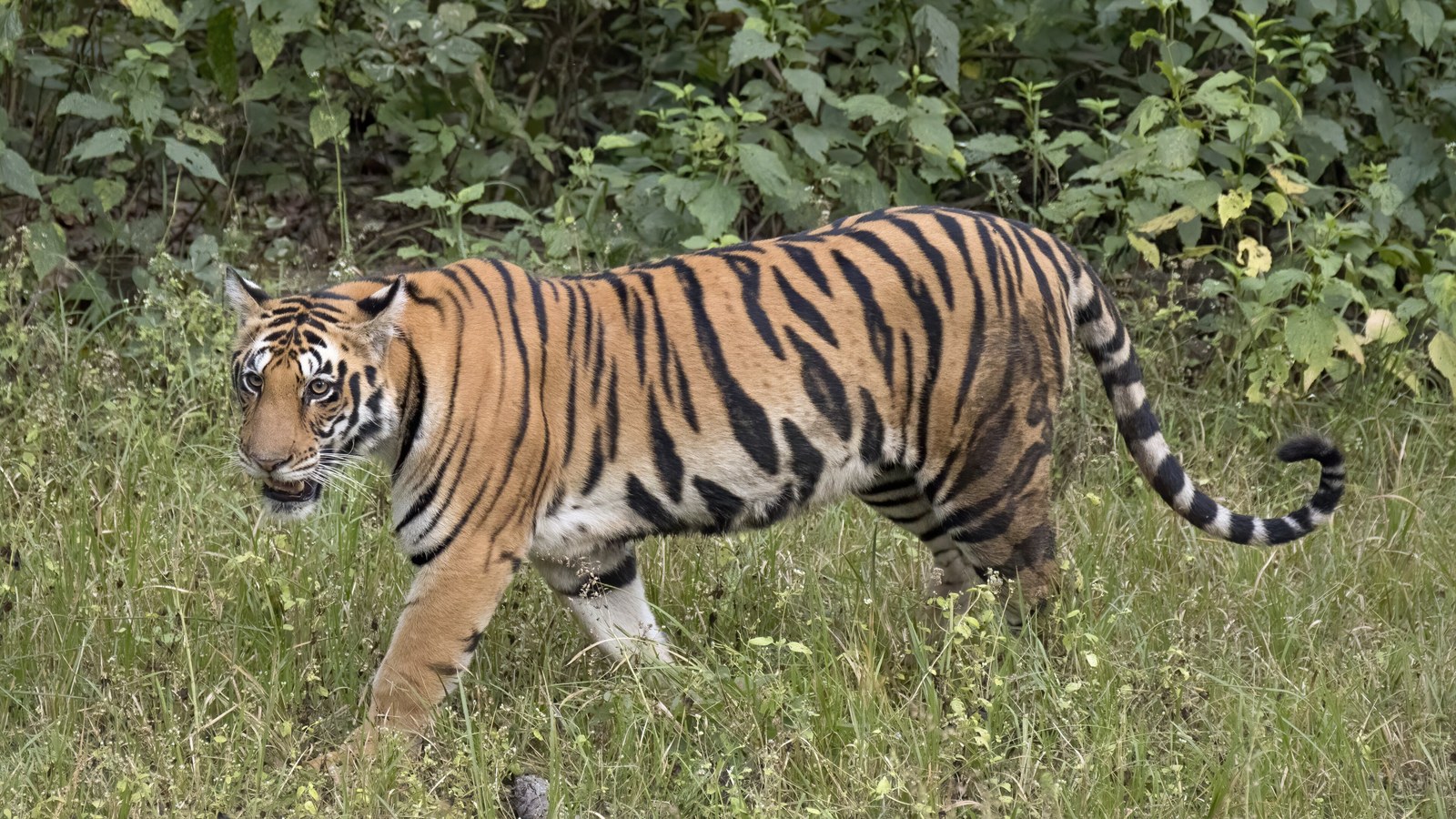
Species deep dive · tiger
Search "tiger" and you meet cinema, stripes, and a number that keeps shifting — how many are left in the wild? Under the mythology sits a real cat: Panthera tigris, Asia's largest living felid, a solitary ambush predator whose orange-and-black pattern is individual enough that researchers treat stripe maps like fingerprints.
In Wilder TCG the Tiger is a Mammalia / Forest card — shorthand for a keystone hunter that still holds ground in India, Nepal, Russia's Far East, Sumatra, and a handful of other strongholds, on a fraction of its historic range.
One species, shrinking map
Historically tigers ranged from Türkiye and the Caspian region across South and Southeast Asia to the Russian Far East and the Sunda islands. Today they occupy on the order of under ~7% of that historic footprint — tropical and subtropical forests, grasslands, mangrove systems such as the Sundarbans, and temperate forests in the Amur region.
Taxonomy is unsettled in public writing: older lists named many subspecies; genomic work often recognizes about six living lineages (including Bengal, Amur, Sumatran, Malayan, and Indochinese groupings, with South China effectively extinct in the wild), while some IUCN frameworks discuss broader continental vs Sunda groupings. For a field note, treat living wild tigers as one species with regional forms — and treat extinct Bali, Javan, and Caspian tigers as gone.
Ambush, not a sprint race
Tigers are mostly solitary and territorial. They mark with scent, scrapes, and vocalizations (including a roar that can carry far, and a softer "chuff" used in friendly close contact). Hunting leans on vision and hearing more than scent: stalk from cover, then a short explosive rush, often ending with a neck or throat bite on deer, wild pigs, and large bovids.
They are unusually strong swimmers among cats and will enter water after prey. A large meal can allow days of rest; published prey-need summaries for adults often land around dozens of large ungulates per year depending on sex, habitat, and kill rates — avoid inventing a single universal daily poundage.
Every tiger's stripe pattern is unique. That fact is useful for camera-trap ID; it is not magic camouflage lore — disruptive patterning in dappled light is the ecological story.
Endangered, with local recoveries
IUCN lists the tiger as Endangered. Recent Red List–aligned estimates put wild numbers roughly in the ~3,700–5,600 range (best estimates vary by whether cubs are included and which survey years are pooled; mature individuals are fewer still). Communications around Global Tiger Day 2023 cited figures near ~5,574 across range countries, with India and Nepal often highlighted for doubling since the 2010 St. Petersburg "Tx2" era — while other landscapes remain thin or declining.
Main threats stay familiar: poaching of tigers and their prey, habitat loss and fragmentation, and conflict killings near people and livestock. Where prey and protection hold, tiger numbers can rebound; where either fails, the cat disappears even if "forest" still looks green from a satellite.
As apex predators, tigers shape ungulate pressure and, indirectly, vegetation and watersheds — conservation language about "tiger landscapes" is ecosystem talk, not branding.
From jungle edge to Wilder card
In the Tiger field guide you will find taxonomy, habitat affinity, and in-game stats. On the board, Forest / high-cost Mammalia play echoes a real apex ambusher — solitary, territorial, and dependent on intact prey landscapes.
Open the catalog in the Wilder app to collect the card, or read more species deep dives in the Field Journal.
Quick facts
- Scientific name: Panthera tigris (Linnaeus, 1758)
- Hook: individual stripe patterns; solitary ambush; strong swimmer
- Diet: primarily large ungulates (deer, pigs, buffalo and allies)
- Historic range: much of Asia; now ~<7% of that area
- IUCN: Endangered; wild estimates roughly ~3,700–5,600 depending on source/year
- Social: solitary / territorial; mothers raise cubs
- Wilder family: Mammalia · Forest · Cost 6
Photo credit
Hero photograph: Charles J. Sharp, "Bengal tiger (Panthera tigris tigris) female 3 crop", a Bengal tigress in Kanha National Park, India (Wikimedia Commons), CC BY-SA 4.0. Cropped for the Field Journal hero.

Questions people ask
Why are tigers orange if they hunt in green forests?
Because their prey can't see orange the way we do. Deer and most other mammals are dichromats: they can't reliably tell orange from green. A 2019 University of Bristol study in the Journal of the Royal Society Interface showed that, to a deer, a tiger's coat blends into green vegetation. That means tigers face little evolutionary pressure to be green.
Are white tigers a separate subspecies?
No. White tigers are a rare color variant of the Bengal tiger. A 2013 Current Biology study traced the white coat to a single recessive mutation in the SLC45A2 pigment gene, so a tiger needs two copies to be white. WWF notes that captive white tigers are usually heavily inbred and have no conservation value.
Is the tiger the biggest cat in the world?
Yes. According to Smithsonian's National Zoo, the tiger is the largest cat species. Amur (Siberian) tigers are the biggest, with males weighing up to about 300 kg (660 lb) and measuring up to 3 m (10 ft) from nose to tail tip. Sumatran tigers are the smallest, at up to about 140 kg (310 lb).
How long do tigers live in the wild?
Usually 10–15 years. In human care, and rarely in the wild, a tiger can reach about 20. Early life is the hardest part: Smithsonian's National Zoo says about half of wild cubs die before age two, and only around 40% of those that become independent go on to hold a territory and breed.
What is the tiger's closest relative?
The lion. Smithsonian's National Zoo notes that without their fur, a tiger and a lion are hard to tell apart. Both belong to the big-cat genus Panthera, along with leopards, jaguars, and snow leopards.