Tomato Frog: Sticky Skin, Balloon Defense, and Madagascar's Sangongon
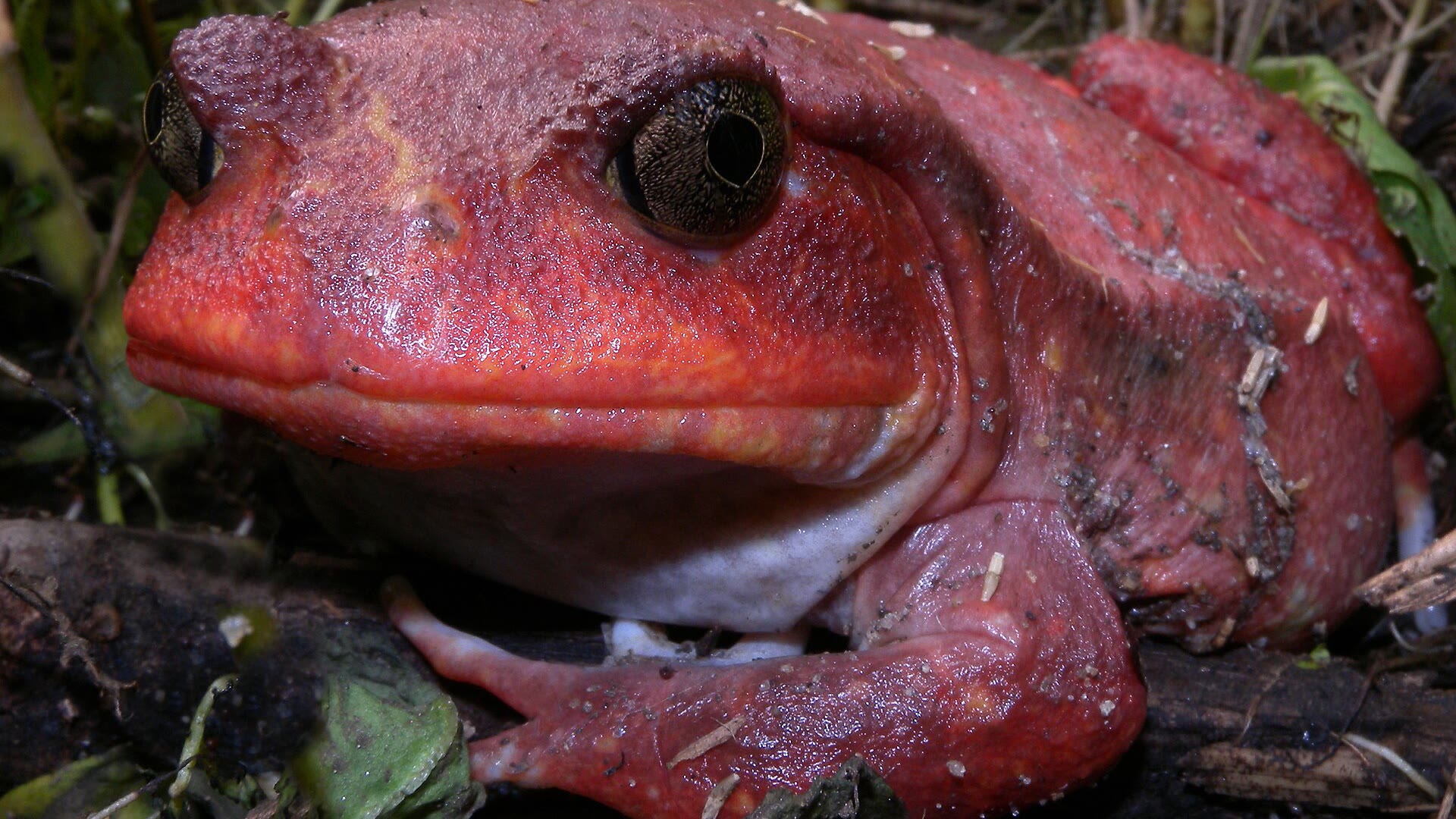
Species deep dive · tomato frog
Search "tomato frog" and you get a bright red amphibian that looks like produce and fights like a glue stick. That is not a meme. Dyscophus antongilii — the Madagascar tomato frog, or sangongon in Malagasy, named for its low call — is a microhylid of northeastern Madagascar whose defenses are sticky, inflatable, and hard to swallow.
In Wilder TCG the Tomato Frog is an Amphibia creature tied to Forest play. The card is shorthand for a real swamp-edge ambusher whose chemistry and shape change when something tries to eat it.
Not a fruit — a microhylid
Tomato frogs belong to the narrow-mouthed frogs (Microhylidae), subfamily Dyscophinae, a small Malagasy radiation of three Dyscophus species. D. antongilii is the classic "tomato": females are larger and brighter red-orange (roughly 8.5–10.5 cm / up to ~230 g in field guides), males smaller and duller (~6–6.5 cm). Bright color is aposematism — advertise that a meal may come with sticky consequences — not camouflage.
They are nocturnal ground foragers: beetles, flies, worms, and other small invertebrates snatched from leaf litter, garden soil, and the edges of ponds and ditches. By day they often sit buried or under cover. Adults are largely terrestrial; water is for breeding and tadpoles.
Glue first, then balloon
When threatened, tomato frogs secrete a sticky white skin mucus that can gum a snake's mouth or a predator's jaws. In humans the same secretion can cause local swelling or allergic irritation — do not treat handling as harmless. If the first line fails, the frog inflates with air into a round, tomato-like ball that is harder to swallow.
That combination — chemical stickiness plus body inflation — is the species' signature, not a cartoon exaggeration. It is defense chemistry and mechanics, not a medical product: do not invent dosages, "toxicity scores," or clinical claims beyond local irritation reports.
Antongil Bay gardens and rainy nights
The species is endemic to northeastern Madagascar, famously abundant around Antongil Bay and the town of Maroantsetra, where it lives in gardens, secondary forest, swamps, and breeding ponds and ditches — including human-modified habitat. It also occurs in sites such as Ambatovaky Special Reserve and likely Masoala National Park.
Breeding follows rainfall rather than a single explosive night: females lay on the order of 1,000–1,500 small black eggs on the water surface; tadpoles hatch in about 36 hours and can reach froglet stage in roughly 45 days under good conditions (figures from Glaw & Vences / AmphibiaWeb summaries). Calls are short, low notes — the sound behind the name sangongon.
Trade, CITES, and a status upgrade
Bright color once made wild tomato frogs a pet-trade target. Captive breeding and CITES listing slowed wild exploitation. The species sat on CITES Appendix I for years and was later transferred to Appendix II, which allows regulated international trade with permits — matching the Wilder field-guide note. Many traded animals today are captive-bred; Madagascar still faces habitat loss and water pollution as longer-term risks.
IUCN listed D. antongilii as Near Threatened for years because of a relatively small extent of occurrence, then reassessed it as Least Concern (2017) after evidence of local abundance and stable populations around Maroantsetra and Ambatovaky. "Least Concern" is not "no risk" — it means the best available assessment no longer meets a threatened category threshold.
Taxonomists still flag confusion with the closely related D. guineti (sometimes sold as "false tomato frog"); keep species labels careful when reading older trade or husbandry notes.
From swamp edge to Wilder card
In the Tomato Frog field guide you will find taxonomy, habitat affinity, and in-game stats. On the board, the Amphibia / Forest identity echoes a real wet-forest and garden specialist whose fight is stickiness and surprise inflation, not a chase.
Open the catalog in the Wilder app to collect the card, or browse more species deep dives in the Field Journal.
Quick facts
- Scientific name: Dyscophus antongilii (Grandidier, 1877)
- Malagasy name: sangongon (call-based)
- Hook: sticky white skin secretion + inflate-to-survive
- Range: northeastern Madagascar (Antongil Bay / Maroantsetra stronghold)
- Clutch: ~1,000–1,500 eggs; hatch ~36 h
- IUCN: Least Concern (2017; previously Near Threatened)
- CITES: Appendix II (formerly Appendix I)
- Wilder family: Amphibia · Forest · Cost 2
Photo credit
Hero photograph: Frank Vassen, "Tomato Frog (Dyscophus antongilli), Maroantsetra, Madagascar" (Wikimedia Commons,_Maroantsetra,_Madagascar.jpg)), CC BY 2.0. Cropped for the Field Journal hero.