Why Black Carpenter Ants Carve Wood They Never Eat
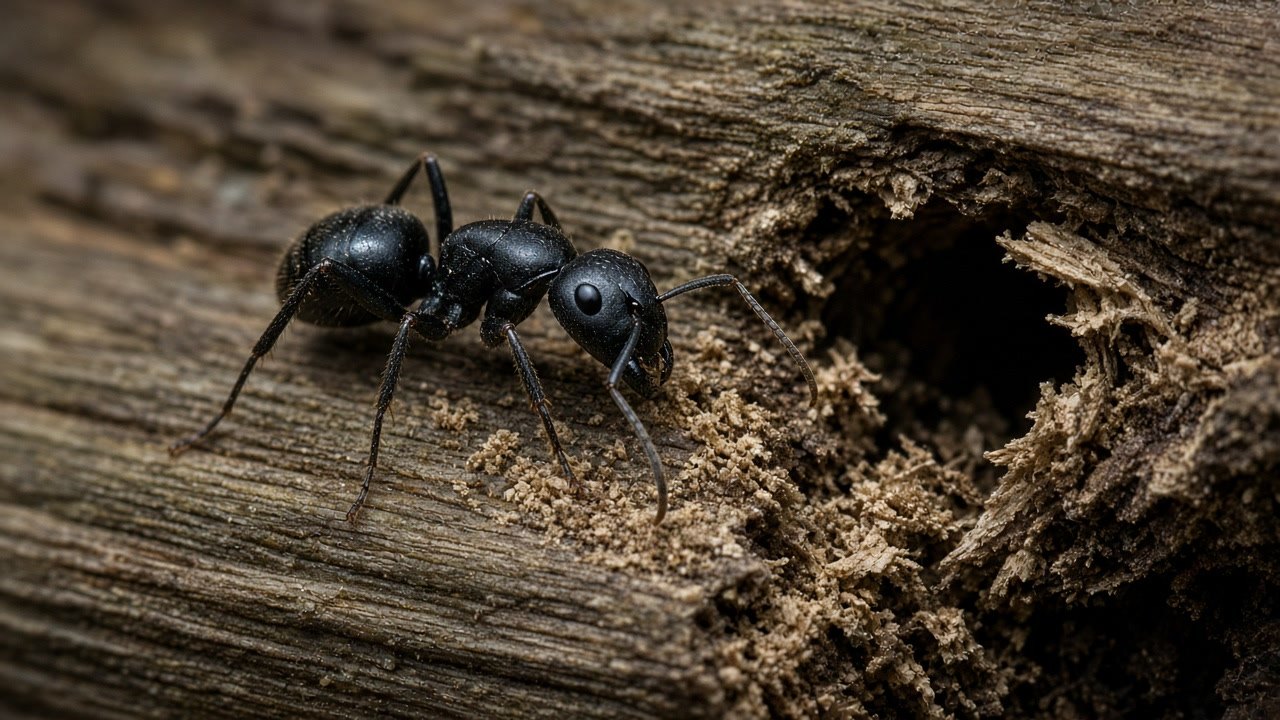
This is a generated illustration, not a photograph.
Species deep dive · black carpenter ant
Why Black Carpenter Ants Carve Wood They Never Eat
Search “carpenter ant” and two ideas collide: wood damage, and the assumption that the ants are eating the house. For the eastern black carpenter ant, Camponotus pennsylvanicus, only the first half is fair. Workers excavate damp or softened wood into smooth galleries — they do not digest timber the way termites do. The sawdust piles (frass) under a porch post or basement beam are demolition debris, not leftovers from a meal.
In Wilder TCG the Black Carpenter Ant is a Common Insecta creature (Forest) with Herd. The card is shorthand for a real colony insect that almost never works alone — and that has been confusing homeowners and naturalists since De Geer named it in 1773, before the Declaration of Independence.
A big, polymorphic eastern ant
C. pennsylvanicus is one of the largest and most familiar carpenter ants of central and eastern North America, ranging from the Atlantic roughly to the Rockies and into southeastern Canada. Workers are dull black, often with pale yellowish hairs on the abdomen, and polymorphic: minors and majors share a colony but differ in size. Field guides and university extension pages commonly put workers around ¼–½ inch (~6–13 mm); queens are larger still (on the order of ~19–21 mm in some descriptions).
Like other formicine ants, they have a single petiole node and lack a sting. Large workers can bite sharply and may spray formic acid into the wound — painful, not medically dramatic for healthy people, and very different from the bullet ant’s hours-long poneratoxin reputation.
Galleries, not groceries
In forests they nest in dead limbs, logs, stumps, and cavities in living trees; in towns they follow moisture into porch posts, window frames, and leak-damaged beams. Extension entomology is consistent on the key point: carpenter ants remove wood to enlarge the nest. Galleries often run with the grain in softer tissue and can feel sandpaper-smooth from fecal polishing — without the mud tubes that flag subterranean termites.
Colonies are typically monogynous (one queen). Texas A&M notes that a black carpenter ant colony may contain on the order of 15,000 workers at the high end; AntWiki and classic counts more often cite mature nests in the low thousands, with large colonies sometimes reaching roughly 10,000–15,000. Satellite nests in nearby wood are common, so “one infestation” can be a small network of galleries. Animal Diversity Web reports queens living over 10 years; workers live months to several years. Building a populous colony is slow — major workers and swarmers appear only after years of growth.
Honeydew highways
What do they eat? Carbohydrates first: honeydew from aphids, scales, and other sap-sucking insects, plus nectar, fruit juices, and plant sap. Protein comes from living and dead arthropods (and, indoors, whatever the kitchen offers). Smaller workers often tend aphids and ferry honeydew; larger workers haul bigger loads and defend the nest. Foragers can travel tens of meters — Wikipedia cites trails up to about 100 yards (~91 m) — laying pheromone paths as they go. Activity is frequently nocturnal, especially in hot weather.
That diet is why a damp maple with an aphid herd can support a thriving Camponotus nest while the ants ignore sound, dry framing next door — until a leak softens a beam.
Named before the United States
Smithsonian BugInfo notes that Camponotus pennsylvanicus was the first North American ant formally described, by Charles De Geer in 1773. The species has been a pest-management case study ever since: not because it “eats houses,” but because large colonies in structural wood are expensive to find and treat. Ecologically, the same nesting habit accelerates decay in dead wood outdoors — a remodeling crew for the forest floor.
From log gallery to Wilder card
In the Black Carpenter Ant field guide entry you will find taxonomy, habitat, and in-game stats. On the board, Herd is the honest translation of colony life: one worker is a scout; a trail of workers is the real animal. Cost 1 and Common rarity fit a species you might meet on a porch rail as easily as in an oak snag.
If you have never tried Wilder, guest play is free in the browser — open packs, build a deck, and swarm the table:
Quick facts
- Scientific name: Camponotus pennsylvanicus (De Geer, 1773)
- Worker size: polymorphic, commonly ~¼–½ inch (~6–13 mm)
- Range: eastern and central United States & eastern Canada (Atlantic toward the Rockies)
- Nest: excavated galleries in damp/rotting or cavity wood — wood is not eaten
- Diet: honeydew, nectar/plant juices, insects (scavenged and captured)
- Colony: one queen; thousands of workers (large nests sometimes cited near ~10,000–15,000); queen tenure often 10+ years
- Wilder family: Insecta · Forest · Common · Herd