Why the Saltwater Crocodile Owns the Strongest Bite on Earth
Species deep dive · saltwater crocodile
Why the Saltwater Crocodile Owns the Strongest Bite on Earth
Search “largest crocodile” or “strongest bite” and you keep meeting the same animal: the saltwater crocodile, Crocodylus porosus — also called the estuarine crocodile, Indo-Pacific crocodile, or simply the saltie. It is the largest living reptile, an opportunistic hypercarnivore that ambushes from mangroves, estuaries, and rivers from India’s east coast across Southeast Asia to northern Australia and parts of the western Pacific.
In Wilder TCG the Saltwater Crocodile is an Uncommon Reptilia creature (Water) with ColdBlooded, Guardian, and Thorns, plus a named Death Roll ability. The card is shorthand for a real apex ambusher whose jaws, patience, and coastal range are hard to overstate.
Earth’s largest living reptile
Adult males commonly range around 3.5–5 m and several hundred kilograms; larger, older males can exceed 6 m, and carefully documented extremes approach roughly 6.3–7 m. A Northern Territory management summary accepts that the very largest individuals are likely in the 6–7 m and roughly 900–1,500 kg ballpark — popular “monster” claims above that are often exaggerated once skulls and shrinkage are checked. Females are much smaller, typically near 2.7–3.1 m, so sexual dimorphism in this species is extreme.
Hatchlings start life at only about 28 cm. Everything about the adult — armored hide, muscular tail, eyes and nostrils set high on the head — is built for waiting at the waterline and exploding upward.
A bite measured in the lab
Saltwater crocodiles are widely cited for the strongest bite force measured in any living animal. In Erickson and colleagues’ comparative crocodilian study, a large C. porosus registered about 16,414 N (roughly 3,690 lbf) — the highest laboratory bite on record. Scaling from body mass suggests still higher values in the biggest documented individuals, but the careful claim is the measured number: sixteen thousand–plus newtons of clamp.
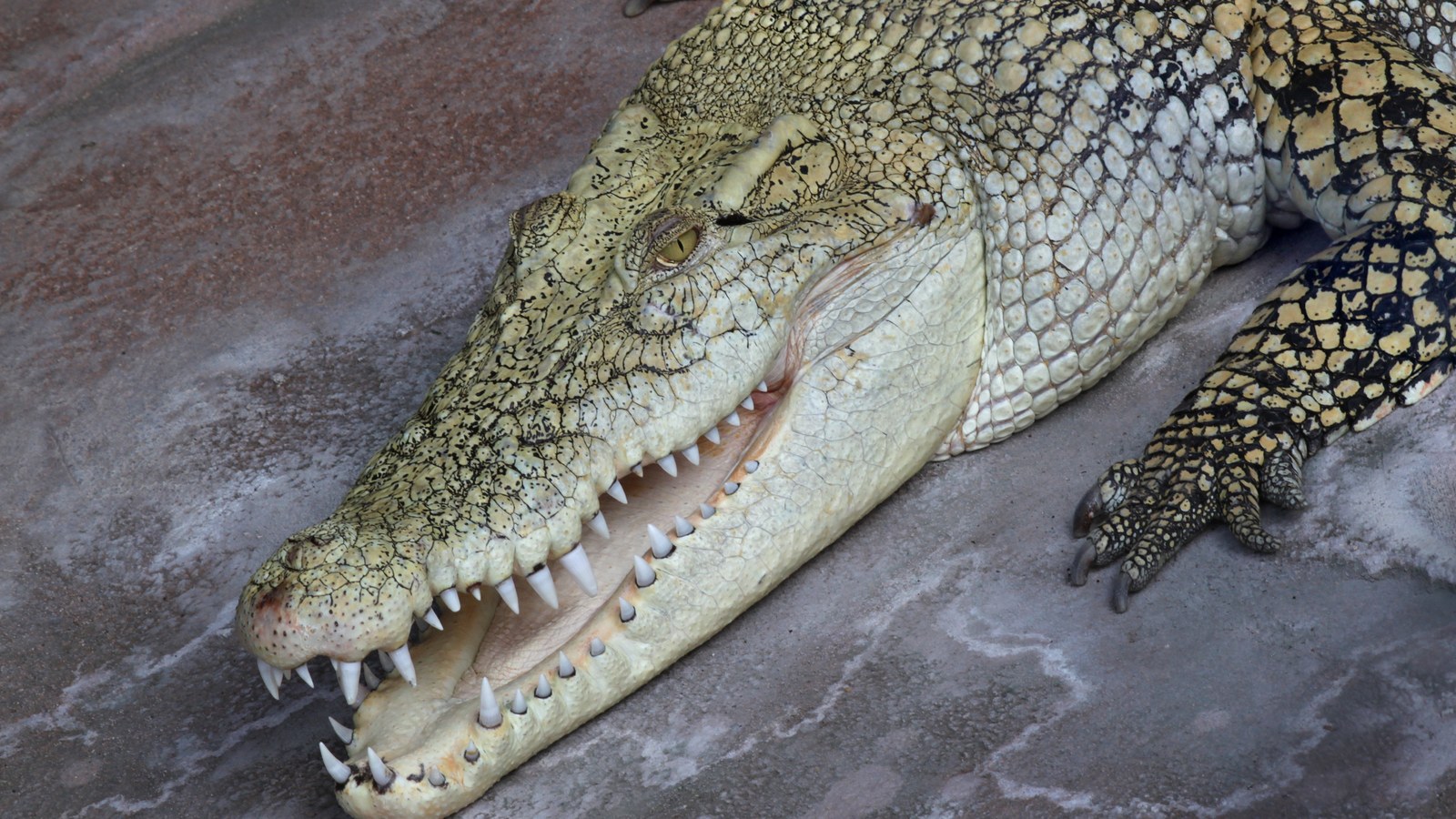
Anatomy does most of the work. Jaw-closing muscle mass is huge; the muscles that open the jaws are comparatively weak — which is why a securely taped snout can keep a crocodile’s mouth shut even though closing force is enormous. Peg-like teeth seize and hold; they are not shearing knives. Small prey is swallowed whole. Large prey is drowned or crushed, then torn into pieces by sudden head jerks or the famous death roll — spinning the body to twist off hunks of meat.
Mangrove nomad
C. porosus thrives in brackish mangrove swamps, river deltas, freshwater rivers, billabongs, and coastal waters from South Asia through Island Southeast Asia to northern Australia. It tolerates full seawater (and has been recorded in hypersaline conditions). Lingual salt glands help it dump excess salt — one reason salties, unlike alligators, can linger in the sea.
They are not tireless open-ocean swimmers so much as current riders. Satellite work has shown adults timing coastal travel with favorable surface currents: one male covered a minimum of about 590 km in 25 days along Cape York; another translocated male returned homeward more than 400 km in about 20 days. Barnacles sometimes settle on long-traveling animals — a quiet clue to weeks spent at sea. That mobility helps explain a range that spans continents and remote islands, even as local populations were hammered by the 20th-century skin trade.
Diet scales with size. Hatchlings take insects and small crustaceans; juveniles add fish, amphibians, birds, and small mammals; large adults can take animals as big as water buffalo, pigs, and — rarely and regionally — other large vertebrates when opportunity and territory allow. They hunt mostly by stealth from the water, not by chasing prey far onto dry land.
Nest, temperature, and a long climb to adulthood
In northern Australia, courtship peaks as the wet season builds; females mound nests of mud and vegetation and typically lay on the order of 40–60 eggs (clutches can run higher). Incubation lasts roughly 80–90+ days. As in other crocodilians, nest temperature influences hatchling sex. Mothers excavate the nest when hatchlings call, may assist eggs in the mouth, and carry young to water — classic reptile maternal care that still cannot stop heavy losses to flooding, predators, and cannibalism. Only a small fraction of hatchlings reach adulthood; those that do may live many decades.
Conservation without soft-focus
IUCN lists C. porosus as Least Concern, with a wild population often summarized as more than 400,000 non-hatchlings — Australia alone holding a large, recovering share after protection from the early 1970s. That global label hides local trouble: habitat loss, illegal killing, and depleted adult size-structure in parts of Southeast Asia and island populations. CITES still restricts trade (Appendix I for most wild populations; Appendix II for Australia, Indonesia, and Papua New Guinea under managed conditions).
The species is genuinely dangerous to people who enter its water. Fatal attacks occur at low but non-zero rates where humans and large crocs share rivers and coasts; wildlife agencies lean on warning signs, education, and removal of problem animals — translocation alone often fails because large males can home.
From estuary to Wilder card
In the Saltwater Crocodile field guide entry you will find taxonomy, habitat, and in-game stats. On the board, Death Roll plays like the real finishing move: spend energy to deal damage after the ambush has already done its job. ColdBlooded, Guardian, and Thorns nod to sit-and-wait patience, territorial bank-holding, and the cost of closing with armored hide and crushing jaws.
If you have never tried Wilder, guest play is free in the browser — open packs, build a deck, and put a saltie on the table:
Quick facts
- Scientific name: Crocodylus porosus (Schneider, 1801)
- Also called: estuarine crocodile, Indo-Pacific crocodile, “saltie”
- Size: males often ~3.5–5 m; large males can exceed 6 m (extreme ~6.3–7 m); females much smaller
- Bite force: highest lab-measured living animal bite (~16,414 N in Erickson et al. 2012)
- Range: India/Sri Lanka through SE Asia to northern Australia and western Pacific coasts
- IUCN: Least Concern; often cited >400,000 wild non-hatchlings
- Wilder family: Reptilia · Water · Uncommon · ColdBlooded, Guardian, Thorns · Death Roll
Photo credit
Hero photograph: Holger Krisp, "Salzwasserkrokodil Crocodylus porosus", a saltwater crocodile at the zoological garden in Stuttgart, Germany (Wikimedia Commons), CC BY 3.0. Cropped for the Field Journal hero.

Sources
- Wikipedia — Saltwater crocodile
- Australian Museum — Estuarine Crocodile
- Erickson et al. (2012) — crocodilian bite-force study (PLOS ONE)
- National Geographic — Crocodiles Have Strongest Bite Ever Measured
- Campbell et al. (2010) — ocean-current riding (Journal of Animal Ecology)
- Read et al. (2007) — satellite tracking / homing (PLOS ONE)
- IUCN Red List / CSG — Crocodylus porosus
- Wilder TCG — Saltwater Crocodile field guide