Do Squirrels Remember Where They Bury Their Nuts?
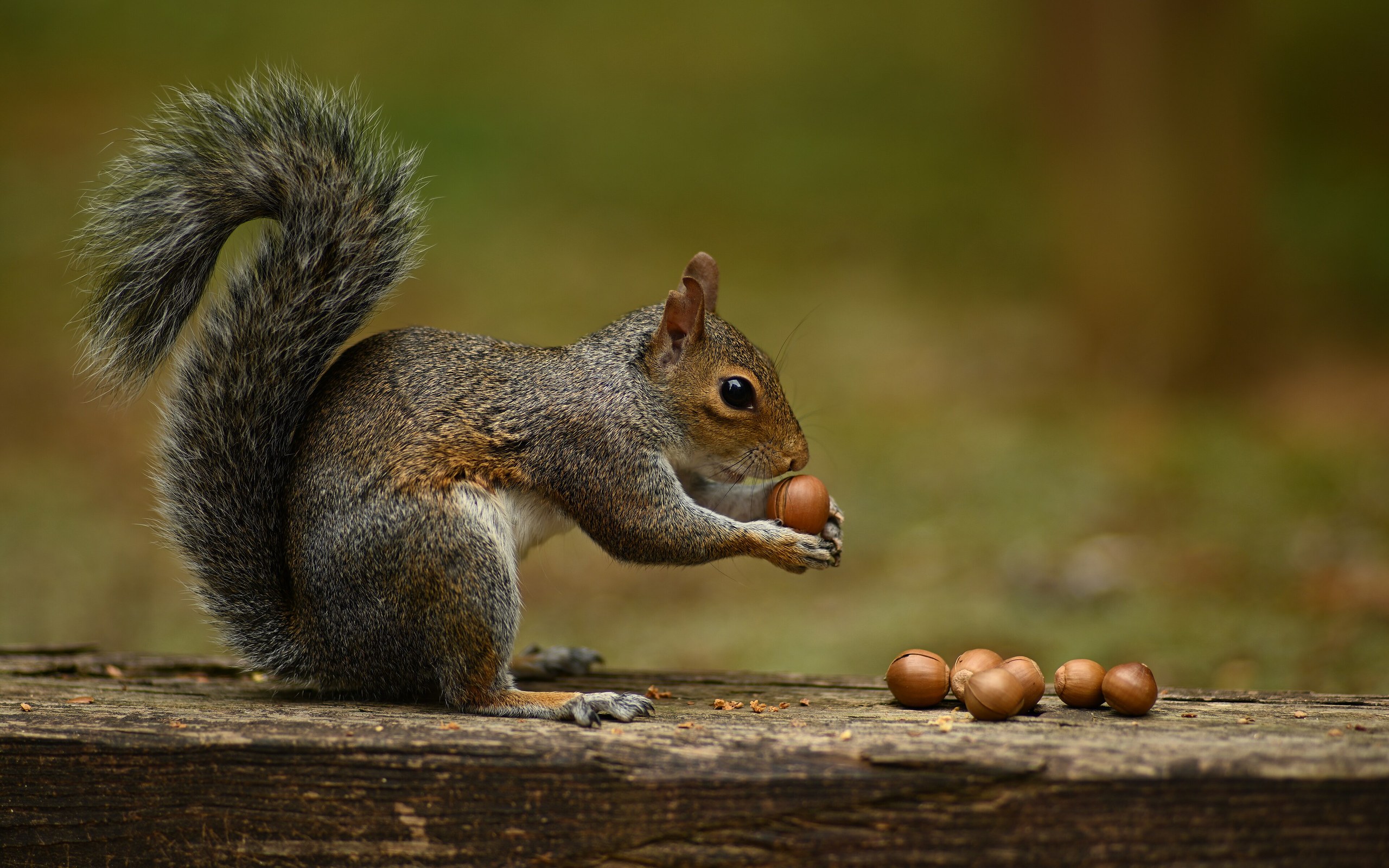
Species deep dive · eastern gray squirrel
Yes, much better than their reputation suggests. In a classic Princeton experiment, captive eastern gray squirrels (Sciurus carolinensis) each buried 10 hazelnuts in a large outdoor arena. Two, four or twelve days later, the researchers buried fresh nuts both in each squirrel's own cache sites and in sites other squirrels had chosen, so every spot smelled of nut. Each squirrel still dug up significantly more nuts from its own sites, after every delay. Gray squirrels can find buried nuts by smell, the authors concluded, but they also remember where they put each one (Jacobs & Liman 1991). Lucia Jacobs later described it simply: the squirrels retrieved about twice as many of their own nuts as other squirrels' (Scientific American).
One nut, one hole, thousands of times
Gray squirrels are scatter-hoarders: instead of one big pantry, they bury nuts one by one in separate spots and dig them up months later (Jacobs & Liman 1991). A single squirrel can make several thousand caches in a season (University of New Hampshire Extension). That's why October is so frantic. In a study of urban gray squirrels, caching started as soon as nuts ripened and stopped when winter set in, recovery ran from then until spring food appeared, and the squirrels recovered 84.6% of the nuts they had buried, and cached food made a significant contribution to their winter diet (Thompson & Thompson 1980).
Squirrels don't only rely on a one-off memory, either. Jacobs has watched gray squirrels go back to cache sites, rearrange the leaves and sometimes dig up and rebury nuts. "They are out there every day rehearsing, rehearsing, rehearsing," she told Scientific American (Scientific American).
Fake burials for an audience
Gray squirrels also bluff. When they're being watched, they sometimes go through the whole routine of digging a hole, pretending to push a nut in and covering it with soil and leaves, with nothing inside. Michael Steele's team at Wilkes University found squirrels faked it up to 20% of the time, and did it more after watching people raid their real caches (Steele et al. 2008; New Scientist). Whether that means squirrels understand a thief's intentions, or have just learned that it works, is still open (New Scientist).
They read the acorn, too
Not every acorn is worth burying. Red oak acorns stay dormant over winter and sprout in spring, while white oak acorns sprout soon after they fall in autumn, and a sprouting acorn pours up to half its stored energy into the seedling. In more than 1,500 feeding trials, Steele and Peter Smallwood found squirrels ate about 85% of white oak acorns soon after finding them but stored about 60% of red oak acorns (University of Richmond via ScienceDaily). When gray squirrels do cache white oak acorns, they can cut out the embryo first so the acorn can't germinate in the ground (Fox 1982; Steele et al. 2001).
Accidental foresters
The nuts that never get dug up matter as much as the ones that do. How many go unrecovered varies from place to place and year to year, but Steele has said gray squirrels can fail to recover up to 74% of the acorns they store in some situations, and that this helps oaks regenerate and spread. Red oak seedlings ended up more widely dispersed through the forest than white oaks, which tended to come up next to the parent tree (University of Richmond via ScienceDaily). As one forester put it, the few buried acorns squirrels forget germinate into oak seedlings (University of New Hampshire Extension).
A problem guest in Britain
The same squirrel is an invasive species in Britain. Gray squirrels were brought to England from North America in the late 19th century and now number about 2.7 million across Great Britain. They out-compete the native red squirrel for food and spread squirrelpox, a virus that is usually fatal to reds but rarely harms greys. England now has only about 38,900 red squirrels (GOV.UK, Defra). In Cumbria, red squirrels declined 17–25 times faster in areas where the virus was present in grey squirrels than in comparable areas without it (Rushton et al. 2006). One unexpected ally is the pine marten: Defra notes that pine martens living alongside gray squirrels can reduce their numbers, pointing to population changes seen in Ireland and Scotland (GOV.UK, Defra).
On the Wilder card
The Eastern Gray Squirrel is a Common Mammalia (Forest) card: Cost 1, Attack 1, Health 2, with Camouflage. At Cost 1 it's an easy early play, and Camouflage fits an animal that survives by vanishing up a trunk and keeping its stash out of sight. The flavour text is "Nuts today, outrun the hawk tomorrow." Try it against the red fox in the free browser collectible card game.
The short version: gray squirrels do remember where they bury many of their nuts, they use smell as a backup, they fake-bury when someone's watching, and the acorns they fail to recover help plant the next generation of oaks.
Photo credit
Hero photograph: Dkwikiedt, Eastern Grey Squirrel with Acorns, Wikimedia Commons, CC0 1.0 (public domain dedication). Cropped for the Field Journal hero.

Questions people ask
Do gray squirrels hibernate?
No. Eastern gray squirrels are active by day all year, though in winter one may sleep for several days in a row. They build leafy nests high in the branches and use tree cavities to escape bad weather (Illinois DNR).
Why are some gray squirrels black?
Black squirrels are the same species, with a pigment gene that is missing a piece of DNA. The faulty gene is identical to one in the fox squirrel, so it most likely passed to gray squirrels through interbreeding (Anglia Ruskin University; McRobie et al. 2019). Britain's first wild black squirrel was recorded at Woburn in 1912 (ARU).
When do gray squirrels have babies?
Twice a year for older females. Mating happens in January and again in June and July. After about six weeks, two or three young are born in a leaf nest, tree cavity or nest box, and they nurse for about two months. Females about a year old usually breed once a year (Illinois DNR).
Are eastern gray squirrels endangered?
No. Sciurus carolinensis is listed as Least Concern on the IUCN Red List (IUCN). In Illinois numbers have fallen where mature forest was cleared, but the species is common in cities (Illinois DNR). See the Wilder card.
Sources
- Jacobs & Liman 1991, Animal Behaviour 41 — Grey squirrels remember the locations of buried nuts
- Scientific American (2023) — Do Squirrels Remember Where They Buried Their Nuts?
- University of New Hampshire Extension (2018) — The Year of the Gray Squirrel
- Thompson & Thompson 1980, Canadian Journal of Zoology 58 — Food habits and caching behavior of urban grey squirrels
- Steele, Halkin, Smallwood, McKenna, Mitsopoulos & Beam 2008, Animal Behaviour 75 — Cache protection strategies of a scatter-hoarding rodent: do tree squirrels engage in behavioural deception?
- New Scientist (2008) — Squirrels 'fake it' to fool would-be thieves
- University of Richmond via ScienceDaily (1998) — Researchers tackle the nutty truth on acorns and squirrels
- Fox 1982, Evolution 36 — Adaptation of gray squirrel behavior to autumn germination by white oak acorns
- Steele, Turner, Smallwood, Wolff & Radillo 2001, Journal of Mammalogy 82 — Cache management by small mammals: experimental evidence for the significance of acorn-embryo excision
- GOV.UK (Defra, updated 6 Feb 2026) — Grey squirrel policy statement
- Rushton et al. 2006, Epidemiology and Infection 134 — Disease threats posed by alien species: the role of a poxvirus in the decline of the native red squirrel in Britain
- Illinois Department of Natural Resources — Eastern gray squirrel
- Anglia Ruskin University (2019) — Interbreeding turned grey squirrels black
- McRobie, Moncrief & Mundy 2019, BMC Evolutionary Biology 19 — Multiple origins of melanism in two species of North American tree squirrel (Sciurus)
- IUCN Red List — Sciurus carolinensis (Cassola 2016)