Tilcayo Tiger Cat: First New Wild Cat Species in a Century
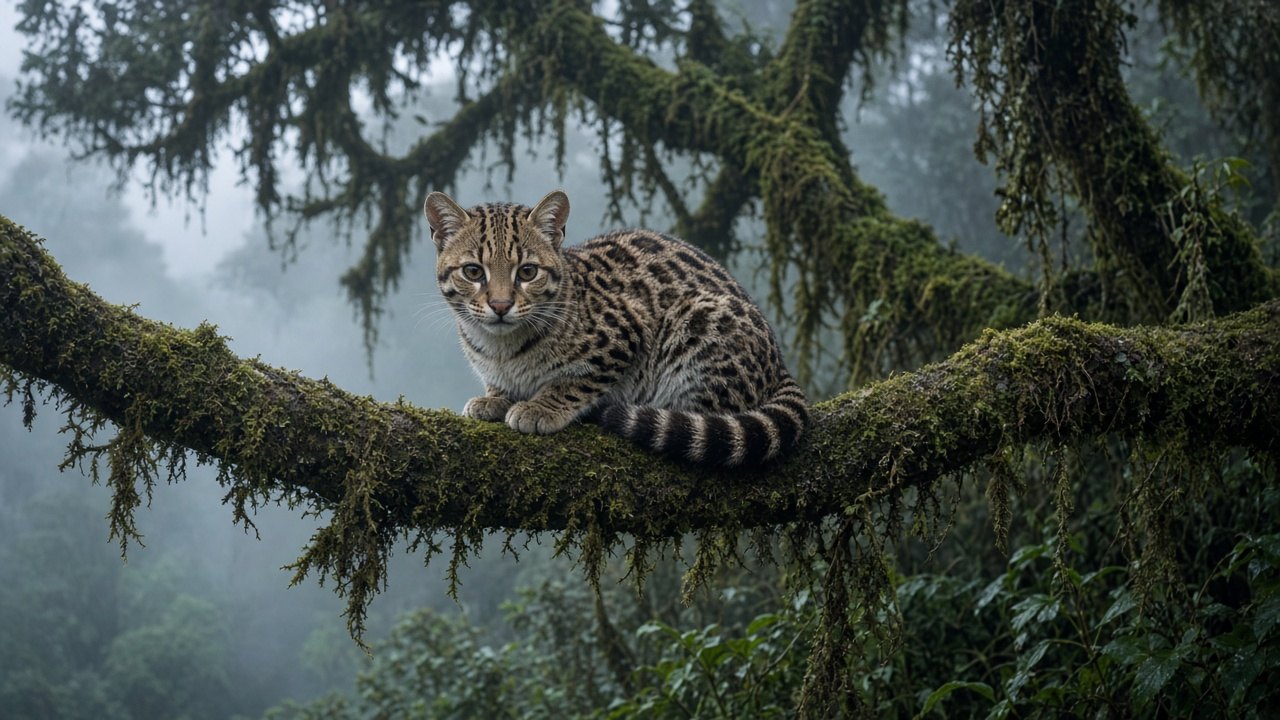
This is a generated illustration, not a photograph.
Species deep dive · tilcayo tiger cat
Search "Tilcayo tiger cat" and you will meet a headline that sounds impossible in 2026: a brand-new living wild cat. Leopardus tilcayo is real — a tiny spotted felid of Bolivia’s Yungas cloud forests, formally described in September 2026 after genomics split what field guides long treated as one widespread tiger-cat complex.
In Wilder TCG the Tilcayo Tiger Cat is a Mammalia · Forest · Cost 2 creature. The card is free to play with — and it stands for a wild species, not a pet for sale. If you arrived here wondering about price or purchase, stop: this is a newly recognized Bolivian cloud-forest hunter, and the Wilder entry is a field-guide plus game card, not a marketplace listing.
What is the Tilcayo / Tilcayo tiger cat?
Locals in Bolivia’s Yungas already called it tilcayo. Science kept it lumped with the tiger-cat species complex (Leopardus tigrinus and allies) until an international team — including National Geographic Explorer Paola Nogales-Ascarrunz — sequenced genomes across South American Leopardus and found a deep Bolivian lineage of its own.
The paper in Current Biology (Lescroart, Nogales-Ascarrunz, and colleagues, September 2026) names Leopardus tilcayo and redraws tiger cats into five species-level lineages, plus a new Peruvian subspecies of L. tigrinus (L. t. antisuyo). Genetic clocks put the tilcayo split at roughly 1.4 million years ago — long enough that it is not a “new mutation,” but a lineage we failed to recognize.
National Geographic and other outlets framed it as the first new wild cat species formally described in about a century (often compared with the last major living-felid descriptions around the early 1920s). That claim is about naming a previously unrecognized living species — not inventing an animal from nowhere. Camera traps and local knowledge were already brushing past these cats; the breakthrough was genomic proof that Bolivia’s Yungas form is its own species.
Size, spots, and a cloud-forest address
Live measurements place L. tilcayo in the small end of the tiger-cat complex: about 42–50.5 cm head–body length, tail roughly 25–26.5 cm, and body mass around 1.5–2 kg. Press accounts of the famous sanctuary male often round that to ~18 inches / ~3 pounds — smaller than a typical house cat. Fur is light brown with irregular rosettes that look larger than those of many Brazilian “oncilla” references; ears are short and round.
Confirmed habitat so far is the Bolivian Yungas — humid montane cloud forest on the eastern Andean slopes, especially Nor Yungas (La Paz). The type locality sits near Arapata at about 1,570 m; field notes place the species in dense understory roughly 1,300–2,000 m. Full geographic limits are still being mapped. Tiger cats are routinely misidentified as oncillas or margays on camera traps, so absence of labeled photos is not proof of absence.
Is it a carnivore? How does it hunt?
Yes — like every other cat, the tilcayo is an obligate carnivore. It cannot live on a plant-based diet. Scat work from Cotapata National Park and related Yungas sites shows small vertebrates, with rodent remains highlighted in press interviews with the research team. Lizards and birds fit the expected mesopredator menu of small Leopardus cats, but published tilcayo-specific prey lists are still thin — treat those as ecology-informed expectations, not a complete stomach inventory.
Hunting style matches other small spotted cats: stealth, short stalks, and a pounce, often in dense cover. Observers note easy climbing and trunk-marking — behaviors consistent with a forest mesopredator that uses vertical structure, not open-plain chases. Home-range and movement figures published for Bolivian tiger cats (when still labeled L. tigrinus) suggest individuals can travel on the order of a couple of kilometers and hold ranges from a few hectares to tens of hectares; treat those as order-of-magnitude context until tilcayo-specific telemetry is richer.
Camera-trap timing hints at mostly nocturnal activity. That is the opposite of a bold daytime fighter: it is a cryptic hunter that prefers not to be seen.
Are they aggressive? How do they fight?
There are no published aggression statistics for L. tilcayo — and inventing bite rates would be dishonest. What we can say carefully:
- It is a small wild felid, typically solitary, elusive, and nocturnal. Avoidance of people is the default, not confrontation.
- Cornered or handled, small cats defend themselves with hissing, swipes, and bites — the same toolkit as other wild felids of this size. That is defense, not a movie villain arc.
- It is not a pet. The holotype story makes that plain: a local family took in a “kitten,” then after about a year recognized it as a wild animal and brought it to a sanctuary. Cute ears do not rewrite wild-animal welfare or law.
Fighting among predators is likewise under-documented for this species. Expect the usual small-carnivore pattern — contest over space or a kill, quick threat displays, then withdrawal — not staged gladiator battles. If you are comparing it to larger cats or to domestic dogs in “who would win” searches, remember the tilcayo’s job in the forest is rodents and other small prey, not dominating the food web.
One named cat, many unknowns
The Leopardus tilcayo holotype is an adult male Tilcayo named Tigrino, living at Senda Verde wildlife sanctuary in the Yungas since around 2017 (found as a cub slightly earlier); if you'd like to help with his care, you can support Senda Verde. As of the 2026 description he was about ten years old — a lower bound on lifespan for at least one individual, not a species average. Study co-authors have said their live sample was essentially two examined individuals plus a small number of camera-trap records. That does not mean only two animals exist in the wild; it means science has barely begun counting them.
L. tilcayo is not yet assessed by the IUCN as its own species. Tiger cats previously assessed as broader units were often listed Vulnerable; splitting lineages can raise urgency because each piece of the former range must be judged separately. Yungas forests face deforestation, agriculture, fire, and mining pressure — conservation planning needs species-specific maps that do not yet fully exist.
Support the refuge where it was found
Senda Verde, the wildlife sanctuary in Bolivia’s Yungas where Tigrino lives and where the Tilcayo was first identified, has launched an official Tigrino shirt collection to help fund the care of its roughly 1,200 rescued animals. According to Senda Verde’s presale announcement, the presale runs October 5–14, 2026, at Bs 250 per shirt, with orders taken through Senda Verde’s WhatsApp. Wilder isn’t affiliated with Senda Verde and earns nothing from the sale. If the presale has closed, you can still support Senda Verde directly.
From Yungas mist to Wilder card
In the Tilcayo Tiger Cat field guide entry you will find taxonomy, habitat, and in-game stats. On the board, a low-cost Forest Mammalia card is a nod to a real cloud-forest specialist that stayed hidden in plain sight until genomics caught up with local names.
If you have never tried Wilder, guest play is free in the browser — open packs, build a deck, and put Bolivia’s newest named cat on the table:
Quick facts
- Scientific name: Leopardus tilcayo Nogales-Ascarrunz, Aliaga-Rossel, Lescroart & Eizirik, 2026
- Common names: Tilcayo; Tilcayo tiger cat
- Hook: first new wild cat species formally described in ~100 years
- Size: ~42–50.5 cm head–body; ~1.5–2 kg
- Diet: obligate carnivore — small vertebrates (rodents confirmed in scat)
- Habitat: Bolivian Yungas cloud forest (~1,300–2,000 m)
- Activity: largely nocturnal (camera-trap indication); solitary; climbs
- Conservation: not yet IUCN-assessed as its own species; restricted known range + habitat threats
- Wilder family: Mammalia · Forest · Cost 2
Sources
- Lescroart, Nogales-Ascarrunz et al. (2026) Current Biology — Phylogenomics of tiger cats
- National Geographic — Meet the First New Cat Species Discovered in 100 Years
- Reuters — New cat species identified in Bolivia
- BBC News — Spotted wildcat from Bolivian forest revealed as new species
- Discover Wildlife — New species of wild cat in Bolivia’s cloud forest
- PUCRS — New feline species Leopardus tilcayo
- Wilder TCG — Tilcayo Tiger Cat field guide