West Indian Ocean Coelacanth: Living Fossil, Lazarus Rediscovery, and Critically Endangered Depths
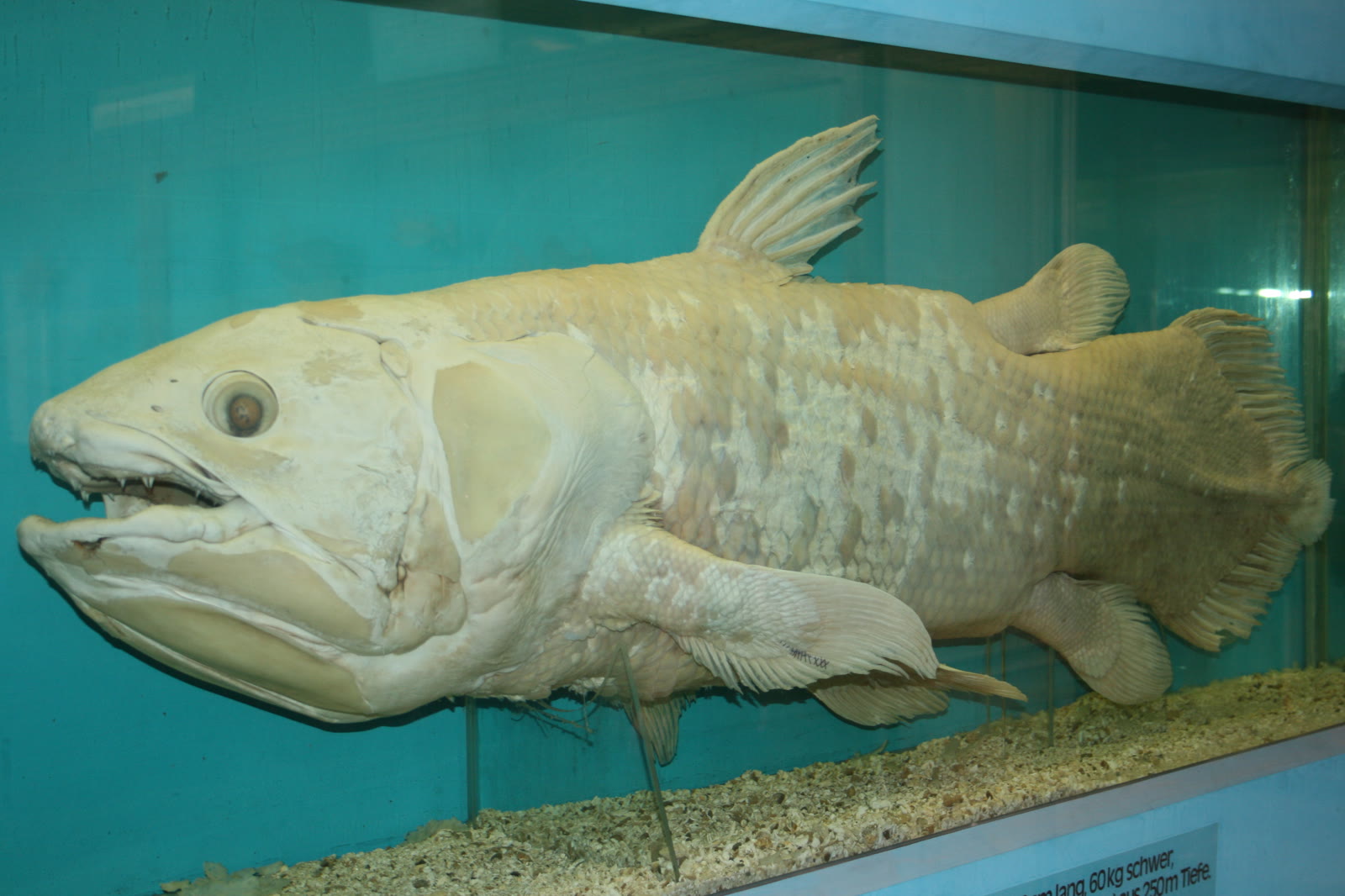
Species deep dive · west indian ocean coelacanth
Search “are coelacanths extinct,” “what is a living fossil fish,” or “when was the coelacanth rediscovered,” and you land on the same deep-blue silhouette science once filed under gone forever. Latimeria chalumnae — the West Indian Ocean coelacanth — was known only from fossils until a trawler catch off East London, South Africa, in 1938 put a “Lazarus taxon” back on the living checklist. There are two living Latimeria species; Wilder’s card covers this Critically Endangered western Indian Ocean fish, not its Indonesian sister.
Latimeria chalumnae is a lobe-finned sarcopterygian of deep coastal caves — IUCN Critically Endangered, CITES Appendix I, with a wild population often framed in the low hundreds. In Wilder TCG it is a Cost 5 Pisces Water Guardian with Resilient: a Rare mid-to-late board presence that echoes an animal whose evolutionary résumé is four hundred million years of simply refusing to die.
The Lazarus fish of 1938
Museum curator Marjorie Courtenay-Latimer recognized that a strange catch did not match any local field guide and contacted ichthyologist J. L. B. Smith. Smith named the species Latimeria chalumnae for Courtenay-Latimer and the Chalumna River mouth waters — and the world learned that a lineage last common in Cretaceous seas still swam. “Living fossil” is a popular label for that shock: the body plan looks ancestral, even though living coelacanths are not frozen in time. The point for searchers is simpler — coelacanths are not extinct.
Two living species — don't mix the cards
Only two coelacanth species are known alive today:
- West Indian Ocean coelacanth (Latimeria chalumnae) — Critically Endangered; Wilder’s roster species
- Indonesian coelacanth (Latimeria menadoensis) — assessed Vulnerable on the IUCN Red List; a sister species, not the same animal
In 2026, Indonesian researchers (BRIN with OceanX and NHK partners) documented 18 L. menadoensis individuals in underwater caves off Talise Island, North Sulawesi — including a dense cluster in one cave — and used the find to push a national sanctuary and UNESCO World Heritage nomination. That news is real conservation momentum for the Indonesian species. It is not evidence that Wilder already ships an Indonesian coelacanth card, and it does not change the Critically Endangered status of L. chalumnae.
Lava caves, lobe fins, and a slow life
By day, West Indian Ocean coelacanths often gather in rocky or lava caves roughly 100–200 m deep (cooler tropical thermocline waters). At night they may range from about 70 to 700 m, drift-hunting fish and other suitable prey that pass within a short strike distance. Seven fleshy-lobed fins — including paired pectorals and pelvics that can move in a diagonal, almost walking gait — give the fish uncanny agility: upright, inverted, or nose-down postures show up on submersible footage.
Reproduction is ovoviviparous (live-bearing with yolk-supported embryos). Gestation estimates run from roughly 13 months to multi-year extremes depending on the aging method; broods of about 5–26 near-term young are cited, with females maturing late and reproducing infrequently. Scale-ring work published in Current Biology (Mahé et al., 2021) suggests African coelacanths may live on the order of ~100 years, with one of the slowest marine-fish life histories known — which makes accidental gillnet bycatch especially costly.
Adults can approach ~2 m and ~100+ kg in extreme individuals; ADW notes females averaging larger than males. Blue scales with individual white speckles turn brown after death — one reason museum specimens look less electric than dive photos of living fish.
Why Critically Endangered still sticks
Humans are the only known predator that matters at population scale. Coelacanth flesh is generally considered unfit to eat; mortality is mostly bycatch (oilfish and shark gillnet fisheries along East Africa and the Comoros). Small colony sizes, late maturity, long gestation, and deep-habitat specialization leave little buffer. CITES Appendix I (since 1989) blocks commercial international trade; the IUCN Critically Endangered listing remains the sober status for L. chalumnae.
On the Wilder card
In the West Indian Ocean coelacanth field guide entry you will find Water habitat tagging, Critically Endangered conservation status, and Guardian + Resilient flavor for a Cost 5 Pisces Rare — the game echo of a lobe-finned survivor that outlasted an extinction headline and still needs quiet deep water to keep doing so.
If you have never tried Wilder, guest play is free in the browser — open packs, build a deck, and put a living fossil on the table:
Quick facts
- Scientific name: Latimeria chalumnae
- Family: Latimeriidae (lobe-finned fishes / Sarcopterygii)
- Hook: “living fossil” / Lazarus rediscovery 1938; two living Latimeria species; deep cave specialist
- Size: up to ~2 m / ~100+ kg (extremes); females typically larger
- Habitat: western Indian Ocean — Comoros core, plus sparse East African / Madagascar / South African colonies; day caves ~100–200 m
- Reproduction: ovoviviparous; long gestation; small broods; late maturity
- Longevity: on the order of ~100 years (scale analyses)
- Status: IUCN Critically Endangered; CITES Appendix I; population often cited in the low hundreds
- Sister species: Latimeria menadoensis (Indonesian coelacanth; IUCN Vulnerable) — 2026 Talise news is about this species
- Wilder family: Pisces · Water · Cost 5 · ATK 4 / HP 7 · Guardian + Resilient · Rare
Photo credit
Hero photograph: MichalPL, "Latimeria chalumnae, taxidermy, Natural History Museum, Vienna, Austria, July 2011" (Wikimedia Commons), CC BY-SA 4.0. Cropped for the Field Journal hero.

Sources
- Animal Diversity Web — Latimeria chalumnae
- IUCN Red List — Latimeria chalumnae
- Mahé et al. 2021 — New scale analyses reveal centenarian African coelacanths
- Frontiers in Marine Science 2021 — Behavioral ecology of L. chalumnae off South Africa
- RRI / BRIN–OceanX–NHK 2026 — 18 Indonesian coelacanths off Talise Island
- FishBase — Latimeria chalumnae
- Wilder TCG — West Indian Ocean coelacanth field guide