Are Ticks Active in Fall and Winter?
Species deep dive · black legged tick
Yes. In much of eastern North America, fall is when adult deer ticks are at their busiest. Adult blacklegged ticks (Ixodes scapularis), also called deer ticks, are most active from early October to late November, with a second peak from late March through May (UNH Extension). They don't hibernate. An adult can look for a host on any winter day when the temperature is above freezing (Penn State Extension; Connecticut Agricultural Experiment Station). Cooler weather is not a reason to skip the tick check after a walk in the woods.
Why the adults turn up in autumn
A blacklegged tick lives for about two years and takes just three blood meals, one as a larva, one as a nymph and one as an adult. Females lay their eggs in May. The larvae hatch in mid to late July and peak in August. After feeding they molt into nymphs, which appear the following year in late spring and peak in May, June and July. Nymphs that have fed then molt into adults, which appear in the fall of that same year (Connecticut Agricultural Experiment Station). Larvae and nymphs feed mostly on small mammals such as mice and chipmunks, and on birds (Penn State Extension).
Adults want a bigger meal. They feed on medium and large mammals, especially white-tailed deer, but any stage will bite people, pets and livestock (Penn State Extension). Penn State Extension notes that adult blacklegged ticks are out in October and November looking for an animal to feed on (Penn State Extension).
How a tick finds you
Ticks can't fly or jump. Most species wait in a pose called questing: they cling to the tips of grass and shrubs with their third and fourth pairs of legs and hold the first pair out, ready to grab whatever brushes past. They pick their spot along well-used paths and sense a passing animal by its breath, body odor, heat, moisture and vibrations, and some species can even recognize a shadow (CDC). Once aboard, a tick can take anywhere from 10 minutes to 2 hours to settle in before it starts feeding, and its saliva can numb the skin so you don't feel the bite (CDC).
What "active in winter" really means
Winter activity depends on the day. Adult blacklegged ticks stay active through the winter as long as it's above freezing, including sunny days when the air is near freezing but patches of leaf litter warmed by the sun are warmer. They're generally less active under a full blanket of snow, though you can still find them when the snow is patchy or falls right after a warm day (Penn State Extension). In New Hampshire, the extension service puts the line at mild days above about 40°F (4°C) with no snow cover (UNH Extension).
A hard frost doesn't wipe them out, either. When researchers followed blacklegged tick nymphs through real winters at two sites in New York State, more than 80% survived at both sites, whatever the weather (Brunner et al. 2012). Fallen leaves help. In a three-winter experiment in coastal New England, nymphs survived better under leaf litter than where it had been removed, while snow cover was a less reliable insulator (Linske et al. 2019).
Fall adults vs. summer nymphs
Adults carry the Lyme disease bacterium (Borrelia burgdorferi) more often than nymphs, because they've had two chances to pick it up, once as a larva and once as a nymph (Connecticut Agricultural Experiment Station). Even so, about 98% of Lyme disease cases are linked to nymph bites. Nymphs are about the size of a pinhead, hard to spot, and active in late spring and summer, when people spend the most time outdoors. Adults are bigger and get noticed sooner: in one study, nymphs stayed attached for an average of 30 hours before someone found and removed them, while adults stayed attached for 10 (Connecticut Agricultural Experiment Station).
That time matters. It usually takes 36 to 48 hours or more of feeding before the Lyme disease or babesiosis germs pass from tick to person. In one study, the chance of Lyme transmission was 0% at 24 hours of attachment, 12% at 48 hours, 79% at 72 hours and 94% at 96 hours. The agent of ehrlichiosis can pass in less than 24 hours, so a prompt check still matters (Connecticut Agricultural Experiment Station).
Where you live changes the picture too. The blacklegged tick ranges across the eastern United States, the north-central states and southern Canada, but few of the ticks in the southeastern U.S. have been found carrying the Lyme bacterium, so the Lyme risk from this tick there is considered relatively low (Connecticut Agricultural Experiment Station). Farther north it's spreading: Penn State notes the tick's range has grown in recent years and it's now found throughout Pennsylvania (Penn State Extension).
A fall tick routine
The Connecticut Agricultural Experiment Station calls checking for ticks and removing attached ones promptly "probably the most important and effective method of preventing infection." Repellents help as well, especially DEET on skin and permethrin on clothing, but the station notes they're under-used. To remove a tick, grip it with thin-tipped tweezers as close to the skin as you can and pull straight up with steady, even pressure, so the mouthparts come out too (Connecticut Agricultural Experiment Station). If you get a fever, aches or a rash within a few weeks of a tick bite, the CDC advises seeing a healthcare provider (CDC).
On the Wilder card
The Black-legged Tick is a Common Arachnida (Forest) card: Cost 1, Attack 1, Health 2, with Venom. Venom is a nod to the tick's saliva: the CDC notes that tick paralysis is thought to be caused by a toxin in an attached tick's saliva (CDC). The flavour text is "Hitches a ride, stays for dinner." On its card page it takes on the European mantis, and the mantis wins that matchup. Try both in the free browser collectible card game.
The short version: ticks don't disappear in autumn. Adult blacklegged ticks peak in October and November, keep looking for hosts on winter days above freezing, and survive the cold in leaf litter, so fall hikes, yard work and hunting trips still call for a tick check.
Photo credit
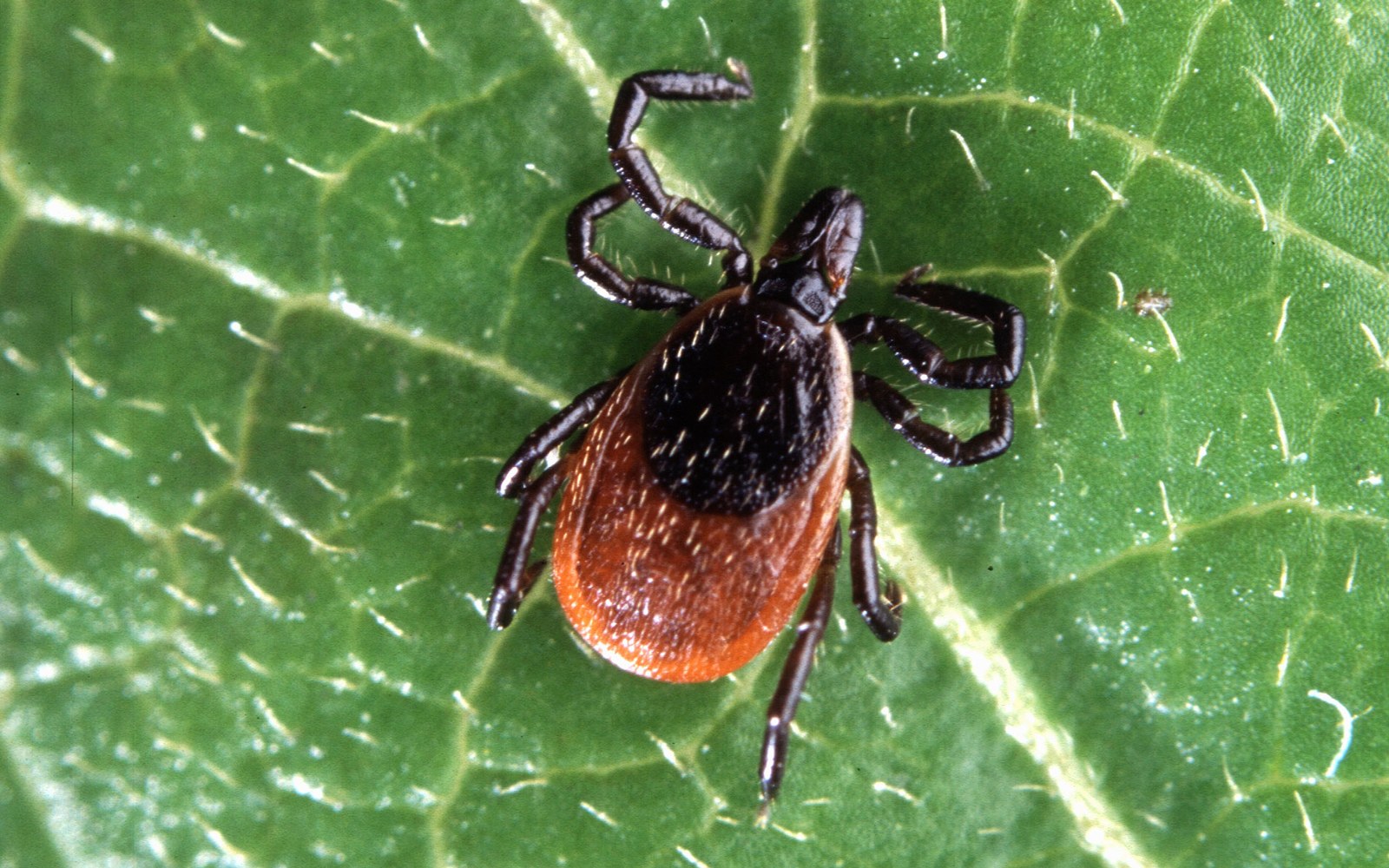
Hero photograph: Scott Bauer, USDA Agricultural Research Service, An adult deer tick (Ixodes scapularis) sits on a leaf (K8002-1), Wikimedia Commons, public domain (work of the U.S. federal government). Cropped for the Field Journal hero.

Questions people ask
Are deer ticks and blacklegged ticks the same thing?
Yes. Blacklegged tick is the correct common name for Ixodes scapularis, the tick most people call the deer tick, and the two names aren't combined into "blacklegged deer tick" (Connecticut Agricultural Experiment Station). The nickname comes from the adults' favourite host, the white-tailed deer (Penn State Extension).
Can ticks survive the washing machine?
Often, yes. Many blacklegged ticks can survive a warm or hot water wash, but they cannot withstand one hour in a hot dryer. Ticks carried indoors on clothing can survive for days depending on humidity: in the lab, over half of nymphs died within 4 days at 65% relative humidity, but some lived over 6 months at 93–100% (Connecticut Agricultural Experiment Station).
Does the blacklegged tick live in Europe?
No. Europe's version is the castor bean tick (Ixodes ricinus), from the same genus and also called the sheep tick or deer tick. It spreads Lyme borreliosis and tick-borne encephalitis virus, is usually most active in spring and autumn, and is predicted to spread throughout Norway, Finland and Sweden by 2071–2100 (ECDC).
How many eggs does a deer tick lay?
An engorged female blacklegged tick typically lays about 2,000 to 3,000 eggs in a single batch and then dies (Connecticut Agricultural Experiment Station).
How big is an adult deer tick?
Tiny. An unfed adult female is about 3 to 3.7 mm long (about 1/10 inch), with a reddish body and a dark brown shield behind the mouthparts. Males are smaller, 2 to 2.7 mm, and completely dark brown. Nymphs are 1.3 to 1.7 mm and larvae just 0.7 to 0.8 mm (Connecticut Agricultural Experiment Station).
Sources
- University of New Hampshire Cooperative Extension — Biology and Management of Ticks in New Hampshire
- Penn State Extension — Common Ticks and Tick-borne Diseases in Pennsylvania
- Penn State Extension — Know Your Vector: Blacklegged Ticks
- Penn State Extension — Preventing Tick Bites in the Fall
- Stafford 2007, Tick Management Handbook (Connecticut Agricultural Experiment Station Bulletin 1010)
- CDC — About Ticks and Tickborne Disease
- Brunner, Killilea & Ostfeld 2012, Journal of Medical Entomology 49(5) — Overwintering survival of nymphal Ixodes scapularis under natural conditions
- Linske et al. 2019, Insects 10(8):227 — Impacts of deciduous leaf litter and snow presence on nymphal Ixodes scapularis overwintering survival in coastal New England
- ECDC — Ixodes ricinus factsheet for experts