Has Anyone Died From an Inland Taipan Bite?
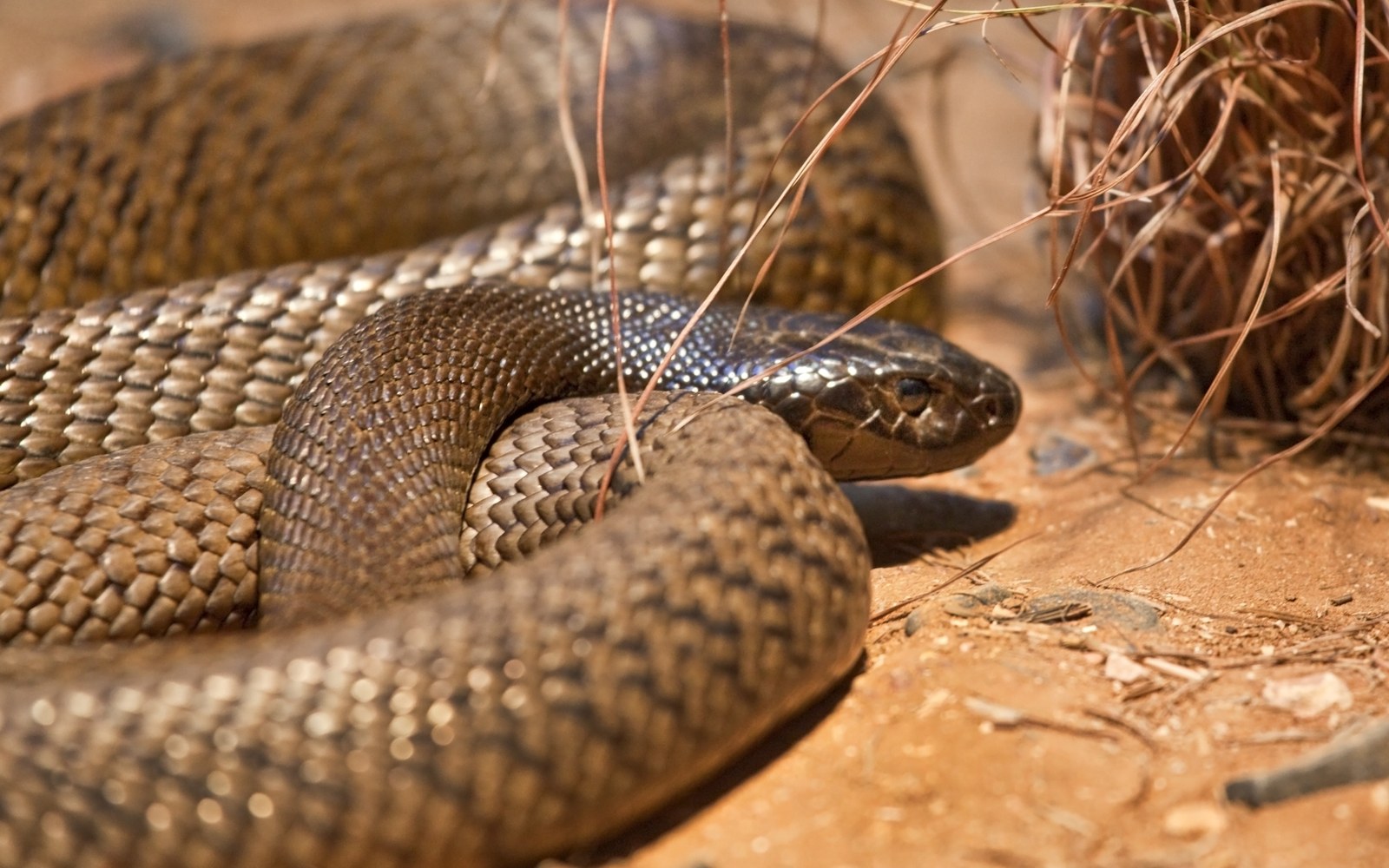
Species deep dive · inland taipan
No. There is no recorded human death from an inland taipan bite. Only about a dozen envenomings by Oxyuranus microlepidotus have ever been formally documented, most of them keepers and herpetologists working with captive snakes, and every one of those people survived (Weinstein et al. 2025, Toxicon; Australian Museum). The snake with the most toxic venom ever measured in mouse tests has a human death toll of zero, because it lives where almost nobody goes, hides most of the day, and would rather bluff than bite.
That doesn't make a bite survivable on its own. The survivors got fast first aid, hospital treatment and taipan antivenom. The Australian Museum calls a bite "potentially life-threatening" and says anyone who may have been bitten needs immediate medical attention (Australian Museum).
Why it almost never bites anyone
It lives in some of Australia's emptiest country. The inland taipan is found on the deep cracking-clay and cracking-loam floodplains of the Channel Country in south-western Queensland and north-eastern South Australia, where it shelters in soil cracks, holes and mammal burrows among sparse saltbush and lignum (Australian Museum).
It spends little time in the open. It is active by day, mostly in the first half of the morning, when it basks briefly and hunts in or near soil cracks and burrows before going back into shelter for the rest of the day. In cooler weather it may also be out in the afternoon (Australian Museum).
It is shy. Despite the old name "fierce snake", it is far calmer than its relative the coastal taipan, and many reptile keepers regard it as a placid snake to handle. When it is provoked it warns first, raising the front of its body into a tight, low S-shaped curve facing the threat. Only if that warning is ignored does it strike, with a single bite or several quick ones (Australian Museum).
What a bite actually does
A detailed recent account comes from Florida. In a case published in Toxicon in 2025, a 22-year-old man was bitten on the hand by a captive female inland taipan while doing routine maintenance at a public educational reptile exhibit. He reached hospital within 25 minutes. Within about five minutes of the bite he had briefly lost consciousness and had confusion, nausea, a headache, weakness and severe pain at the bite. Tests showed his blood had largely lost the ability to clot, his platelet count dropped, and cranial nerve palsies made his eyes misalign (Weinstein et al. 2025).
He was treated with four vials of Australian polyvalent antivenom and one vial of taipan antivenom, all of them past their expiry dates, by between one month and 38 years. They worked. He went home after 48 hours with no lasting effects. The authors stress that any collection keeping dangerous non-native venomous snakes needs an antivenom and emergency plan ready in advance (Weinstein et al. 2025).
The venom is strongly neurotoxic, and it also contains hyaluronidase, a "spreading factor" enzyme that speeds up absorption. Symptoms can include headache, nausea, vomiting, abdominal pain, collapse and paralysis (Australian Museum).
Built for rats, not people
That venom is tuned to a very particular menu. In the wild the inland taipan appears to eat only mammals, especially the long-haired rat (Rattus villosissimus), plus introduced house mice and small marsupial predators called dasyurids. It usually corners prey in a burrow or soil crack and bites several times in quick succession. Because the venom works so fast, the snake can hold on instead of letting go and waiting, which is what many snakes do to avoid being hurt by struggling prey (Australian Museum).
Long-haired rats go through boom-and-bust cycles, breeding to plague numbers in good seasons and almost vanishing in drought. When rats are everywhere, the snakes grow sleek and fat. When the rats crash, the snakes fall back on scarcer prey and their fat reserves until the rats return (Australian Museum).
How it ranks against other snakes by lab toxicity is its own story, covered in our most venomous snakes showdown.
A snake that changes colour with the seasons
Few snakes change colour through the year, but the inland taipan does. It turns darker in winter and fades in summer, ranging from pale fawn to dark brown, with the head and neck several shades darker than the body (Australian Museum; Herpetofauna 1983). The head can look almost glossy black at times (Australian Reptile Park). The dark winter colour presumably helps the snake warm up quickly in cool months, and the pale summer colour helps it avoid overheating (Australian Museum).
That is genuinely unusual. A 1989 review called colour change in snakes very uncommon, listing seasonal change in just three Australian elapids and one European viper, the adder Vipera berus (Hedges, Hass & Maugel 1989).
Lost to science for almost a century
The species was first described in 1879 by Frederick McCoy, from specimens collected at the junction of the Murray and Darling Rivers in north-western Victoria. Another was collected near Bourke in New South Wales in 1882, and then the species went missing from the scientific record (Australian Museum). It stayed "lost" for almost 100 years, until a grazier, Herb Rabig, collected a specimen in far western Queensland. Queensland Museum herpetologist Jeanette Covacevich confirmed what it was and went into the field with Charles Tanner to find more (Memoirs of the Queensland Museum). It has never been recorded in Victoria or New South Wales since those first records, and it is presumed extinct in both states (Australian Museum).
Rivals settle things without biting. Male combat has been seen in late winter, when two large snakes intertwined, raised their heads and front bodies and lashed at each other with closed mouths for about half an hour (Australian Museum).
On the Wilder card
The Inland Taipan is a Rare Reptilia card from the Desert element: Cost 4, Attack 5, Health 3, with Venom and ColdBlooded. That's a big hit for its cost on a fragile body, which fits a snake whose strength is its venom rather than its size. The flavour text says it all: "Drop-for-drop the deadliest bite, yet it hides shyly in desert cracks." For a very different venomous snake, read about the king cobra, then try both in the free browser collectible card game.
The short version: nobody is known to have died from an inland taipan bite. Only about a dozen bites are on record, mostly in captivity, and the snake lives in remote Channel Country, shelters most of the day and warns before it strikes. Its venom is built to drop long-haired rats in a burrow, not people.
Photo credit
Hero photograph: Sheba_Also, Fierce Snake-1and, Wikimedia Commons (via Flickr), CC BY-SA 2.0. Cropped for the Field Journal hero.

Questions people ask
How big does an inland taipan get?
Most are about 2 metres long in total. The longest total length on record is 2.5 m, and the largest reliably measured snake was a female with a snout-to-vent length of 170 cm. Males and females are about the same size on average (Australian Museum).
How many eggs does an inland taipan lay?
Usually 11 to 20, with 16 the average clutch. The eggs are about 6 × 3.5 cm when laid and take 9 to 11 weeks to hatch at 27–30°C, and the hatchlings are around 47 cm long. Females carrying eggs have been found in mid-spring (Australian Museum).
Is the inland taipan endangered?
Not globally. The IUCN Red List assesses Oxyuranus microlepidotus as Least Concern (IUCN). Locally it is listed as Rare in Queensland and presumed extinct in New South Wales and Victoria (Australian Museum). See the Wilder card.
How many species of taipan are there?
Three. The genus Oxyuranus holds the coastal taipan (O. scutellatus), the inland taipan (O. microlepidotus) and the western desert taipan (O. temporalis), which was only described in 2007 and seems widespread but rare across the western deserts of central Australia (Australian Journal of Zoology).
Sources
- Weinstein, Keyler et al. 2025, Toxicon — Envenoming by a captive inland taipan, Oxyuranus microlepidotus: case report, expired antivenom, review
- Australian Museum — Inland Taipan
- Australian Reptile Park — Inland Taipan
- Herpetofauna 14(2) 1983 — Herpetological notes: Seasonal colour changes in the inland taipan
- Hedges, Hass & Maugel 1989, Journal of Herpetology — Physiological color change in snakes
- Memoirs of the Queensland Museum 2016 — Vale Jeanette Adelaide Covacevich (1945–2015)
- Australian Journal of Zoology 2025 — Science meets the taipan — discovery and description of an iconic venomous snake
- IUCN Red List — Oxyuranus microlepidotus (Wilson et al.)