King Cobra: How Dangerous Is a King Cobra Bite?
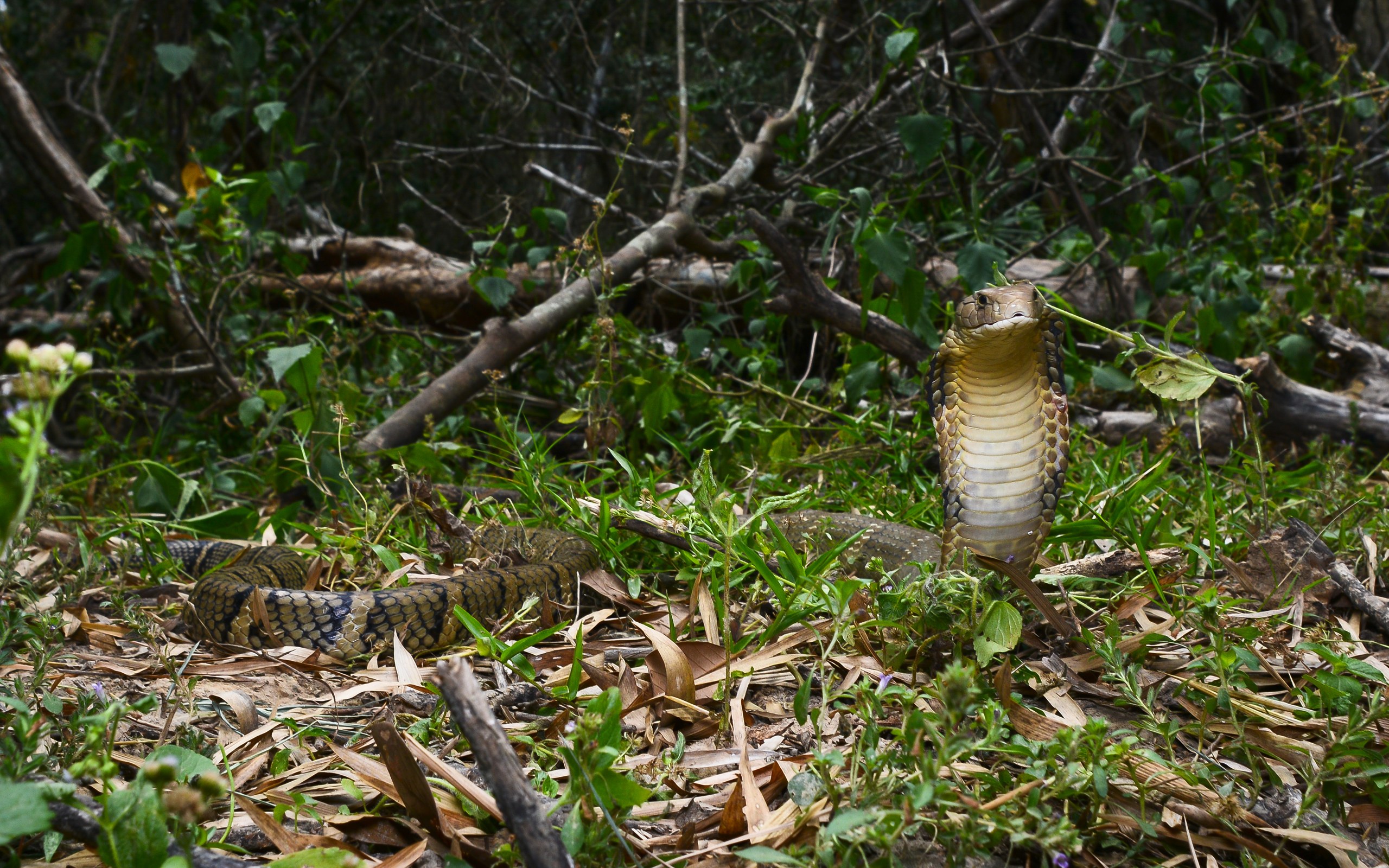
Species deep dive · king cobra
Very dangerous if it bites you, but it very rarely does. A king cobra can inject an enormous dose of venom that paralyses the nerves, and without hospital care and breathing support the paralysis can stop a person's breathing and kill them (Tan et al. 2022). Yet bites are uncommon, and most happen when people catch, handle or play with the snake. In a Malaysian study of 32 confirmed king cobra bites, 13 victims needed a ventilator and one died (Renault et al. 2024).
So the king cobra deserves its fearsome reputation for each bite, but it's nowhere near the top of the list of snakes that actually kill people.
Why a king cobra bite is so serious
The problem is quantity as much as quality. The king cobra is the longest venomous snake in the world, and a big one has a lot of venom to give. In a 2022 review, venom researcher Choo Hock Tan and colleagues wrote that, in their experience, a king cobra can deliver more than 1 gram (dry weight) of venom in a single bite. It also tends to hang on for several minutes instead of striking and letting go like many other snakes (Tan et al. 2022).
That venom attacks in two ways:
- Neurotoxic paralysis. Its main toxins block the signals between nerves and muscles, causing a descending paralysis. When the breathing muscles fail, the victim suffocates, which is the main way king cobra bites kill (Tan et al. 2022; Renault et al. 2024).
- Local tissue damage. Bites cause intense pain and swelling that can spread up the whole limb. In severe cases the tissue dies, and patients need repeated surgery, skin grafts or even amputation (Tan et al. 2022).
In the Malaysian series, 24 of the 32 patients (75%) showed signs of envenoming, 13 (40.6%) needed a breathing tube and ventilator, and four were left with permanent injuries. The one death, in 2018, came from complications of necrotizing fasciitis and severe sepsis (Renault et al. 2024).
Who actually gets bitten
Almost always, people who go looking for trouble or are paid to deal with it. In that Malaysian series, 14 victims were bitten while trying to catch the snake, 8 while playing with it and 7 during rescue handling, which together cover 29 of the 32 cases. Fire and rescue workers were the most common occupation among the victims (Renault et al. 2024).
The medical literature tells the same story. The 2022 review found only nine published clinical reports of king cobra envenoming between 1971 and 2020: three from Myanmar, one each from Thailand and Malaysia, and four from outside Asia (two in the USA, one in the UK and one in the Netherlands). The reported bites happened around snake handling, and snake charming and snake shows have produced documented cases too (Tan et al. 2022). The three Myanmar patients, for example, were all bitten while performing the famous snake dance at the Yangon zoo (Tin-Myint et al. 1991).
The World Health Organization reflects this by putting the king cobra in Category 2, its group of highly venomous snakes that can kill but are implicated less often, or for which good data are lacking (Tan et al. 2022).
Why it isn't one of the deadliest snakes
Snakebite kills an estimated 81,410 to 137,880 people a year worldwide (WHO), and a nationally representative study estimated that India alone averaged about 58,000 snakebite deaths a year from 2000 to 2019. But when Indian studies identified the snake, the culprits were mostly Russell's vipers (43% of identified cases), kraits (18%) and Naja cobras (12%), not king cobras (Suraweera et al. 2020). Those snakes live in fields and villages, get stepped on in the dark, or slip into houses at night. A king cobra needs to be cornered, grabbed or disturbed before it bites.
It's the same lesson as the inland taipan: the snake with the scariest venom isn't necessarily the one that kills the most people. Our most venomous snakes showdown ranks venom strength, and the inland taipan piece explains why the world's most toxic snake has so few victims. Australia's eastern brown snake shows the other side: a snake that lives close to people causes most of the country's snakebite deaths.
Treatment: one antivenom, very high doses
Only one antivenom in the world is made specifically for king cobra bites: Ophiophagus hannah Monovalent Antivenom, produced by the Thai Red Cross Society's Queen Saovabha Memorial Institute in Bangkok from the venom of Thai king cobras (Tan et al. 2022). It works, but it takes a lot of it. In the published case reports, patients received between 20 and 115 vials, probably because of the sheer amount of venom a king cobra injects. King cobra venom also varies from place to place: in mouse tests, venom from China and Indonesia was more lethal than venom from Malaysia and Thailand, which may make the Thai antivenom less effective in some regions (Tan et al. 2022).
In Malaysia, 22 of the 32 patients received antivenom. The most common amount was a single 10-vial dose, but most of the treated patients needed more than one course (Renault et al. 2024). The authors credit fast hospital access and timely antivenom for the good outcomes. Any suspected king cobra bite is a medical emergency that needs a hospital immediately.
For the rest of the king cobra's story, from leaf-litter nests to its snake-eating diet, read King Cobra: World's Longest Venomous Snake.
How the king cobra plays in Wilder
The King Cobra (Ophiophagus hannah) is a Rare Reptilia card in the Grassland element. It costs 5 Energy, with Attack 5 and Health 4, and has Basking and Venom, plus the activated ability Hood Flare: spend 3 Energy to Pacify an enemy creature so it can't attack on its next turn. That's a nod to the real snake, which would much rather rear up and warn you off than bite. Flavour text: "The longest venomous snake alive. It eats other snakes."
Wilder is a free browser collectible card game about real animals, and you can play it free in your browser with no signup.
Photo credit
Hero photograph: Rushenb (photo by Thai National Parks), "Ophiophagus hannah, King cobra - Kaeng Krachan National Park" (a king cobra with its hood spread in Kaeng Krachan National Park, Thailand), Wikimedia Commons, CC BY-SA 4.0. Cropped for the Field Journal hero.

Questions people ask
Are king cobras aggressive toward people?
Not usually. Field scientists often describe the king cobra as a placid snake that only turns aggressive when it's disturbed or cornered. Even then it prefers to warn first: it raises the front of its body, spreads its hood and gives a loud, growling hiss (Tan et al. 2022). The Malaysian bite study found that king cobras mainly bite in defence, when provoked or accidentally harmed (Renault et al. 2024).
Can a king cobra bite without injecting venom?
Yes, sometimes. In Malaysia, 8 of 32 people with confirmed king cobra bites showed no signs of envenoming (Renault et al. 2024). In Myanmar, one snake-dance performer had no symptoms despite a sustained bite, though doctors suspected he may have had some immunity from traditional venom scratching (Tin-Myint et al. 1991). Every bite still needs a hospital.
What are the first signs of a king cobra bite?
Pain and swelling at the bite, then drooping eyelids. In the Malaysian series, ptosis (drooping upper eyelids) was the most frequent early sign of nerve poisoning, seen in 13 of 32 patients. Shortness of breath and dizziness were the most common heart and breathing symptoms, and nausea and vomiting also occurred (Renault et al. 2024).
Where do king cobras live?
Across tropical Asia. King cobras range through Southeast Asia and the Malay Archipelago, southern China including Hainan and Hong Kong, northern and eastern India, and the Western Ghats of southwestern India. They use rainforest, mangroves, highlands, wetlands and scrub, and also farmland and other places changed by people (Tan et al. 2022).
Sources
- Tan, Bourges & Tan (2022) King Cobra and snakebite envenomation: on the natural history, human-snake relationship and medical importance of Ophiophagus hannah, J Venom Anim Toxins incl Trop Dis 28: e20210051
- Renault et al. (2024) Frequency, geographical distribution, clinical characteristics, antivenom utilisation and outcomes of King Cobra (Ophiophagus hannah) bites in Malaysia, PLOS Neglected Tropical Diseases 18: e0012359
- Tin-Myint, Rai-Mra, Maung-Chit, Tun-Pe & Warrell (1991) Bites by the king cobra (Ophiophagus hannah) in Myanmar: successful treatment of severe neurotoxic envenoming, Quarterly Journal of Medicine 80: 751-762
- World Health Organization: Snakebite envenoming (fact sheet)
- Suraweera et al. (2020) Trends in snakebite deaths in India from 2000 to 2019 in a nationally representative mortality study, eLife 9: e54076