Yellow-Legged Hornet: What Happens to Asian Hornet Nests in Winter?
Species deep dive · yellow legged hornet
The colony dies, and only the new queens make it through. By early winter a yellow-legged hornet nest is emptying out: the old queen dies, the workers and males dwindle away, and the nest is left to fall apart. The survivors are young, newly mated queens that leave the nest and hibernate on their own or in small groups in sheltered cavities. Each one that lives until spring starts a brand-new colony somewhere else (National Bee Unit; NNSS).
So the big papery ball you can suddenly see in a bare tree this month is a one-season home. What matters for next year is where its queens went.
Autumn: a nest that switches to making queens
The yellow-legged hornet (Vespa velutina), still widely called the Asian hornet, lives in annual colonies like other Vespa hornets. For most of the summer a nest produces sterile female workers that hunt and build. In autumn it changes job. The National Bee Unit says that in France a single nest may produce up to 350 gynes (future queens) and about three times as many males (National Bee Unit).
This is also when the hornets hit honeybee hives hardest. Predation on bee colonies starts from July and keeps rising until the end of November (National Bee Unit), and the NNSS notes that hornets try to get at hives most of all from September to December, while the nest is raising its new queens (NNSS). The young queens are fed a rich diet to see them through the winter (APHA Science Blog).
After mating, the males die and the newly fertilised queens leave to find somewhere to spend the winter. The old founding queen dies, and without her the nest dwindles and dies off (National Bee Unit; APHA Science Blog). Researchers at the Paris natural history museum, who dissected 77 French nests, describe the same pattern: each colony is founded in spring by a single queen, grows until autumn, and dies after it releases its males and future queens (MNHN; Rome et al. 2015).
Winter: empty nests, hidden queens
In France, the NNSS says, it's unlikely that nests still hold living colonies during the winter. Mild weather can stretch things out, though. In the warm, damp winter of 2006/07, single queens were already hibernating in cavities while some nests stayed occupied by workers until at least December (NNSS).
The nest itself doesn't come back to life. One queen creates only one colony a year (NNSS). Birds clean up what's left: in Aquitaine, green woodpeckers, jays and tits have been seen raiding declining nests in the run-up to winter to eat the last larvae (NNSS).
Winter is hard on the queens, too. Of all the gynes a nest releases, only a small number mate successfully and survive the winter (National Bee Unit). Even those that wake up are not safe yet: APHA says many overwintered queens die in spring and early summer from predation, low fat reserves and cold snaps (APHA Science Blog). The ones that survive look for sugary food, then build a small "primary" nest alone, and the cycle starts again (National Bee Unit).
That's the opposite of a honeybee hive, which survives the winter as a living colony huddled around its queen. Our piece on what honey bees do in winter explains how the western honey bee pulls that off. Native social wasps such as the German yellowjacket follow the hornet's annual pattern instead, which is part of why wasps get so pushy in autumn.
Why you're suddenly seeing nests now
Leaves. Active yellow-legged hornet nests can be hard to find despite their size, because they often stay hidden until the leaves fall in autumn (NNSS). That's exactly what has been happening across Europe this month:
- In Germany, a nest roughly the size of three footballs was found about nine metres up a tree next to a sports ground in Nieder-Olm, with officials estimating 3,000 to 5,000 hornets still active. Experts warned people not to try removing such nests themselves (SWR, 16 November 2026).
- Guernsey had recorded 44 nests in 2026 by early November, compared with 17 in the year to December 2025 (BBC News).
- In the UK, the National Bee Unit had logged 237 credible sightings and 91 nests in 2026 as of 12 November, all destroyed (National Bee Unit).
A nest found in late autumn may still be busy, so keep your distance. In Great Britain the advice is to report a suspected yellow-legged hornet or nest with a photo and its location, using the Asian Hornet Watch app or the online form (National Bee Unit).
Can the queens survive a British winter?
Yes, at least some can. Inspectors send destroyed nests and trapped hornets for DNA testing to work out how they are related. That analysis showed that two nests from 2023 went on to produce a nest within 5 km in 2024. APHA called it the first evidence that queens had mated, overwintered in the UK and built their own successful nest the following year (APHA Science Blog).
That's why every autumn nest counts. A mature nest can release several hundred future queens (MNHN), so a nest found and destroyed before its queens disperse is worth far more than one found after the leaves have gone and the queens have left.
For the hornet's notorious bee-hunting, see how Japanese honey bees defend their hives, and don't confuse it with the much bigger northern giant hornet, the so-called murder hornet.
How the yellow-legged hornet plays in Wilder
The Yellow-legged Hornet (Vespa velutina) is an Uncommon Insecta card in the Air element. It costs 3 Energy, with Attack 3 and Health 2, and has Ambush, a nod to a hunter that hangs in the air outside a hive and picks off returning bees. Flavour text: "It hovers at the hive entrance and snatches bees out of the air." Put it up against the Western Honey Bee for the matchup European beekeepers worry about most.
Wilder is a free browser collectible card game about real animals, and you can play it free in your browser with no signup.
Photo credit
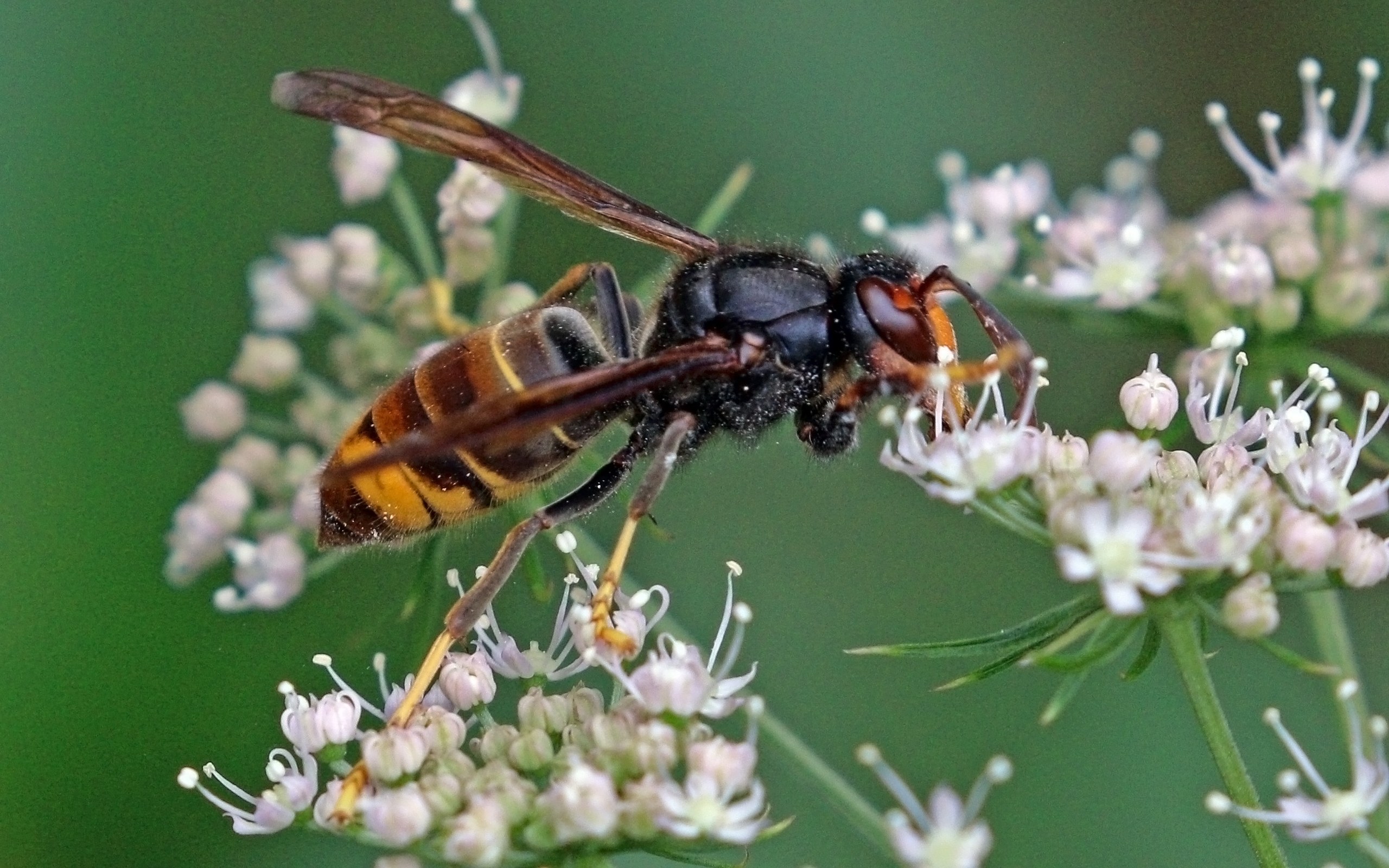
Hero photograph: Charles J. Sharp, "Asian hornet (Vespa velutina), Portugal" (a yellow-legged hornet feeding on flowers, 24 September 2016), Wikimedia Commons, CC BY-SA 4.0. Cropped for the Field Journal hero.

Questions people ask
When do yellow-legged hornet queens come out of hibernation?
In spring, and in mild areas as early as February. Queens may start laying eggs in February, but many found their nests later, because a queen's activity depends on temperature and on how well she can feed (NNSS). The UK's spring trapping ran from mid-April to early June, when queens stop flying out to forage because their first workers take over (APHA Science Blog).
How many hornets can one Asian hornet nest produce?
Up to about 13,000 in a season. A study of 77 French nests found that one colony can produce up to 13,000 individuals between April and December, with a peak of about 2,000 adults at once in October (MNHN; Rome et al. 2015). The National Bee Unit gives an average of about 6,000 per colony per season (National Bee Unit).
Does spring queen trapping stop Asian hornets?
Not well enough to rely on, according to UK officials. Defra decided against a government spring trapping programme for 2026, saying that finding and destroying nests is the most effective control, while spring trapping means searching a large area for a few queens (National Bee Unit). In 2024, more than 600 traps and over 14,000 trap checks caught 13 queens (APHA Science Blog).
How high do Asian hornets build their nests?
Often more than 10 metres up a tree. About 70% of nests reported in France were over 10 m high, and about 70% of the nests studied were secondary nests, built after the colony moved out of the queen's first nest (MNHN). They prefer tall trees and avoid conifers, but nests also turn up in garages, sheds and under decking (NNSS).
Sources
- APHA National Bee Unit: Yellow-legged hornet (life cycle)
- APHA National Bee Unit: Yellow-legged hornet 2026 rolling update
- APHA National Bee Unit: Yellow-legged hornet spring trapping (2026 decision)
- APHA Science Blog (2025): Yellow-legged hornet monitoring and eradication in the UK
- GB Non-native Species Secretariat (NNSS): Asian hornet, Vespa velutina, species information
- Muséum national d'Histoire naturelle (2015): Première description de la structure et de l'évolution des colonies du frelon asiatique
- Rome, Muller, Touret-Alby, Darrouzet, Perrard & Villemant (2015) Caste differentiation and seasonal changes in Vespa velutina (Hym.: Vespidae) colonies in its introduced range, Journal of Applied Entomology
- BBC News (4 November 2026): Sightings of Asian hornet nests in Guernsey double in a year
- SWR Aktuell (16 November 2026): Asiatische Hornisse: Riesen-Nest am Sportplatz Nieder-Olm