German Yellowjacket: Why Wasps Get Aggressive in Autumn
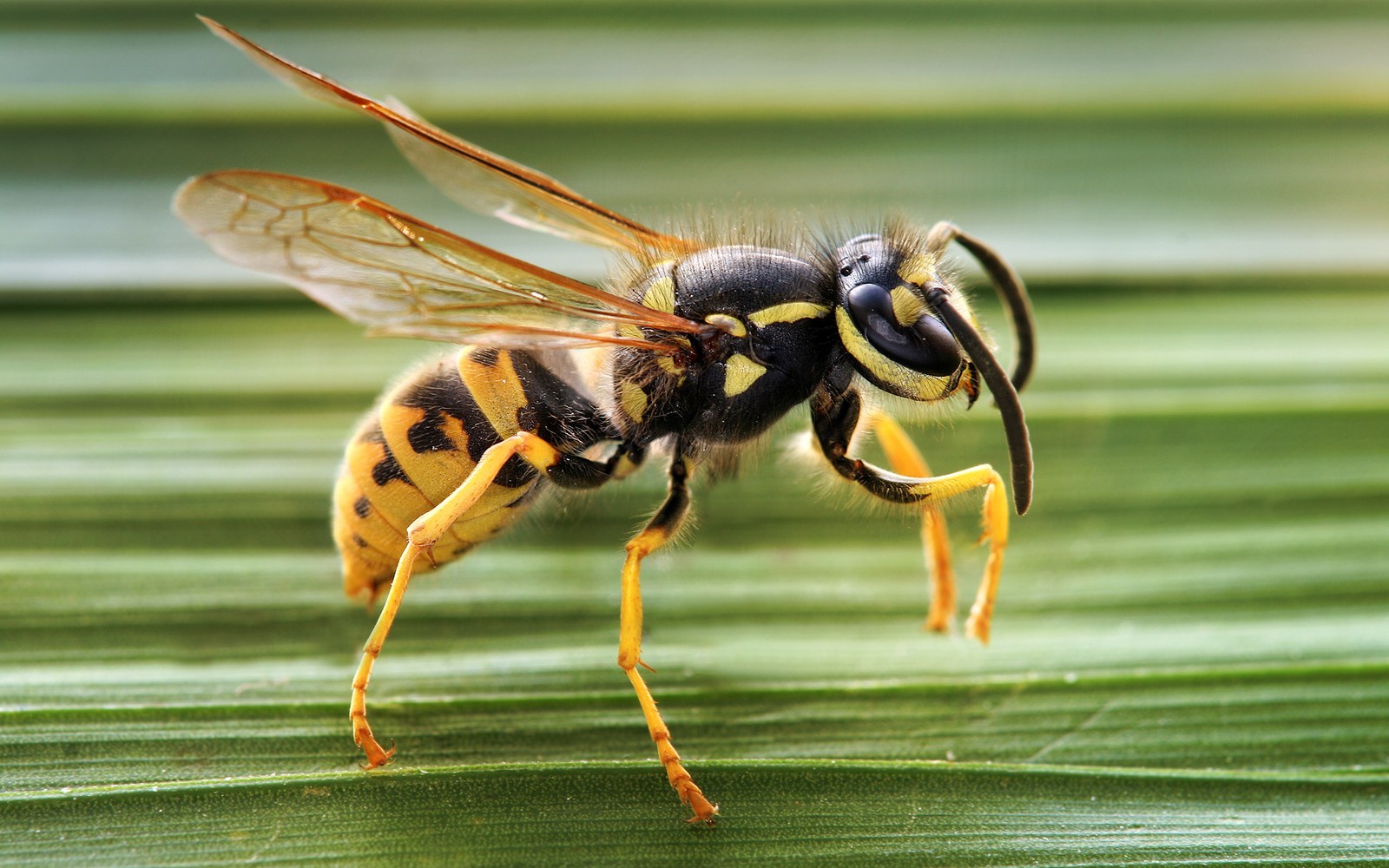
Species deep dive · german yellowjacket
Because autumn is when their colonies are biggest and hungriest. By late summer a yellowjacket nest has grown from one queen to thousands of workers. At the same time, the colony stops raising the larvae whose sugary spit the workers drink, and flowers and insect prey are running short. The result is a crowd of sugar-starved wasps that turns up at every picnic, soda can and fruit stall. Illinois Extension entomologist Phil Nixon calls it "a very large, very hungry population of wasps that are short-tempered and sting with little provocation" (Illinois Extension; Canadian Wildlife Federation).
Here's how a German yellowjacket colony builds to that autumn peak, why it suddenly wants your lemonade, and what happens to all those wasps when winter comes.
From one queen to thousands of wasps
Every colony starts with a single queen who survived the winter. In spring she builds a small paper nest of chewed wood fibre, makes 30–55 cells and raises the first brood herself. About 30 days later the first 5–7 workers emerge and take over the foraging and building, and the queen switches to full-time egg laying (Connecticut Agricultural Experiment Station).
From there the colony grows all summer. Yellowjacket nests peak at about 1,000–4,000 wasps, depending on the species (Connecticut Agricultural Experiment Station). In California, a German yellowjacket nest may hold more than 4,000 wasps by July or August and measure more than 60 cm (2 feet) across. That strain likes to nest in attics and wall cavities, which puts it close to people (UC Riverside Center for Invasive Species Research).
Why they suddenly want your soda
For most of the summer, yellowjackets are hunters. Workers catch flies, caterpillars and other insects, chew them up and feed them to the larvae. Adults don't eat the prey themselves. In return, the larvae give off a sugary liquid that the adults drink, a food swap called trophallaxis (Clemson Home & Garden Information Center; Xerces Society).
Late in the season that deal breaks down. The queen stops laying eggs, the last larvae grow up and leave their cells, and the workers lose their main sugar supply (Canadian Wildlife Federation; Xerces Society). The colony now puts its effort into raising new queens and males instead (Connecticut Agricultural Experiment Station). Meanwhile flowers are fading and insect prey is getting scarce (Illinois Extension; University of Kentucky Entomology).
So the foragers switch from protein to sugar, and the sweetest food around is often ours: soft drinks, juice, ice cream, fruit and picnic leftovers (UMass Amherst Extension; Clemson HGIC). UMass Amherst notes that conflicts with people peak around August and September, when colony numbers are highest (UMass Amherst Extension).
They aren't really angrier, just more numerous, hungrier and closer to us. Near the nest it's a different story. If a German yellowjacket nest is disturbed, guard wasps attack and release a scent that rallies their nestmates, which is why victims often get several stings (UC Riverside CISR).
Where do yellowjackets go in winter?
In cold climates, almost all of them die. The first hard frost kills the workers, and the old queen and the males die too (UMass Amherst Extension; Clemson HGIC). Only the newly mated queens survive. They spend the winter tucked under loose bark, in leaf litter, in firewood or inside buildings, and each one starts a brand-new colony the following spring. The old nest is never reused (Illinois Extension; Connecticut Agricultural Experiment Station).
That's why the wasps seem to vanish overnight after the first real cold snap, and why an empty paper nest in your shed in December is nothing to worry about.
The exception: giant nests in mild places
German yellowjackets are native to Europe, North Africa and temperate Asia, but people have carried them, often as hibernating queens, to North and South America, South Africa, Australia and New Zealand (Agriculture Victoria; de Villiers et al. 2017, PLOS One). They reached Tasmania in 1959 and became established in the northeastern United States in the 1970s (Agriculture Victoria; UC Riverside CISR).
Where winters are mild, the normal cycle can break. In areas with warmer winters and longer summers, queens and workers can survive the winter, and the colony keeps growing the next season (de Villiers et al. 2017). A few active German yellowjacket nests have been found all year round in California (UC Riverside CISR).
New Zealand shows what that means. The German wasp arrived there in the 1940s, and the country now has some of the highest densities of German and common wasps in the world, partly because the winters are mild. Colonies that survive the winter can become huge, and the world's largest recorded wasp nest, found at Waimauku near Auckland, was 3.75 m tall and 1.7 m wide (New Zealand Department of Conservation). In one study in Nelson, just two overwintered German wasp nests made up 4% of the active colonies but supplied 38% of the German wasp workers leaving nests in the area (Plunkett et al. 1989).
How to avoid autumn stings
Don't swat. Swatting can trigger a defensive sting. Blow on a yellowjacket or gently brush it away, or simply let it take a sip and leave, then cover or clear the food (Illinois Extension; UMass Amherst Extension). Pour drinks into cups so you can see what you're drinking, and keep bins tightly lidded (Illinois Extension; Xerces Society). If a nest is somewhere nobody goes, the simplest option is to leave it alone, because the colony will die off at the first hard frost (UMass Amherst Extension).
For a wasp that is famously relaxed by comparison, read are red paper wasps aggressive?. To see where a yellowjacket sting ranks for pain, check the Schmidt pain index top 10.
How the German yellowjacket plays in Wilder
The German Yellowjacket (Vespula germanica) is a Common Insecta card in the Air element. It costs 3 Energy, with Attack 2 and Health 2, and it has Swarm, a nod to a colony that can number in the thousands by autumn. Flavour text: "Aggressive, social, and it can sting again and again."
Wilder is a free browser collectible card game about real animals, and you can play it free in your browser with no signup.
Photo credit
Hero photograph: Richard Bartz, "Vespula germanica Horizontalview Richard Bartz", Wikimedia Commons, CC BY-SA 2.5. Cropped for the Field Journal hero.

Questions people ask
Can a yellowjacket sting you more than once?
Yes. A yellowjacket's stinger is smooth, so it doesn't stay in your skin and the wasp can sting several times. A honey bee's barbed stinger usually stays behind, so it stings only once (Clemson HGIC; Connecticut Agricultural Experiment Station).
Are yellowjackets good for anything?
Yes. For most of the season they are predators that feed caterpillars, flies, mosquitoes and other insects to their larvae, so they act as free pest control, and adults visiting flowers may do some pollination (Illinois Extension; Canadian Wildlife Federation).
Can male yellowjackets sting?
No. Only females, the queens and the sterile workers, can sting; males cannot. Males appear in late summer, when the colony starts raising new queens and males for mating flights (Connecticut Agricultural Experiment Station).
Is the German yellowjacket the same as the European wasp?
Yes. Vespula germanica is known as the European wasp in Australasia, South Africa and South America and as the German wasp elsewhere (de Villiers et al. 2017, PLOS One). In North America it is usually called the German yellowjacket (Connecticut Agricultural Experiment Station).
Sources
- Connecticut Agricultural Experiment Station: Yellowjackets (Vespidae) fact sheet
- UC Riverside Center for Invasive Species Research: German Yellowjacket
- Illinois Extension: Yellowjackets (Good Growing, 2018)
- UMass Amherst Extension: Yellowjackets fact sheet
- Clemson Home & Garden Information Center: Yellowjackets
- Canadian Wildlife Federation: Why are yellow jackets so annoying at the end of summer?
- Xerces Society: Wasp World
- University of Kentucky Entomology: Foraging Yellowjackets (EF634)
- Agriculture Victoria: European wasp
- de Villiers, Kriticos & Veldtman (2017) Including irrigation in niche modelling of the invasive wasp Vespula germanica. PLOS One
- New Zealand Department of Conservation: Wasps
- Plunkett et al. (1989) Overwintering colonies of German and common wasps in New Zealand. New Zealand Journal of Zoology 16:345–353