Red Paper Wasp: Are They Aggressive? Inside a Nest-Hopping Colony
Species deep dive · red paper wasp
Red paper wasps are not usually aggressive away from their nest, but they defend it quickly. In this tropical paper wasp, an attack is set off by what the guards see, with dark objects near the nest more likely to trigger one than moving objects, and the smell of venom works as an alarm signal that lowers the colony's threshold to attack and draws more defenders in (Jeanne 1982). Give the nest space and you will rarely be stung.
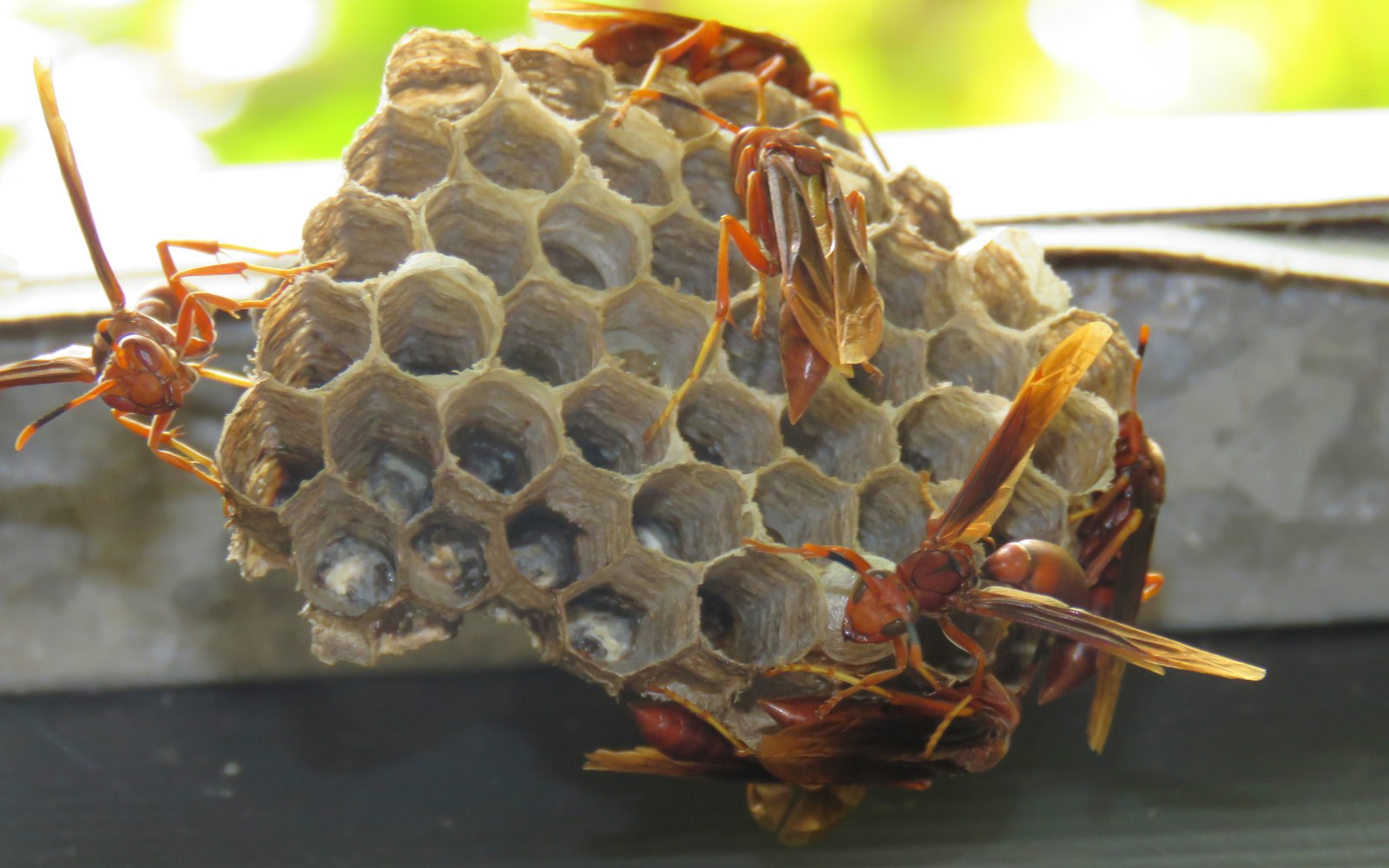
The Red Paper Wasp, Polistes canadensis, is a rust-red paper wasp of the American tropics and the most widely distributed American species of its genus (Wikipedia). Its open paper combs have no outer envelope, so the adults sit right on the cells. That makes the species easy to watch, and it has become one of the best-studied social wasps in the world. What scientists found inside its colonies is stranger than its sting.
How a red paper wasp nest defends itself
Robert Jeanne at the University of Wisconsin tested what makes P. canadensis attack. Attack was released visually, and dark-coloured objects worked better as triggers than moving ones. Once a wasp is alarmed, the odour of venom spreads the message: it causes an alarm response in nestmates, reduces the threshold for attack and acts as an attractant (Jeanne 1982). So one disturbed wasp can quickly become many.
Away from the nest it is a different animal. Extension entomologists at the University of Maryland note that social wasps do not seek people out to sting them. They catch prey with their jaws and save the sting for defending the nest, themselves or their food. Paper wasps in general are less defensive of a nest than hornets and yellowjackets and may bump into an intruder as a warning before stinging (University of Maryland Extension).
One queen who rules by reach
A red paper wasp colony has a single egg-laying queen. She dominates the other females physically, using lateral abdominal vibrations and stroking to keep nestmates in line, and she guards the empty cells and new eggs. Fights over the egg-laying area can escalate and sometimes turn fatal. Her control only works on wasps within her physical reach. Even the subordinate with the most developed ovaries usually waits for the queen's decline instead of challenging her (Wikipedia).
Workers that hop between nests
Classic kin-selection theory says a worker should stay home and help raise her own sisters. In 2005, a team led by Seirian Sumner glued tiny radio tags, each weighing under 1% of a wasp's body mass, onto 422 P. canadensis females from 27 nests in Panama and put antennas at the entrances of 33 nests (Sumner et al. 2007).
The result was surprising:
- Of the 157 wasps recorded at least twice, 88 (56%) visited more than one nest.
- Drifting showed up at 31 of the 33 monitored nests, and some pairs of nests shared up to 54.5% of their wasps.
- Even after correcting for drifters being easier to detect, the minimum drift rate was 39.5%, more than 30 times higher than any earlier record for a social insect in the wild.
The team ruled out lost wasps, social parasites and queen succession as explanations. Their interpretation is that related colonies nest close together, so a worker can gain indirect fitness by helping several relatives' nests, choosing the ones where her help is worth the most (Sumner et al. 2007).
Any worker can become the queen
In P. canadensis the queen looks exactly like her workers, and if she dies, one of the workers quickly takes her place. When researchers sequenced individual brains, they found that queens and workers differed in the expression of only 67 genes, about 0.4% of those measured. The difference lay in how gene networks were organised rather than in a set of special "queen genes" (Patalano et al. 2015). That flexibility suits a tropical wasp whose colonies have no fixed end to the year (Sumner et al. 2007).
On the Wilder card
In Wilder the Red Paper Wasp is an Uncommon Insecta card in the Forest element: Cost 2, Attack 2, Health 2, with Venom and Herd. Venom makes the combat damage it deals to another creature lethal, a nod to a sting Justin Schmidt compared to acid on a paper cut, and Herd fits a colony insect that defends its nest in numbers. Its flavour text reads: "Never in Canada, despite the name. Its sting: acid on a paper cut." To see how its sting ranks, read Most Painful Stings in the World, Ranked: The Schmidt Pain Index Top 10.
Wilder is a free browser collectible card game about real animals, and you can play it free in your browser with no signup.
Photo credit
Hero photograph: Célio Moura Neto, "Neotropical Red Paper Wasp (Polistes canadensis)" (6 December 2020), via iNaturalist and Wikimedia Commons, licensed CC BY 4.0. Cropped for the Field Journal hero.

Questions people ask
Can a red paper wasp sting more than once?
Yes. Like other social wasps, a red paper wasp can sting repeatedly, unlike a honey bee (University of Maryland Extension). Compare our Western Honey Bee card.
Is a red paper wasp sting dangerous?
For most people, no. A sting usually means pain and a small swollen lump that gets better in a few days. The real danger is a serious allergic reaction: the NHS says to call emergency services if your lips, mouth or throat swell or you struggle to breathe (NHS).
Should you swat a red paper wasp?
No. Wasps sting when they feel threatened, including when they are swatted or handled, and some release a scent that draws in nestmates. If a wasp comes near you away from its nest, calmly walk away or gently move it along with a piece of paper (University of Maryland Extension).
How long does a red paper wasp colony last?
There is no fixed end to the colony cycle in this tropical species (Sumner et al. 2007). A colony winds down as its queen ages and loses control: the nest is abandoned and the younger females with the most developed ovaries found new colonies (Wikipedia).
Sources
- Jeanne (1982): Evidence for an alarm substance in Polistes canadensis, Experientia 38
- Sumner et al. (2007): Radio-tagging technology reveals extreme nest-drifting behavior in a eusocial insect, Current Biology 17
- Patalano et al. (2015): Molecular signatures of plastic phenotypes in two eusocial insect species with simple societies, PNAS 112
- University of Maryland Extension: Social wasps: yellowjackets, hornets, and paper wasps
- NHS: Insect bites and stings
- Wikipedia: Polistes canadensis