Rock Dove: How Homing Pigeons Find Their Way Home
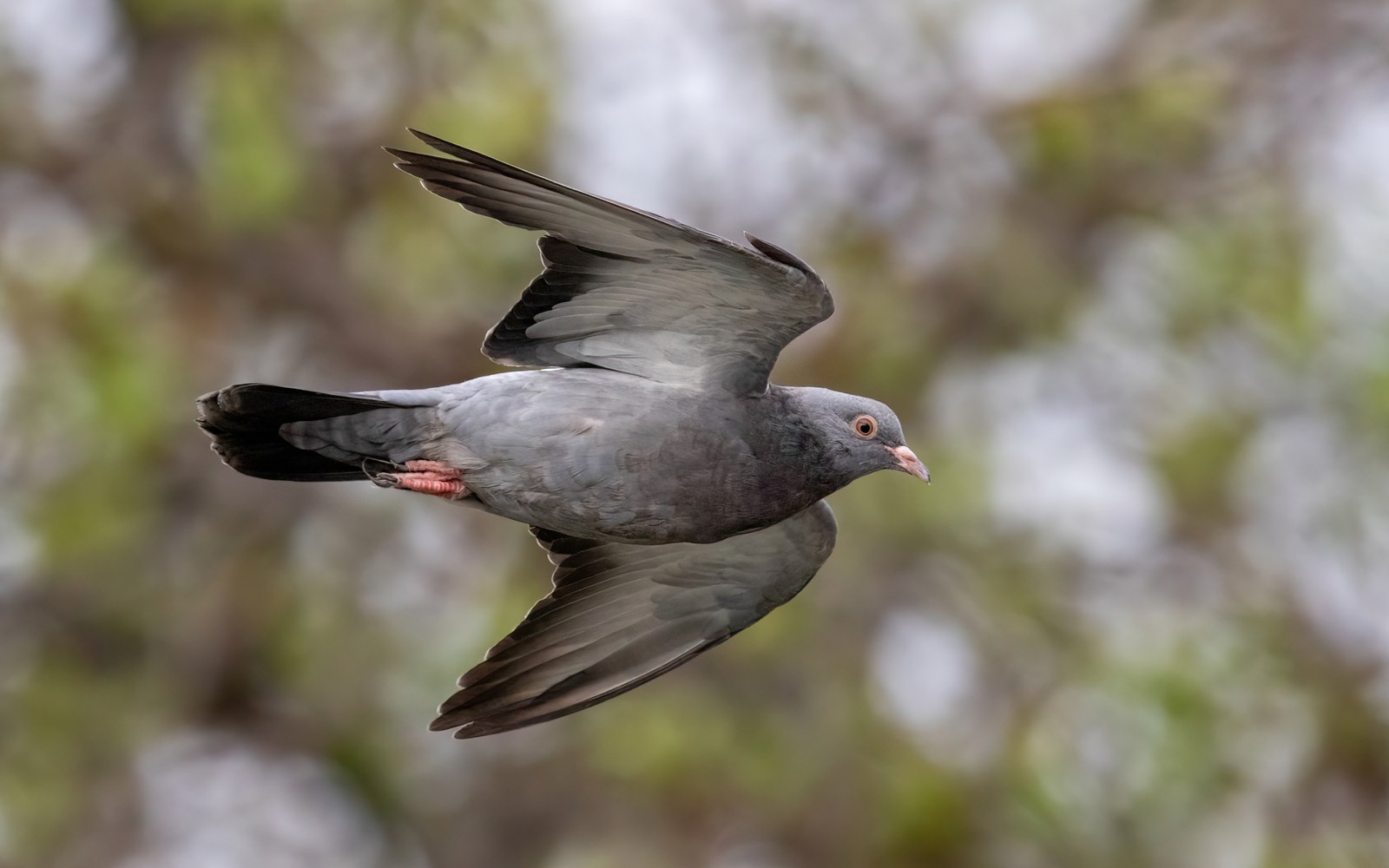
Species deep dive · rock dove
Homing pigeons find their way home with a toolkit, not a single sense. They use the sun as a compass, fall back on the Earth's magnetic field when the sky is overcast, build a "map" from smells carried on the wind, and over repeated flights learn landmarks and favourite routes, sometimes following roads (Guilford & Taylor 2014; Keeton 1971; Gagliardo 2013; Lipp et al. 2004). Scientists still argue about parts of the map, which is what makes the question so interesting.
Homing pigeons are domesticated rock doves, Columba livia, the same species as the pigeons on city squares and the wild doves on sea cliffs. Our earlier piece on why city pigeons are really rock doves covers that family history. This one is about the skill people bred them for.
A map and a compass
Navigating home from somewhere new takes two things. A compass tells a bird which way is which. A map tells it where it is compared with home, so it knows which direction to choose. Researchers have long described pigeon homing in exactly these terms (Mora et al. 2004). The compass is fairly well understood. The map is where the debate is.
The sun compass
On sunny days pigeons steer by the sun. Because the sun moves across the sky, a bird has to read its position against an internal clock, compensating for the time of day. The classic test is the clock-shift experiment: keep pigeons under lights shifted by several hours, then release them, and they fly off in a predictably wrong direction, because their clock now misreads the sun (Guilford & Taylor 2014).
A magnetic backup
In 1971 William Keeton glued small magnets to pigeons' backs. Experienced birds released 27 to 50 km from home under clear skies homed normally. Under total overcast, when the sun compass was unavailable, the magnet-carrying birds were often disoriented. The conclusion was that pigeons can use the Earth's magnetic field as a backup compass when they can't see the sun (Keeton 1971).
Later lab work showed pigeons can learn to detect a magnetic anomaly. That ability disappeared when a magnet was attached to the cere above the beak, when the upper beak was anaesthetised, or when the trigeminal nerve branch serving the beak was cut, but not when the olfactory nerve was cut (Mora et al. 2004). Exactly which cells do the sensing is still unsolved.
A map made of smells
The strongest evidence for the map points somewhere unexpected: the nose. Some 40 years ago, Floriano Papi and colleagues found that pigeons without a sense of smell couldn't home from unfamiliar places. The leading explanation is that, at the loft, young pigeons learn which odours arrive on which winds. Released far away, a bird smells the local air, compares it with what it learned, and works out roughly which direction home lies. Measurements suggest airborne volatile compounds form gradients stable enough to make that possible (Gagliardo 2013).
A map made of sound?
A more controversial idea is that pigeons hear their way home. Geophysicist Jonathan Hagstrum has proposed that infrasound, sound far too low for human ears, coming from the area around a loft acts as a map cue. He argues this could explain why Cornell's pigeons regularly vanished in random directions when released at one site, Jersey Hill in New York, which he modelled as sitting in an "acoustic shadow" (Hagstrum 2013). It is a hypothesis, not settled science.
Roads, routes and landmarks
Close to home, pigeons switch to what they know. GPS tracking of 216 flights around Rome found pigeons attracted to highways and a railway heading in the home direction. Some followed a highway to a major junction even though it meant a detour. This road-following grew with repeated releases, so it is learned (Lipp et al. 2004). In Oxford, pigeons released again and again from the same sites developed their own favourite route home. Each bird's route was stereotyped but often not the most direct one, and birds released away from their route went straight back to it, a sign they were recognising landmarks (Biro et al. 2004).
Flocks that learn
Pigeons also navigate socially. GPS tracking of flocks of up to 10 birds revealed a leadership hierarchy, with some birds consistently more influential than others (Nagy et al. 2010). When researchers swapped out one flock member at a time over several "generations", routes kept improving, and later generations beat both solo birds and fixed groups. That is an example of cumulative knowledge passed on between birds (Sasaki & Biro 2017).
On the Wilder card
In Wilder the Rock Dove is a Common Aves card in the Air element. It costs 1 Energy, with Attack 1 and Health 2, and has Resilient and Flock. It's a cheap, hardy bird built for life in a group, fitting for a species whose flocks literally get better at finding home together. Its flavour text reads: "Cliff colonist turned urban survivor." For a very different flier, read how the peregrine falcon, a famous pigeon hunter, came back from DDT.
Wilder is a free browser collectible card game about real animals, and you can play it free in your browser with no signup.
Photo credit
Hero photograph: Alexis Lours, "Feral pigeon in flight" (feral pigeon Columba livia in flight in Paris, 6 April 2022), via Wikimedia Commons, licensed CC BY 4.0. Cropped for the Field Journal hero.

Questions people ask
How far can a homing pigeon fly to get home?
Hundreds of miles. In July 1942 a British pigeon named Mercury flew 480 miles from northern Denmark on a special wartime mission, and a bird called Princess returned about 500 miles, mostly over sea, from Crete to her loft in Alexandria. Both received the PDSA Dickin Medal (PDSA).
Were homing pigeons really used in war?
Yes. In World War I the US Army had a Pigeon Service, and the pigeon Cher Ami became famous for a 1918 message from the surrounded "Lost Battalion", though military records can't confirm which bird carried the key message (Smithsonian). In Britain, 32 pigeons have received the PDSA Dickin Medal for wartime service (PDSA).
Do pigeons have magnets in their beaks?
Probably not. Iron-rich cells in the pigeon's upper beak were once thought to be magnetic sensors, but a 2012 study found they are macrophages, a type of immune cell, not nerve cells (Treiber et al. 2012). Pigeons do respond to magnetic fields, but how they sense them is still an open question.
Are pigeons born knowing the way home?
Not entirely. Young birds lean heavily on built-in compass senses: magnets disturbed first-flight pigeons even in sunshine, while experienced birds were mainly affected under overcast skies (Keeton 1971). With repeated releases, pigeons learn landmarks, settle on favourite routes and follow roads more often (Biro et al. 2004; Lipp et al. 2004).
Why do pigeons bob their heads when they walk?
To keep their view steady. High-speed film shows the head stays "locked" in place while the body walks forward, then darts ahead to a new spot. On a treadmill, where the scenery doesn't move, the bobbing stops, which suggests it is mainly a visual response (Frost 1978).
Sources
- Guilford & Taylor (2014): The sun compass revisited, Animal Behaviour 97
- Keeton (1971): Magnets interfere with pigeon homing, PNAS 68
- Mora, Davison, Wild & Walker (2004): Magnetoreception and its trigeminal mediation in the homing pigeon, Nature 432
- Treiber et al. (2012): Clusters of iron-rich cells in the upper beak of pigeons are macrophages not magnetosensitive neurons, Nature 484
- Gagliardo (2013): Forty years of olfactory navigation in birds, Journal of Experimental Biology 216
- Hagstrum (2013): Atmospheric propagation modeling indicates homing pigeons use loft-specific infrasonic 'map' cues, Journal of Experimental Biology 216
- Lipp et al. (2004): Pigeon homing along highways and exits, Current Biology 14
- Biro, Meade & Guilford (2004): Familiar route loyalty implies visual pilotage in the homing pigeon, PNAS 101
- Nagy, Ákos, Biro & Vicsek (2010): Hierarchical group dynamics in pigeon flocks, Nature 464
- Sasaki & Biro (2017): Cumulative culture can emerge from collective intelligence in animal groups, Nature Communications 8
- Frost (1978): The optokinetic basis of head-bobbing in the pigeon, Journal of Experimental Biology 74
- Smithsonian National Museum of American History: Cher Ami fact sheet
- PDSA: The PDSA Dickin Medal