Peacock Spider: How a 5 mm Spider Makes Rainbows and Super Black
Species deep dive · peacock spider
Peacock spiders make their colours in two different ways. Reds, creams and whites come from pigment in their scales, while blues and full rainbows come from microscopic structures that bend light (Stavenga et al. 2016; Hsiung et al. 2017). Around those colours, some species add a velvety super black that reflects less than 0.5% of light, which makes the colours next to it look even brighter (McCoy et al. 2019).
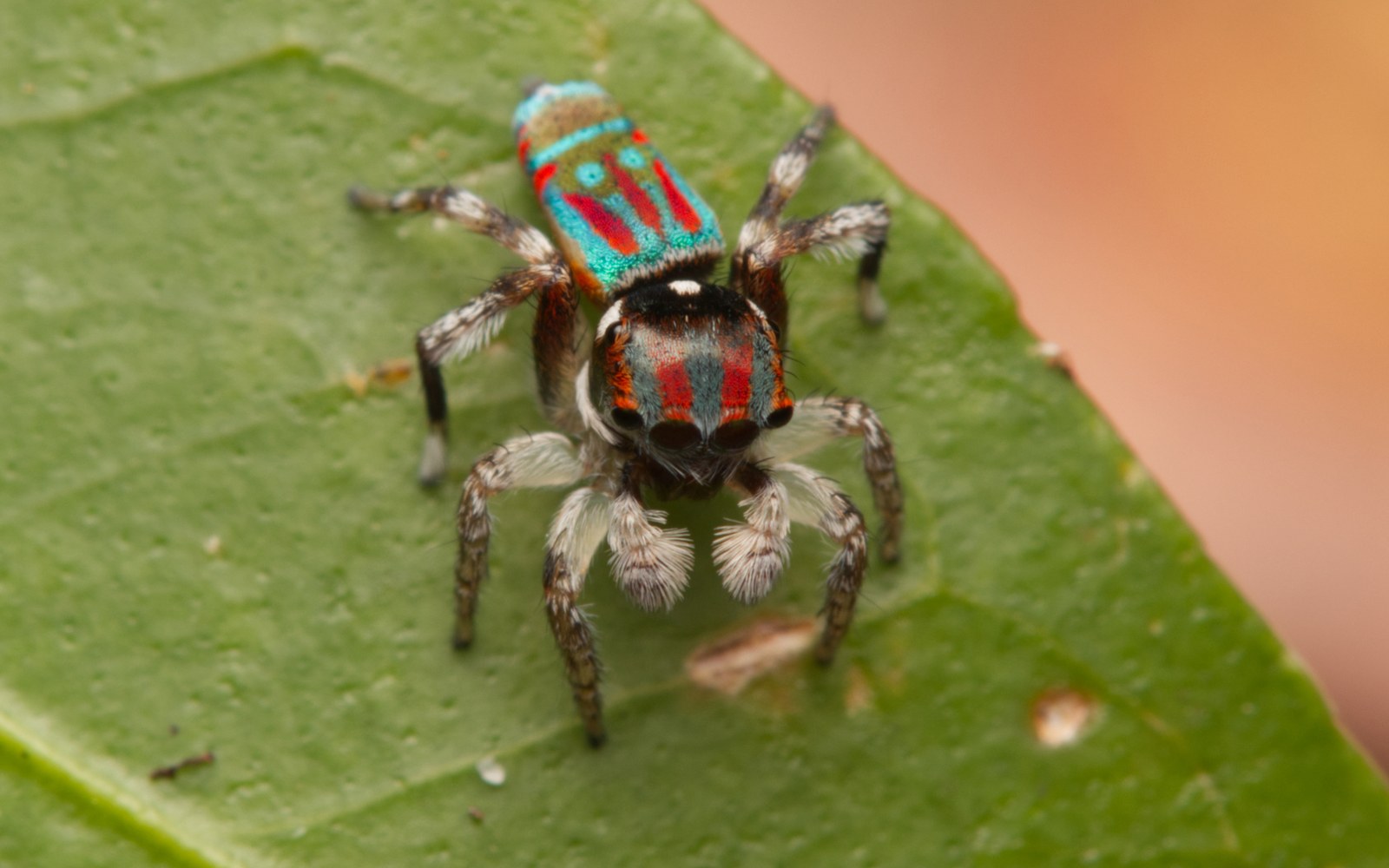
The peacock spider on our card, Maratus volans, is a jumping spider only about 5 mm long. Peacock spiders as a group live only in Australia, and more than 110 species have now been described (Australian Geographic). It is the males that carry the colour, on an abdomen they raise and wave at females during courtship. Scientists have now taken those abdomens apart scale by scale.
Red is pigment, blue is architecture
In the splendid peacock spider (Maratus splendens), the body is covered in scales. The white, cream and red scales have an elaborate shape with many spines, and their colour is pigment. The blue scales have no pigment at all. Their colour is structural: each blue scale is built from two layers of chitin with ridges, separated by an air gap, with an array of tiny filaments on the inner sides. Optical modelling showed that the filament array was a previously unknown way of making structural colour, and that it fine-tunes the scale to the blue we see (Stavenga et al. 2016).
The spiders that wear a rainbow
Two even smaller species, Maratus robinsoni and M. chrysomelas, go further. M. robinsoni is only about 2.5 mm long. Its iridescent abdominal scales are about 40 by 10 micrometres, and with the slightest movement they shift from red to green to violet (Hsiung et al. 2017).
Electron microscopy showed why. Each scale is curved like an aircraft wing and covered in fine parallel ridges that work as a diffraction grating, the same physics that splits light on the back of a CD. Because the grating sits on a curved surface, it separates colours with at least twice the resolving power of a flat grating of the same spacing. The researchers called it the first true rainbow-iridescent signal known in animals, and they built nano-3D-printed prototypes to test the design, hoping it could inspire smaller spectrometers (Hsiung et al. 2017).
Super black: the frame that makes colours glow
Next to the colour, many peacock spiders have patches of deep, velvety black. In Maratus speciosus and M. karrie, these super black patches reflect only 0.44% and 0.35% of light. The trick is shape, not just pigment: the cuticle is covered in tall, tightly packed bumps that act like tiny lenses, and M. karrie adds a dense layer of brush-like black scales on top. Together they cut surface glare and send light deeper into light-absorbing melanin (McCoy et al. 2019).
Super black removes the white highlights that eyes use to judge colour, so colours beside it look brighter, even glowing. Birds of paradise evolved super black next to their bright patches too, a striking case of two unrelated groups landing on the same display trick (McCoy et al. 2019). The ordinary black scales of rainbow species contain eumelanin, and a dense layer of melanin under the cuticle likely boosts the contrast further (Hsiung et al. 2017).
Who the show is for
Bright colour is rare on spiders, because most spiders lack the visual sensitivity to see much colour (University of Cincinnati). Peacock spiders are different. Microspectrophotometry by Nathan Morehouse's lab found that Maratus has photoreceptors sensitive to ultraviolet, blue, green and red, a set of four that is most similar to birds. North American Habronattus jumping spiders see red too, but they do it with a red filter in the retina, while peacock spiders evolved a red-sensitive cell with no filter needed (University of Cincinnati).
So the colours are a message, and the female is the judge. Males court from just a few centimetres away (Hsiung et al. 2017). In mating trials with M. volans, a male's success depended on a combination of his visual display and the vibrations he drums into the ground, evidence of strong sexual selection by females (Girard et al. 2015). The Peacock Spider card FAQ covers the dance itself, and what happens when it fails.
On the Wilder card
In Wilder the Peacock Spider is a Rare Arachnida card in the Forest element. It costs just 1 Energy, with Attack 1 and Health 2, and has Ambush. Its ability, Fan Dance, costs 2 Energy and pacifies an enemy, a nod to a display so dazzling it stops the audience in its tracks. Its flavour text reads: "Twenty minutes of dancing, and she still might eat him." For another animal that plays tricks with light, read Glasswing Butterfly: Why Are Its Wings Transparent?
Wilder is a free browser collectible card game about real animals, and you can play it free in your browser with no signup.
Photo credit
Hero photograph: Nigel Main, "Flying Peacock Spider (Maratus volans)" (23 August 2021), via iNaturalist and Wikimedia Commons, licensed CC BY 4.0. Cropped for the Field Journal hero.

Questions people ask
Are female peacock spiders colourful too?
No, not like the males. Females typically have a mottled brown or grey body that camouflages them from predators, while males have brilliantly coloured abdomens and long third legs, often with white tips, for courtship (Australian Geographic).
How many eyes does a peacock spider have?
Eight. The two big principal eyes on the front of the head sit at the end of long tubes and give sharp, full-colour binocular vision, while the six secondary eyes on the sides give the spider more or less 360-degree vision (University of Cincinnati).
How long do peacock spiders live?
Up to about a year. They hatch from eggs in summer and moult several times before becoming adults. After mating, the female lays her eggs in a silk cocoon and guards it until the spiderlings emerge some 4 to 5 weeks later (Australian Geographic).
How far can a peacock spider jump?
Far for its size. A male splendid peacock spider (Maratus splendens) can jump 15 times its own body length. Despite weighing as little as 2 mg, peacock spiders are skilled hunters of small insects and other tiny invertebrates (Australian Geographic).
Are any peacock spiders endangered?
At least one is. Sarah's peacock spider (Maratus sarahae), known only from Western Australia's Stirling Range, was declared critically endangered in 2018. Many species are so newly described that their status is still unknown, and small ranges leave them exposed to habitat loss, climate change and altered fire regimes (Australian Geographic).
Sources
- Stavenga, Otto & Wilts (2016): Splendid coloration of the peacock spider Maratus splendens, Journal of the Royal Society Interface 13
- Hsiung et al. (2017): Rainbow peacock spiders inspire miniature super-iridescent optics, Nature Communications 8
- McCoy et al. (2019): Structurally assisted super black in colourful peacock spiders, Proceedings of the Royal Society B 286
- University of Cincinnati Magazine: Tiny dancers (Morehouse lab on peacock spider colour vision)
- Girard, Elias & Kasumovic (2015): Female preference for multi-modal courtship in peacock spiders, Proceedings of the Royal Society B 282
- Australian Geographic: Peacock spider fact file