Glass Frog: How See-Through Frogs Hide Their Blood
Species deep dive · dianes bare hearted glass frog
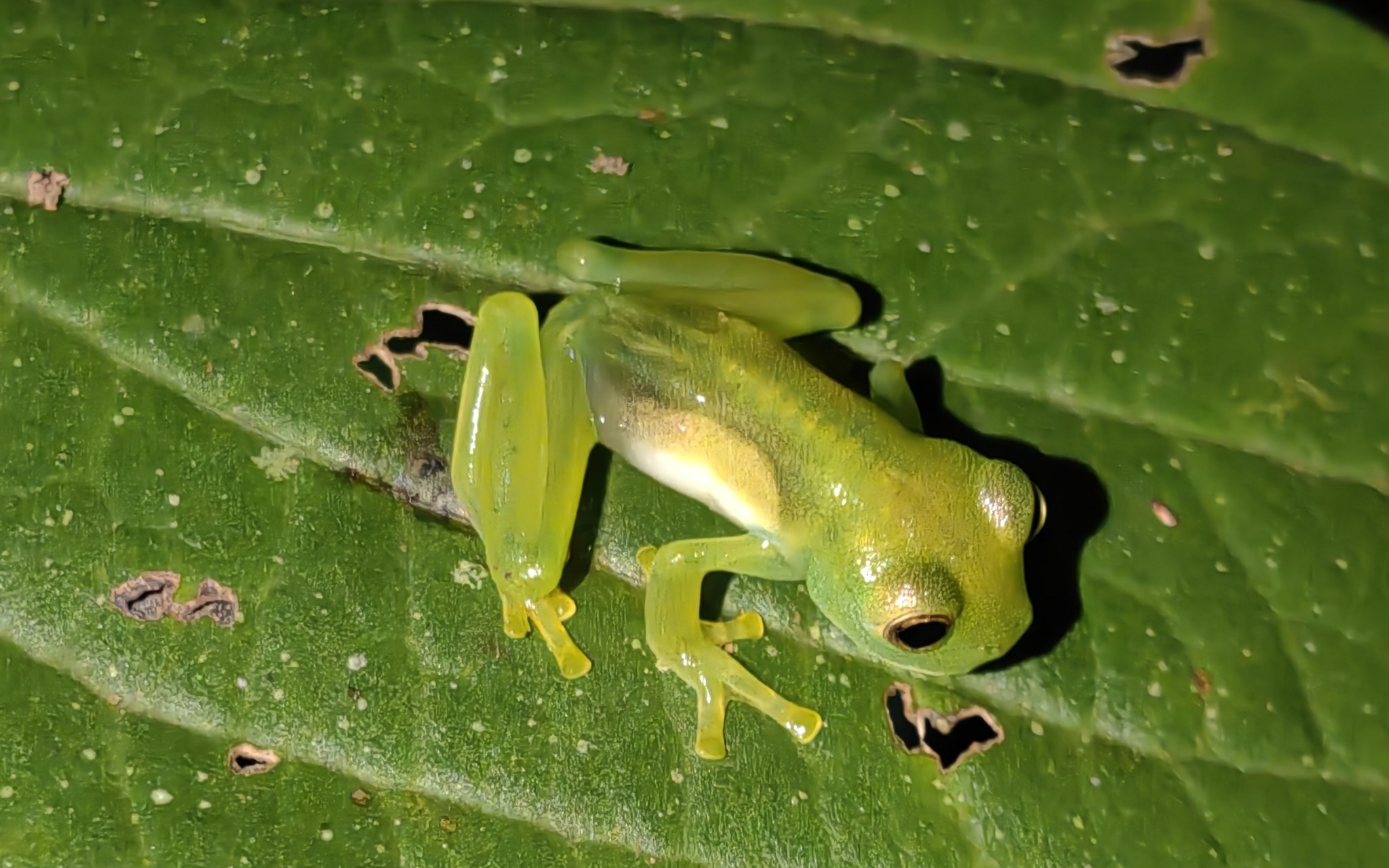
Glass frogs hide their blood in their liver. When a Fleischmann's glass frog sleeps on a leaf, it pulls about 89% of its red blood cells out of circulation and packs them into its liver, which makes the frog two to three times more transparent. When it wakes up and moves, the blood floods back out (Taboada et al. 2022).
Glass frogs are famous for their see-through bellies, through which you can watch the bones, gut and beating heart (Barnett et al. 2020). The Diane's Bare-hearted Glass Frog (Hyalinobatrachium dianae) from Costa Rica even has it in its name. But being see-through is hard for an animal with red blood, and it took until 2022 for scientists to work out the trick.
Why blood is a problem
Many animals use transparency as camouflage, especially animals that sit still. It is particularly hard for vertebrates, though, because red blood cells strongly absorb and scatter light (Taboada et al. 2022). A frog with clear skin and clear muscles would still give itself away with a red network of blood vessels.
The blood vanishes while the frog sleeps
The team behind the 2022 Science study worked with Fleischmann's glass frog (Hyalinobatrachium fleischmanni), a member of the same genus as Diane's frog that sleeps through the day. They photographed 11 frogs while asleep, awake, calling to mates, after exercise and under anaesthesia. Sleeping frogs let through 34 to 61% more light than in any other state (Taboada et al. 2022).
Looking closer, the reason was clear. Sleeping frogs circulated plasma with very few red cells in it, and the red cell count jumped as soon as they woke. Within seconds of exercise, the amount of light passing through a frog dropped two- to threefold (Taboada et al. 2022).
Where the blood goes
Using photoacoustic imaging, which uses light and sound to track blood cells inside a living animal, the researchers followed the cells to the liver. In 12 frogs, red cells sat packed in the liver while the frogs rested, flowed out into the blood vessels during exercise, and gathered in the liver again after recovery. The red-cell signal in the liver fell by an average of 83% after exercise, then returned (Taboada et al. 2022).
The liver is also one of the few organs in these frogs you can't see through. In Hyalinobatrachium glass frogs, the bulbous liver and the digestive tract are covered in white iridophores, light-reflecting pigment cells (Kubicki et al. 2015). Remarkably, the frogs can pack their blood this tightly without it clotting. The authors say that could offer insight for blood-clot research (Taboada et al. 2022).
See-through, but not quite invisible
Glass frogs are not as clear as glass. Their backs carry sparse pigment, so scientists describe them as translucent rather than transparent. A 2020 study found that the frogs' brightness shifts with whatever leaf they sit on, which made them harder to spot and helped them survive better than opaque frogs. The effect was strongest in the legs, which ring the body at rest and blur its outline into the leaf instead of leaving a sharp edge. The researchers called this camouflage strategy "edge diffusion" (Barnett et al. 2020).
Meet Diane's bare-hearted glass frog
Hyalinobatrachium dianae was described in 2015 from the Caribbean foothills of Costa Rica. In life it is uniformly lime green on top. Underneath, its skin and the membranes around its belly and heart are transparent, and the heart and main belly vein show blood red (Kubicki et al. 2015). Its look quickly earned it a nickname: news reports called it a real-life Kermit the Frog (National Geographic).
It went unnoticed for so long partly because it sounds wrong. Its call is a single long, metallic whistle lasting about half a second, more like an insect than other Costa Rican glass frogs. On top of that, males call unpredictably: one night a site is full of calls, the next it is silent (Kubicki et al. 2015).
Dads on egg duty
Females lay their eggs in a single layer on the underside of a leaf. Males have been seen at night calling next to these egg masses, 0.5 to 5 m above the ground. Unusually for glass frogs, which normally breed over streams, Diane's frogs have been seen attending eggs over dry forest floor. The describers suggest heavy rain could turn these low, sloping spots into runoff channels that carry the hatching tadpoles to a nearby stream (Kubicki et al. 2015).
Across the glass frog family, field observations of 40 species found that egg care is widespread. Care given only by the father evolved two to three times from care given only by the mother, and it came with much more care overall (Delia et al. 2017).
On the Wilder card
In Wilder, Diane's Bare-hearted Glass Frog is a Common Amphibia card in the Forest element. It costs 1 Energy, with Attack 1 and Health 2, and has Camouflage and Guardian. Camouflage suits a frog that fades into its leaf, and Guardian suits a father that stays with the eggs. Its flavour text reads: "Leaf-side sentry with a see-through secret." For another frog with a colour trick, read Lemur Leaf Frog: Turns Brown at Night.
Wilder is a free browser collectible card game about real animals, and you can play it free in your browser with no signup.
Photo credit
Hero photograph: Michelle Monge-Velazquez, Fleischmann's glass frog (Hyalinobatrachium fleischmanni), Concepción, Costa Rica, 13 July 2024, iNaturalist observation 239631231, licensed CC BY 4.0. Cropped for the Field Journal hero.
Questions people ask
Where does Diane's bare-hearted glass frog live?
Only in Costa Rica, as far as we know. It is known from three sites in the Caribbean foothills, between Santa Clara in Heredia Province and the headwaters of the Río Victoria in Limón Province, at 400 to 900 m in wet and premontane rainforest. It may also reach northwestern Panama (Kubicki et al. 2015).
How big is Diane's bare-hearted glass frog?
Tiny. Adult males measured 28.5 to 29.4 mm from snout to vent, and the one adult female measured 28 mm (Kubicki et al. 2015). National Geographic described it as about an inch (2.5 cm) long (National Geographic).
Who is Diane's glass frog named after?
The lead describer's mother. The name dianae honours Janet Diane Kubicki, who encouraged Brian Kubicki's lifelong interest in natural history. It also nods to Diana, the Roman goddess of the hunt and of woodlands (Kubicki et al. 2015).
Is Diane's bare-hearted glass frog endangered?
No. The IUCN lists it as Least Concern (IUCN Red List). Most of its known range lies in large, intact rainforests with few roads, though the describers note that disease and climate change are unknown risks (Kubicki et al. 2015).
Do female glass frogs look after their eggs?
Often, briefly. Glass frog care was long thought to be mostly a male job, but fieldwork on 40 species found that a short period of maternal care is widespread, even in species thought to have none. Experiments in two species confirmed that it benefits the eggs (Delia et al. 2017).
Sources
- Taboada et al. (2022): Glassfrogs conceal blood in their liver to maintain transparency, Science 378(6626)
- Barnett et al. (2020): Imperfect transparency and camouflage in glass frogs, PNAS 117(23)
- Kubicki, Salazar & Puschendorf (2015): A new species of glassfrog, genus Hyalinobatrachium (Anura: Centrolenidae), from the Caribbean foothills of Costa Rica, Zootaxa 3920(1)
- Delia et al. (2017): Patterns of parental care in Neotropical glassfrogs: fieldwork alters hypotheses of sex-role evolution, Journal of Evolutionary Biology 30(5)
- National Geographic (2015): New Species of See-Through Frog Found, Looks Like Kermit
- IUCN Red List: Hyalinobatrachium dianae (2020 assessment)