Lemur Leaf Frog: The Frog That Turns Brown at Night
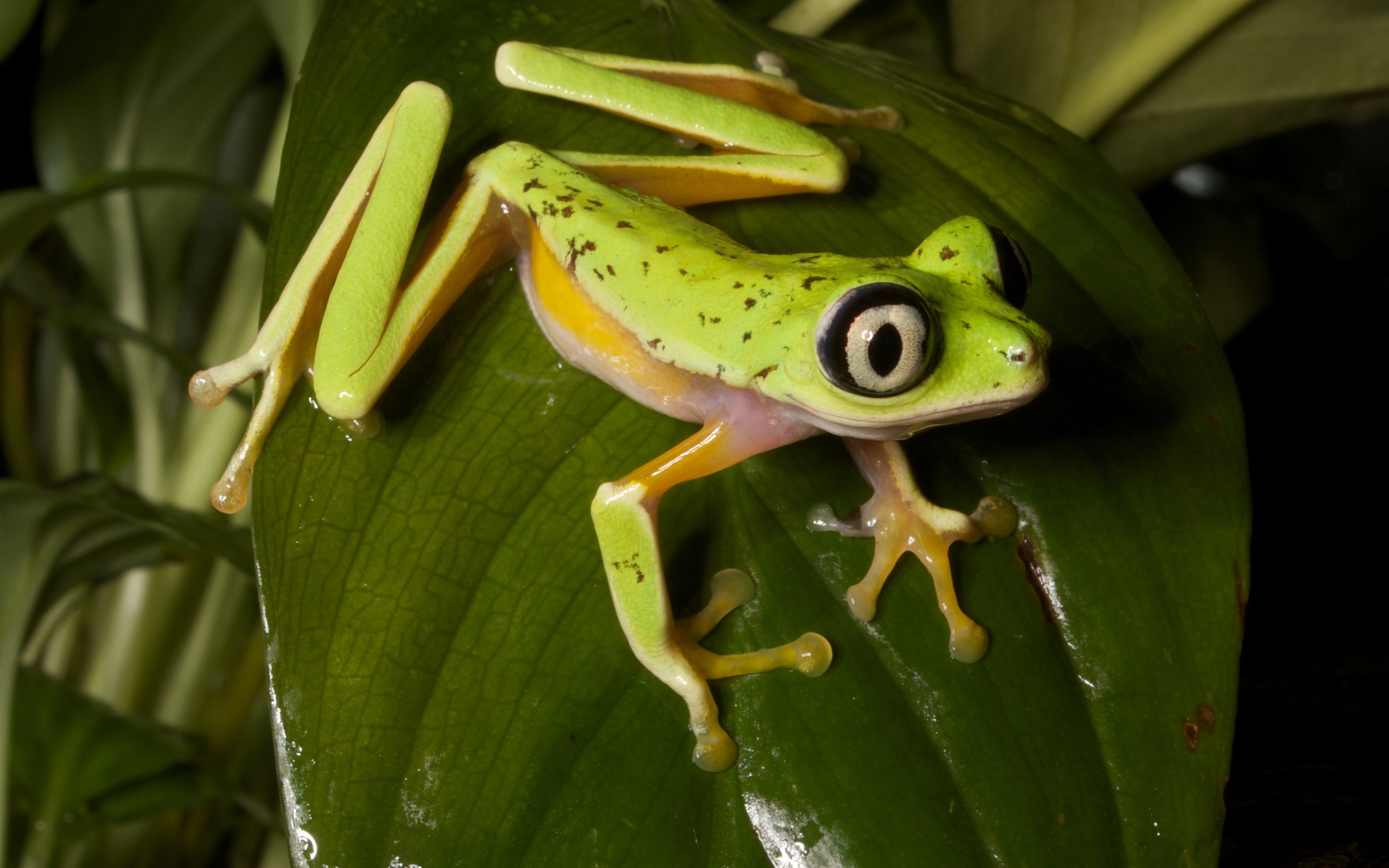
Species deep dive · lemur leaf frog
Yes, the lemur leaf frog changes colour every day. By day it sleeps on a leaf as a bright yellow-green frog with pale silvery eyes. At night, when it wakes up to hunt and call, its skin turns brown and its eyes go dark grey (Smithsonian's National Zoo). Manchester Museum, which runs a breeding programme for the species, describes the night look as "chocolate brown eyes and skin" (University of Manchester). It is also in serious trouble: the species is listed as Critically Endangered after its numbers fell by more than 80% in ten years (IUCN Red List).
Green by day, brown by night
The day colours are camouflage. A sleeping frog folded up on a leaf in yellow-green blends into the foliage, which is exactly when a small frog most needs to be overlooked (Smithsonian's National Zoo). The brown night colour goes with being awake and moving through the branches in the dark. Even the tadpoles switch colour between day and night, although they lack the yellow and orange flanks of the adults (Smithsonian's National Zoo).
Where does a tree frog's leaf-green come from in the first place? A study published in Science Advances in September 2026 found that several unrelated tree-dwelling frogs, including glass frogs, make their green from biliverdin, a bile pigment that animals normally break down or get rid of quickly. These frogs evolved special serpin proteins that grip the pigment and tune it to a leaf-like green (Vignesh et al. 2026, Science Advances). The lemur leaf frog wasn't the focus of that work, so whether its daytime green works the same way is still an open question.
A frog that walks instead of jumps
Leaf frogs move in a way that surprises people who expect frogs to hop. The lemur leaf frog has thin arms and legs and no webbing between its fingers and toes. It moves slowly, walking hand over hand along stems, and rarely jumps unless it is escaping danger (Smithsonian's National Zoo). Manchester Museum adds that it never leaves the trees (University of Manchester).
At night the males get territorial. Each one calls with a short "tick" about 0.2 seconds long, with roughly 40 pulses per second, to tell other males where he is. A resident male that meets an intruder will grab it and try to push it off the perch (Smithsonian's National Zoo).
Eggs on leaves, tadpoles dropped by rain
Lemur leaf frogs breed in the rainy season, from April to July. Males call from plants near or hanging over pools and slow streams. Females lay clutches of 15 to 20 eggs, sometimes two or three clutches in a night, on leaves that hang over the water. The humid air keeps the eggs moist. After 7 to 14 days, rain triggers the larvae to wriggle out and drop into the water below. Metamorphosis comes 69 to 98 days after hatching (Smithsonian's National Zoo).
Why it became Critically Endangered
The species lives in Costa Rica, Panama and a small part of Colombia, in humid lowland and mountain forest on sloping ground. It is not found in degraded habitat (IUCN Red List). The IUCN listed it as Critically Endangered in its 2008 assessment, which is flagged as needing an update. The decline was inferred from the disappearance of most of the Costa Rican population and part of the western Panamanian one, probably mostly because of chytridiomycosis, the amphibian chytrid fungus disease. At El Copé in Panama it declined from 2004 but hung on in small numbers. The assessment points to research suggesting that the lemur leaf frog is one of the more resistant species to chytrid infection, which may be why it survived there. Deforestation remains a threat too, especially in Costa Rica (IUCN Red List). The Smithsonian's National Zoo says it now occupies only about half of its historic range (Smithsonian's National Zoo).
Plastic tubs in the rainforest
One of the most hopeful parts of the story involves very low-tech gear. In 2003 the Costa Rican Amphibian Research Center dug small ponds 1 to 2 metres across and set out plastic tubs of 20 to 40 gallons in the Guayacán Rainforest Reserve. It stocked some of them with 25 to 50 lemur leaf frog tadpoles as breeding founders. A year later, breeding adults were seen regularly around the new sites. In 2005 the team added 55-gallon barrels in another part of the reserve. The center reports that a robust population has re-established itself and spread into neighbouring forest where the species hadn't been seen in earlier surveys (Costa Rican Amphibian Research Center).
In Europe, Manchester Museum keeps and breeds lemur leaf frogs in its Vivarium. In 2016 the University of Manchester launched an education campaign about the frog for primary schools in the UK, in Sweden and in the Guayacán region of Costa Rica, where the frog still survives (University of Manchester). If you were hoping to see them in Manchester soon, note that the Vivarium closes to the public from 2 November 2026 until May 2027 for redevelopment (Manchester Museum).
How the Lemur Leaf Frog plays in Wilder
In Wilder the Lemur Leaf Frog (Agalychnis lemur) is a Common Amphibia card in the Forest element. It costs 2 Energy, with Attack 1 and Health 3, and has Camouflage and Resilient. Camouflage suits a frog that spends the day disguised as part of a leaf. Resilient fits a species that has survived chytrid outbreaks that wiped out many of its neighbours. Its flavour text reads: "Hides among the leaves until the perfect leap." Other frogs in the game include Diane's Bare-hearted Glass Frog, the Hairy Frog and the Tomato Frog, which has its own Field Journal piece.
Wilder is a free browser collectible card game about real animals, and you can play it free in your browser with no signup.
Photo credit
Hero photograph: Brian Gratwicke, "Hylomantis lemur - Lemur leaf frog" (a lemur leaf frog in its green daytime colours, photographed at the Smithsonian's National Zoo), Wikimedia Commons, CC BY 2.0. Cropped for the Field Journal hero.

Questions people ask
How big is a lemur leaf frog?
Small. Females are usually the larger sex at about 4–5 cm long, while males are about 3–4 cm, according to the Smithsonian's National Zoo.
How long do lemur leaf frogs live?
An estimated 5 to 10 years, according to the Smithsonian's National Zoo.
What do lemur leaf frogs eat?
Insects and other small invertebrates in the wild. At the Smithsonian's National Zoo they are fed crickets, fruit flies, worms and beetles (Smithsonian's National Zoo).
Is the lemur leaf frog the same as the red-eyed tree frog?
No. Both belong to the leaf frog genus Agalychnis, but they are different species. The red-eyed tree frog (Agalychnis callidryas) is generally bigger, at about 4–7 cm, with bulging red eyes and webbed orange feet (Animal Diversity Web). The lemur leaf frog has pale silvery eyes by day and no webbing on its fingers and toes (Smithsonian's National Zoo).
Sources
- Smithsonian's National Zoo and Conservation Biology Institute: Lemur leaf frog
- IUCN Red List: Agalychnis lemur (Critically Endangered, assessed 2008)
- Costa Rican Amphibian Research Center: Lemur Leaf Frog in situ conservation
- University of Manchester (2016): Costa Rica backs University conservation campaign
- Manchester Museum: The Vivarium
- Vignesh et al. (2026) Serpin-driven green camouflage and NIR fluorescence in frogs, Science Advances
- Animal Diversity Web: Agalychnis callidryas (red-eyed tree frog)