European Stag Beetle: Where Do Stag Beetles Go in Winter?
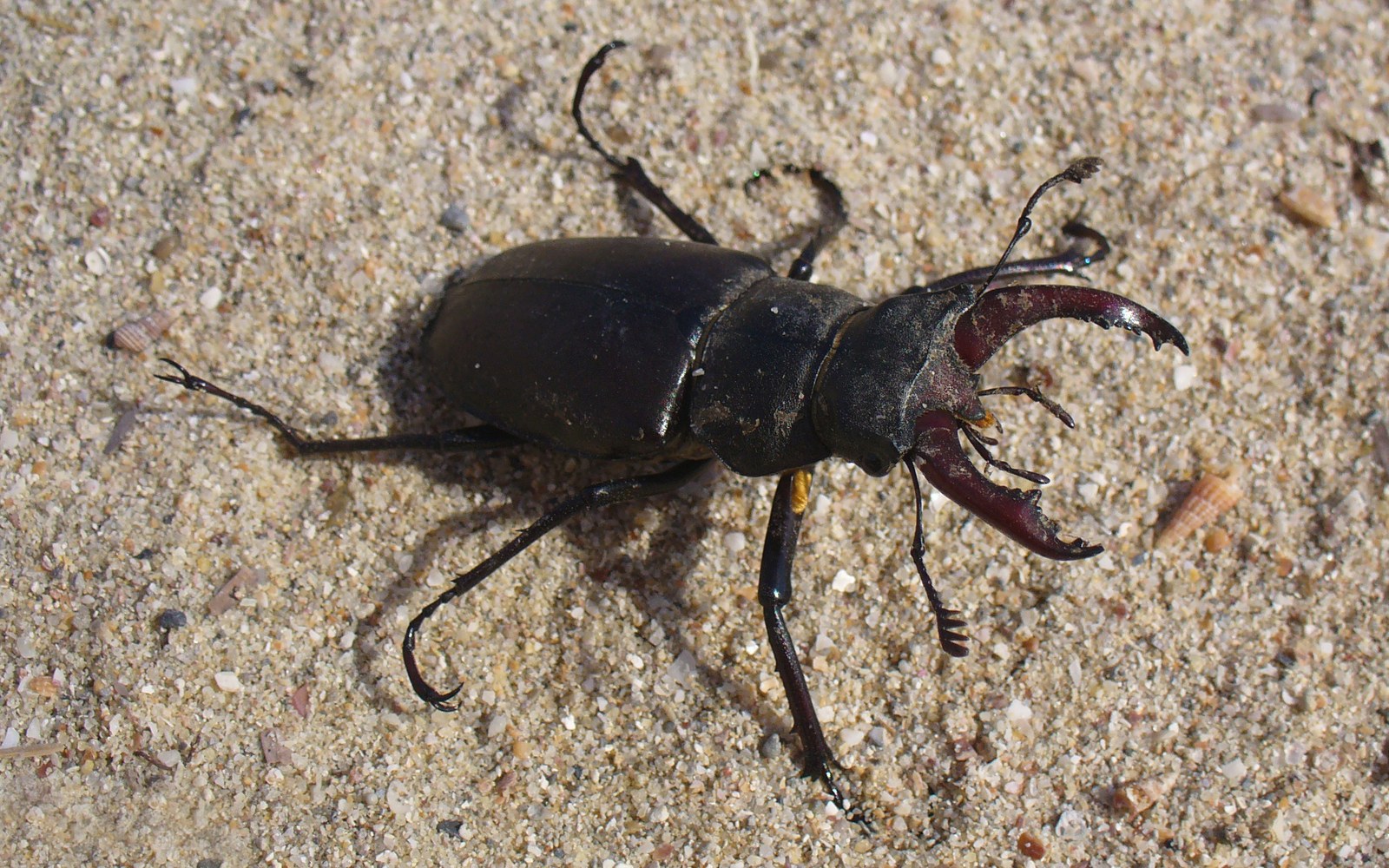
Species deep dive · european stag beetle
European stag beetles spend the winter underground, and no adult beetle survives the winter above ground. The adults you might have seen in June are long gone: most are dead by the end of August, and they do not survive the winter (PTES). Right now the next generations are in the soil. Larvae of different ages are still chewing through buried rotting wood, and the ones that pupated this summer have already turned into adult beetles. They are waiting out the winter underground and will burrow up to the surface in May (PTES; Harvey et al. 2011).
Most of a stag beetle's life is a grub
The famous antlered beetle is really just the short final chapter. A stag beetle spends most of its life as a fat white grub with an orange head, living below ground in decaying wood (PTES). A Europe-wide review by Deborah Harvey and colleagues found that the larval stage lasts 3 to 6 years, with a mean of about 4 years, and up to 6 years in captivity in the UK (Harvey et al. 2011). PTES (People's Trust for Endangered Species), the UK charity that runs the Great Stag Hunt survey, says cold weather stretches the larval stage, and that a full-grown larva can reach 11 cm long and may be found up to half a metre underground (PTES).
What they eat matters for where they are. In mainland Europe more than half of the recorded larval host plants are oak. In the UK the larvae have been found in about 60 kinds of host, and oak makes up only around 9 to 19% of records. British larvae also turn up in railway sleepers, bark chippings, fence posts and compost heaps (Harvey et al. 2011).
The autumn adults that wait until May
Stag beetle timing explains the winter mystery. Females lay their eggs near rotting wood (PTES); clutches recorded across Europe ranged from 15 to 36 eggs, with an average of about 24 (Harvey et al. 2011). When a larva is finally ready, it builds a pupal cell from soil and wood glued together with saliva (PTES). Pupation typically starts in late July, and the pupal stage lasts 28 to 60 days (Harvey et al. 2011). The new adult beetle is ready by around September, just as that year's adults are dying. Instead of heading for the surface, it overwinters underground and burrows up the following May (PTES).
So a beetle that will fly next June already exists today, fully formed, somewhere under a stump.
A short adult summer
Males emerge about a week before females, mostly in late May, and emergence is later in cooler countries such as Sweden. Males are active for roughly 6 to 10 weeks and females for 8 to 14 weeks (Harvey et al. 2011). In that time they don't eat solid food at all. They rely on fat reserves built up as a larva, though they can use a feathery tongue to drink from sap runs and fallen soft fruit (PTES). The males' huge jaws are oversized mandibles used in courtship displays and to wrestle rival males (PTES); bigger males win more fights and secure more mates (PTES).
Why stag beetles need messy gardens
The European stag beetle is listed as Near Threatened in Europe on the IUCN European Red List of Saproxylic Beetles (Nieto & Alexander 2010). It is also on Annex II of the EU Habitats Directive (Harvey et al. 2011). The same review reported that the beetle appears to have died out in Denmark and that its range in neighbouring Sweden has contracted, most noticeably in the south-west (Harvey et al. 2011).
Because the larvae need years of undisturbed dead wood, tidy habits hurt them. PTES warns that tidying woodlands, parks and gardens removes the deadwood the larvae feed on, and that stump-grinding felled trees removes vital habitat (PTES). Its 2026 advice for gardeners is to leave stumps and deadwood where they are, cover water butts, minimise weed-suppressing matting and carefully move any beetle found on a road or other tarmac into a garden border (PTES). That makes autumn, when gardens get cleared, the moment it matters most.
In Britain, people sent the PTES Great Stag Hunt more than 12,000 sightings in 2025, including over 2,500 from Hampshire, over 1,600 from Surrey and over 1,000 from Greater London. For 2026 the survey asked for videos and sound recordings for the first time, to explore whether the beetles' flight "thrumming" could be used for acoustic monitoring (PTES).
How the European Stag Beetle plays in Wilder
In Wilder the European Stag Beetle (Lucanus cervus) is a Rare Insecta card in the Forest element. It costs 4 Energy, with Attack 5 and Health 5, and has Resilient and Guardian. Guardian fits a beetle whose males wrestle rivals with those huge jaws, and Resilient suits a beetle that survives years underground before it ever sees daylight. Its flavour text reads: "Bigger mandibles win the forest throne." For another beetle with a remarkable defence, see the Common Bombardier Beetle and its Field Journal piece. For two more animals that spend the cold months out of sight, read about the American bullfrog in winter and whether badgers hibernate.
Wilder is a free browser collectible card game about real animals, and you can play it free in your browser with no signup.
Photo credit
Hero photograph: George Chernilevsky, "Lucanus cervus male 2008 G1" (a male European stag beetle in Crimea), Wikimedia Commons, public domain. Cropped for the Field Journal hero.

Questions people ask
Are stag beetles dangerous to people?
No. PTES calls stag beetles and their larvae quite harmless, and says that despite their size and impressive jaws they (almost) never bite people (PTES; PTES).
Do stag beetle larvae damage living trees or wooden houses?
No. The larvae only feed on decaying wood, and stag beetles don't damage living wood or dry, treated timber, so PTES asks people not to kill them (PTES).
Can stag beetles fly?
Yes. Males are often seen flying on warm, still summer evenings while searching for females (PTES). Females can fly too, but they are usually seen walking on the ground (PTES). Across Europe, the recorded temperature threshold for flight ranged from about 11 to 18 °C (Harvey et al. 2011).
How can you tell a male stag beetle from a female?
By the jaws and size. Males have large, antler-like jaws and are usually about 4–8 cm long. Females have much smaller jaws and are usually 3–5 cm long (PTES).
Sources
- PTES Great Stag Hunt: About stag beetles
- PTES: Stag beetle facts
- PTES: Clash of the Titans
- PTES press release (July 2026): Help PTES survey spectacular stag beetles this summer
- Harvey et al. (2011) Bionomics and distribution of the stag beetle, Lucanus cervus (L.) across Europe. Insect Conservation and Diversity 4: 23-38
- Nieto & Alexander (2010) European Red List of Saproxylic Beetles, IUCN / European Union