Why Are Glasswing Butterfly Wings See-Through?
Species deep dive · glasswing butterfly
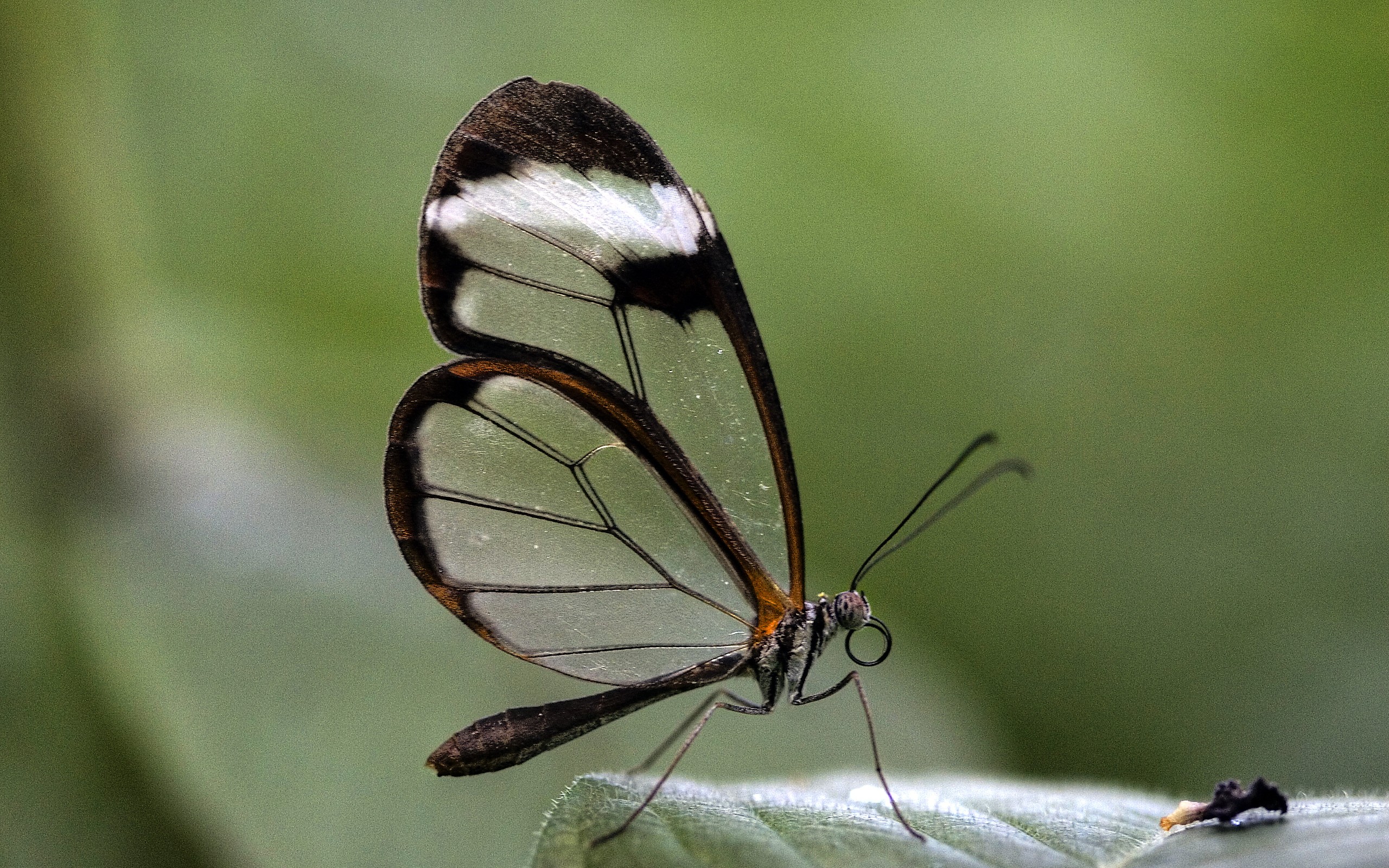
Glasswing butterfly wings are see-through for two reasons. The clear panels carry only a few, very thin scales, so light passes straight through the bare wing membrane. And that membrane is coated in a forest of tiny wax pillars that stop it shining like glass. The clear parts of a Glasswing Butterfly (Greta oto) wing reflect only about 2% of visible light, roughly a quarter of what a pane of glass reflects (Siddique et al. 2015, Nature Communications).
Fewer scales, and the wrong shape to block light
A normal butterfly wing is a clear membrane covered in thousands of flat, overlapping, coloured scales. That's where the colour comes from. In the glasswing, the clear panels have about 100 scales per square millimetre, compared with about 360–375 in the dark wing borders. The few scales in the clear zone aren't the usual flat paddles either. They are thin bristles and small forked scales that cover very little of the membrane (Pomerantz et al. 2021, Journal of Experimental Biology).
Pomerantz's team followed the wings as they developed inside the chrysalis. The difference starts early: fewer scale-building cells form in the future clear regions, and the cells that do form grow thin bristles instead of broad scales.
Wax pillars that kill the glare
Removing scales isn't enough on its own. Bare wing membrane is made of chitin, and like glass it would throw back a shiny reflection. The glasswing gets around that with nanostructures. Its clear membrane is covered in pillars about 400–600 nanometres tall and roughly 120 nm apart, packed closer together than the wavelengths of visible light (Siddique et al. 2015). They make the change from air to wing gradual instead of sudden, so very little light bounces off.
The trick is that the pillars are irregular. Moth eyes and cicada wings use evenly sized, neatly packed bumps to cut glare. By contrast, the glasswing's pillars vary randomly in height and width. Siddique and colleagues showed that this randomness keeps reflection low even when you look at the wing from a steep angle: about 2% up to a 65° viewing angle, and still only about 5% at 80°.
In 2021, Pomerantz and colleagues found that the pillars sit in two layers. Underneath is a regular layer of small dome-shaped bumps. On top is the irregular layer of pillars, made mostly of long-chain wax molecules (n-alkanes). When they dissolved the wax away with a solvent, the wing reflected about 2.5 times more light.
Why be invisible?
Glasswings belong to the Ithomiini, a group of tropical butterflies known to be chemically defended. Adults gather pyrrolizidine alkaloids from flowers and decaying plants. In a classic experiment, golden silk orb-weaver spiders readily ate freshly hatched ithomiines but cut loose wild-caught adults carrying these alkaloids (Brown 1984, Nature).
Most poisonous butterflies advertise with bright colours, like the Monarch Butterfly (read about its milkweed chemistry). So why would a toxic butterfly hide? Experiments with wild birds and people found that the most transparent clearwing species were almost never the first ones spotted and were found less often than opaque species (Arias et al. 2019, Functional Ecology). For these butterflies, being hard to see seems to be worth more than being easy to remember.
Where glasswings live
Greta oto ranges from Mexico to Panama. Its caterpillars feed on Cestrum shrubs in the nightshade family, and at Monteverde, Costa Rica, it is common on the Pacific side from the lowlands up to about 1,500 m (Monteverde Butterflies, W. A. Haber). The Florida Museum of Natural History gives its wingspan as 1.5–2 inches and lists it as Greta morgana oto, one of several names used for this butterfly (Florida Museum).
Engineers are interested too. Pomerantz's team suggests that wax pillars like these could inspire new anti-reflective materials, the kind of glare-cutting coating used on lenses and screens.
How the glasswing plays in Wilder
In Wilder, the Glasswing Butterfly is a Common Insecta card that costs 0 Energy, with Attack 0 and Health 2. It has Camouflage for the see-through wings and Toxin for the alkaloids it carries. Its flavour text sums up the science: "Wings so clear the forest forgets they exist." Want to see another see-through animal? Try Diane's bare-hearted glass frog.
Wilder is a free browser collectible card game, and you can play it free in your browser with no signup.
Photo credit
Hero photograph: liz west, "Glasswinged butterfly (Greta oto)", Wikimedia Commons, CC BY 2.0. Cropped for the Field Journal hero.

Questions people ask
How much light passes through a glasswing butterfly's wing?
Most of it. Siddique and colleagues measured about 84% transmission through the clear wing panels for red light (633 nm). The figure drops only slightly at steep angles, and the wing adds very little haze, which is why the background looks sharp through it (Siddique et al. 2015).
Do all see-through butterflies have anti-glare wings?
No. The giant glasswing (Methona confusa), another clearwing butterfly, has transparent wings but a smooth membrane, so it still reflects light strongly off the wing surface. Greta oto's wax nanopillars are what make its wings nearly glare-free (Pomerantz et al. 2021).
Is the glasswing butterfly related to the monarch?
Yes, distantly. Both belong to the brush-footed butterfly family Nymphalidae and the subfamily Danainae. The glasswing sits in the tribe Ithomiini, while the monarch belongs to the tribe Danaini (Florida Museum: glasswing; Florida Museum: monarch). See the Monarch Butterfly card.
What makes the white and brown patches on a glasswing's wings?
Scales. Outside the clear panels, the wing is covered in ordinary scales. Under the microscope, the scales in the white and brown areas look alike at first, but the brown scales have thin membranes stretched between their ridges, and the white scales don't (Siddique et al. 2015).
Sources
- Siddique, Gomard & Hölscher 2015, Nature Communications — The role of random nanostructures for the omnidirectional anti-reflection properties of the glasswing butterfly
- Pomerantz et al. 2021, Journal of Experimental Biology — Developmental, cellular and biochemical basis of transparency in clearwing butterflies
- Brown 1984, Nature — Adult-obtained pyrrolizidine alkaloids defend ithomiine butterflies against a spider predator
- Arias et al. 2019, Functional Ecology — Transparency reduces predator detection in mimetic clearwing butterflies
- Monteverde Butterflies (W. A. Haber) — Greta oto
- Florida Museum of Natural History — Glasswing
- Florida Museum of Natural History — Monarch