Western Banded Gecko: It Shakes Scorpions 13 Times a Second
Species deep dive · western banded gecko
Yes, western banded geckos eat scorpions, and they have a special move for it. A gecko barely longer than your finger bites the scorpion and then whips its head and body from side to side about 13 times a second, slamming its prey against the ground before swallowing it. Researchers at San Diego State University filmed it at around 1,200 frames per second, because at normal speed it's just a blur (Whitford et al. 2022, Biological Journal of the Linnean Society).
The western banded gecko (Coleonyx variegatus) is one of the night-time reptiles people come across most often in the Sonoran Desert. It ranges from the tip of Baja California through southern California and the Mojave Desert to southern Nevada and southwestern Utah, and through the Sonoran Desert of Arizona and Sonora to southwestern New Mexico (Tucson Herpetological Society; Arizona-Sonora Desert Museum). It seldom grows longer than about 3 inches (7.5 cm) without its tail, and it looks soft and delicate. It isn't.
Shake-feeding, frame by frame
In the study, nine geckos were offered dune scorpions (Smeringurus mesaensis) in 21 trials and harmless prey such as crickets in others. All 21 scorpions were shaken, and the authors conclude that the geckos use this shake-feeding move only on scorpions, the prey that can sting back (Whitford et al. 2022).
What the high-speed cameras showed:
- The swing. In each cycle the gecko's head swung roughly 90–110° to one side, back through the midline to 90–110° on the other side, and back again. It does this by twisting its neck while rocking its spine and shoulders against its hips.
- The speed. The average was 13.06 shakes per second, with peak angular velocities of about 128 radians per second. The authors note that this is about as fast as rats and guinea pigs shake water off their fur, and some bouts lasted more than 10 seconds and over 140 oscillations. That's remarkable for a cold-blooded lizard filmed at 22–25 °C.
- The result. The scorpions were thrashed against the ground and often looked dead or stunned when the gecko ate them, but not always: 40% of the shaken scorpions could still move when they were swallowed.
The researchers aren't yet sure exactly what the shaking achieves. It may stun or kill the scorpion, or damage its stinger, the way bee-eater birds beat bees against a hard surface to disable them. The geckos still often got stung, so shaking may simply cut down how much venom the scorpion can inject (Whitford et al. 2022). The behaviour first caught the eye of biologist Rulon Clark in the 1990s, during fieldwork in the Sonoran Desert near Yuma, Arizona (Science News Explores).
A cat-like hunter on a desert night
Scorpions are an occasional treat, not the main menu. Banded geckos eat beetles, grasshoppers, spiders, sowbugs, termites and solpugids (camel spiders) (Arizona-Sonora Desert Museum). In one Arizona population the diet shifted from mostly beetles, orthopterans and larvae in spring to termites, solpugids and spiders in late summer (Tucson Herpetological Society).
The way it hunts is surprisingly feline. It fixes its vertical pupils on the prey, holds its body and tail just above the ground, creeps forward and vibrates the tip of its tail just before it strikes (Tucson Herpetological Society).
Unlike the house geckos many people know, it belongs to the eyelid geckos (family Eublepharidae), the same group as the pet leopard gecko. It has movable eyelids edged in white, and it blinks (Tucson Herpetological Society; Arizona-Sonora Desert Museum).
A tail that is a decoy and a pantry
When a predator gets close, the gecko raises its tail, arches it over its back or waves it. That draws the attack away from its head and body and toward a tail that breaks off easily (Tucson Herpetological Society). The tail has built-in fracture planes, and the blood vessels close off quickly. The dropped tail keeps writhing while the gecko escapes (Arizona-Sonora Desert Museum; Nevada Department of Wildlife). It works often enough that in one Arizona study, up to 74% of adults had regrown tails (Tucson Herpetological Society).
The raised-tail pose may also make the gecko look like a scorpion. The Nevada Department of Wildlife says it can curl its tail over its body to mimic one, and the Desert Museum notes the suggestion that its walk and posture copy the desert hairy scorpions (Hadrurus) that share its habitat (NDOW; Arizona-Sonora Desert Museum). So the lizard that shakes scorpions may also disguise itself as one.
Losing the tail has a cost, and late October is a bad time for it. The tail stores food and water that the gecko relies on during lean times, including its winter dormancy. Regrowing it takes a lot of energy, and the new tail is shorter, made of cartilage without fracture planes, and differently patterned (Arizona-Sonora Desert Museum). In Parker's 1972 study of a population near Phoenix, adults were recorded on the surface only from April to October (Tucson Herpetological Society), so geckos that lose a tail now go into winter with an empty pantry.
New genetics, same small gecko
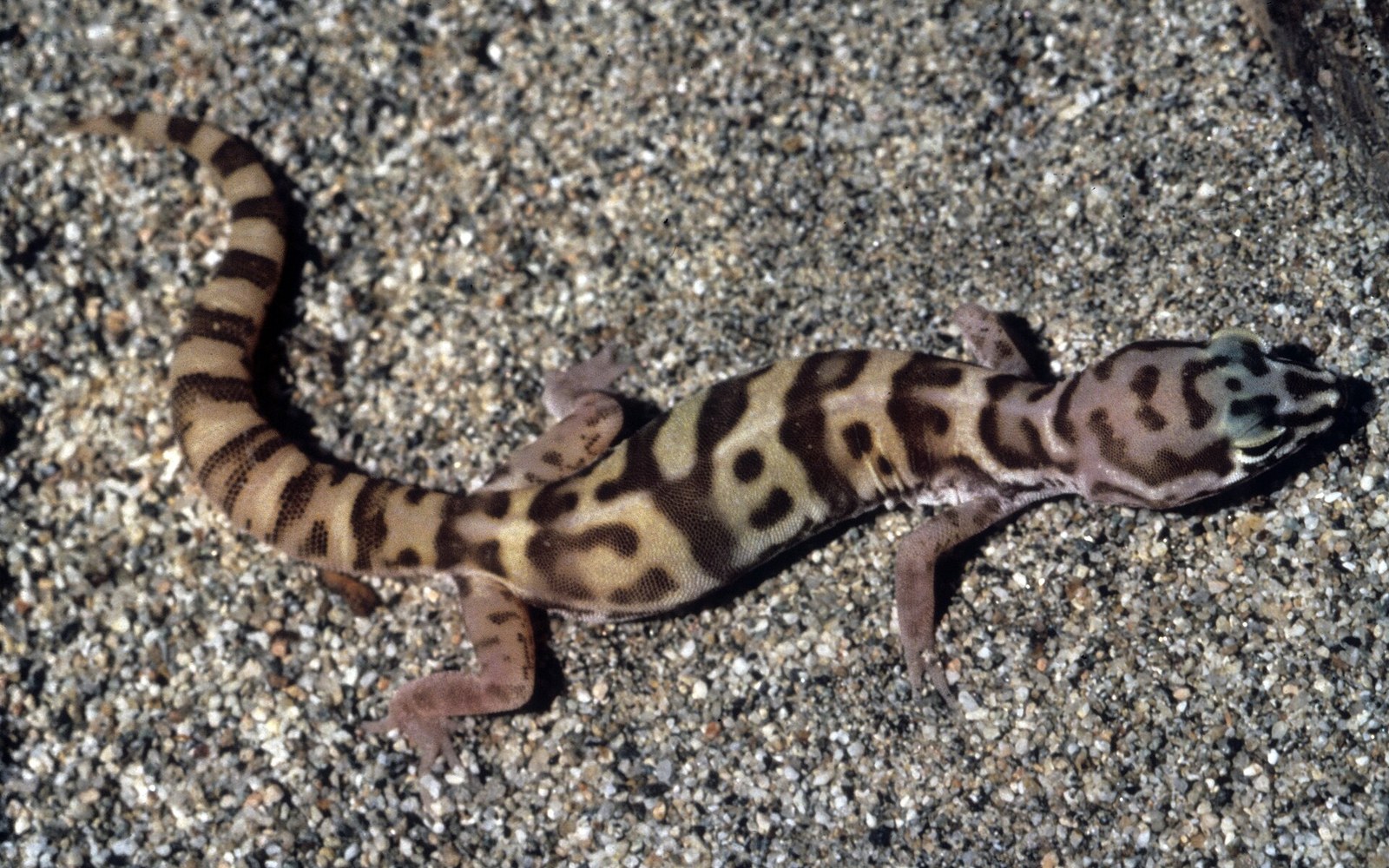
The species is more varied than it looks. Seven subspecies have been recognised (Tucson Herpetological Society), and a 2026 preprint uses genome-wide SNP data to take a fresh look at where the boundaries between its populations really lie (Davis et al. 2026, SSRN preprint). The gecko in our hero photo is a desert banded gecko, C. v. variegatus, from Joshua Tree National Park.
How the Western Banded Gecko plays in Wilder
In Wilder the Western Banded Gecko is a Common Reptilia card in the Desert element. It costs 2 Energy, with Attack 2 and Health 3, and it has Basking and Ambush, which suit a small night hunter that creeps up on its prey. Its ability is Shed Tail: for 1 Energy it heals 2 damage from itself, the card version of dropping a tail to survive an attack. Its flavour text is "Vanishes into heat shimmer." It shares the desert with other small, tough lizards such as the Desert Horned Lizard, and with the scorpion-like arachnids in the game, such as the Emperor Scorpion.
Wilder is a free browser collectible card game about real animals, and you can play it free in your browser with no signup.
Photo credit
Hero photograph: Joshua Tree National Park (NPS photo), "Desert Banded Gecko (Coleonyx variegatus variegatus)", Wikimedia Commons, public domain (U.S. National Park Service). Cropped for the Field Journal hero.

Questions people ask
Is the western banded gecko venomous or dangerous to people?
No. It is a small, harmless insect-eater. People sometimes mistake it for a young Gila monster, but the gecko is much smaller (young Gila monsters are around 15 cm, or 6 in) and it lacks the Gila monster's bead-like scales (Arizona-Sonora Desert Museum).
How long do western banded geckos live?
About 5 to 8 years, according to the Nevada Department of Wildlife. How long they live in the wild hasn't been well studied, but one captive individual lived for more than 14 years (NDOW; Tucson Herpetological Society).
Why does a banded gecko squeak?
Nobody is sure yet. Western banded geckos often give a small squeak when they are grabbed or captured, but the function of the call is still unclear (Tucson Herpetological Society; Arizona-Sonora Desert Museum).
How many eggs does a western banded gecko lay?
Two at a time. Females lay a clutch of two eggs in late spring and can lay two clutches a year. The eggs hatch after about 6 weeks into geckos only about 2.5 cm (1 in) long (Arizona-Sonora Desert Museum; Tucson Herpetological Society).
How can you tell a male western banded gecko from a female?
Look for spurs. Males have small spurs on each side of the base of the tail, which they use during mating (NDOW; Arizona-Sonora Desert Museum; Tucson Herpetological Society).
Sources
- Whitford, Freymiller, Higham & Clark (2022) Shaking things up: the unique feeding behaviour of western banded geckos when consuming scorpions. Biological Journal of the Linnean Society
- SDSU News (2022): SDSU research says docile gecko is a savage scorpion predator
- Science News Explores: Watch how a western banded gecko takes down a scorpion
- Tucson Herpetological Society (Bezy 2010): Western Banded Gecko
- Arizona-Sonora Desert Museum: Western Banded Gecko
- Nevada Department of Wildlife: Western Banded Gecko
- Davis et al. (2026) Genome-wide SNP data reveal population boundaries, gene flow, and diversification patterns in the Western Banded Gecko (Coleonyx variegatus). SSRN preprint