Jaguar: Why the Americas' Biggest Cat Hunts Caimans
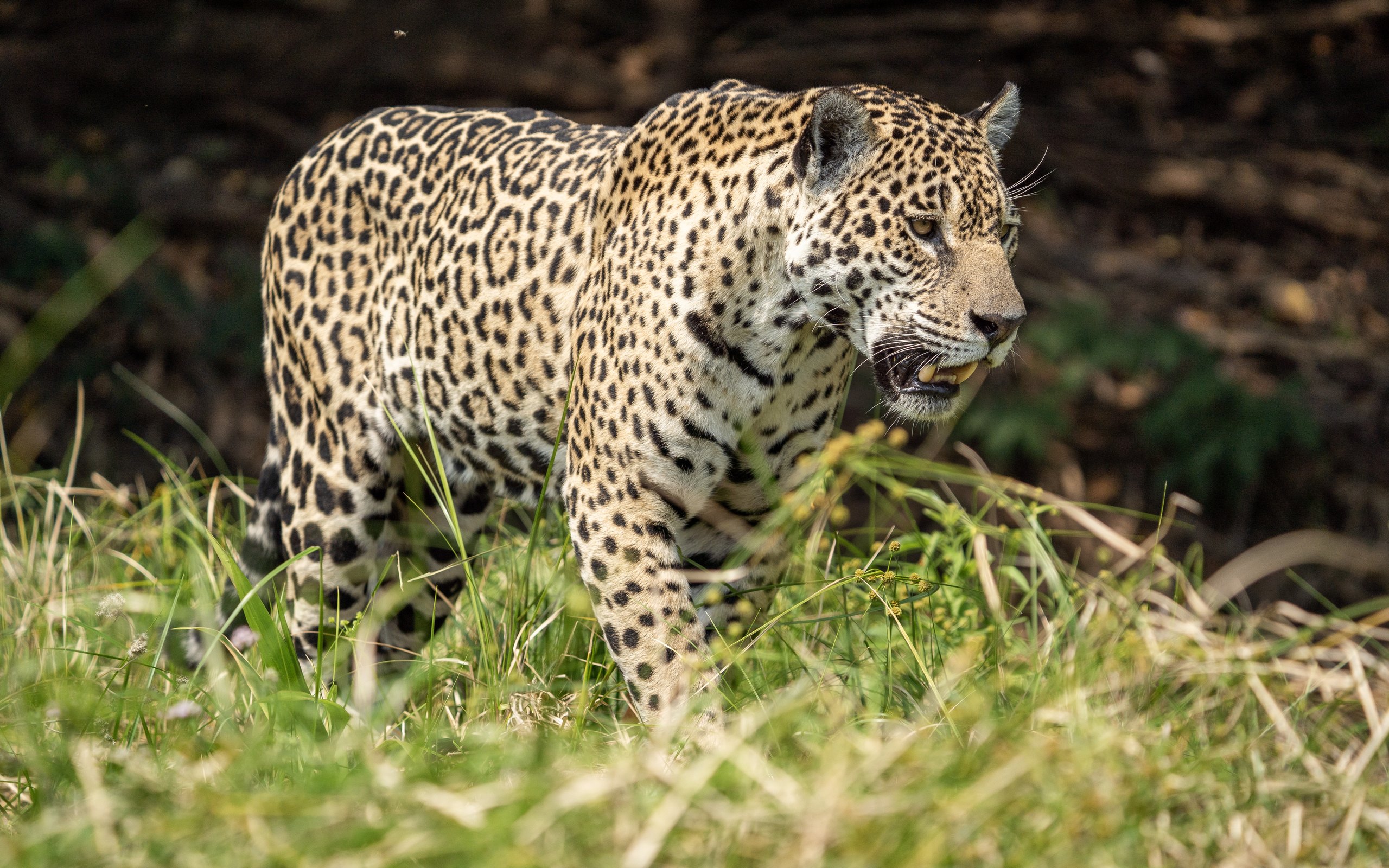
Species deep dive · jaguar
Yes, jaguars hunt caimans, and in some wetlands they are a staple. In Brazil's southern Pantanal, researchers who followed 10 GPS-collared jaguars found that caimans made up 24.4% of 438 prey items, second only to cattle (Cavalcanti & Gese 2010). The reason is simple: where land is flooded for months, caimans are plentiful, and the jaguar has a bite strong enough to get through armour (Animal Diversity Web).
The jaguar (Panthera onca) is the biggest cat in the Americas (Animal Diversity Web). Caimans are crocodilians, armoured reptiles that can be longer than the cat itself, and yet wherever the land floods they end up on the jaguar's menu.
What a jaguar actually eats
Jaguars are strict carnivores with a long menu: more than 85 prey species have been recorded in their diet. Their preferred prey are large mammals such as peccaries, tapirs and deer, but they also take caimans, turtles, snakes, capybaras, fish and large birds (Animal Diversity Web).
In the southern Pantanal study, jaguar kills were 31.7% cattle, 24.4% caimans and 21.0% peccaries, followed by feral hogs, marsh deer, giant anteaters and capybaras. Female jaguars killed more caimans than males did, while males took a bigger share of peccaries (Cavalcanti & Gese 2010).
Why water decides the menu
The caiman share follows the floods. In the Pantanal, rainfall and water levels were the main driver of seasonal kill rates on cattle and caimans. As the water rose, caimans spread out across the landscape and jaguars killed more of them. As it fell, caimans became scarcer and cattle were moved back into the pastures (Cavalcanti & Gese 2010).
A review of jaguar diet studies from 19 sites found the same pattern on a bigger scale. Caimans turned up in jaguar diets only in seasonally flooded habitats: two sites in Amazonian varzea flooded forest, two in the Pantanal and two in Venezuela. Across all 19 studies, reptiles made up 12% of 1,231 prey items, and 51% of those reptile items were crocodilians (Da Silveira et al. 2010).
The Amazon jaguars that live on reptiles
The most reptile-heavy jaguars in that review lived in the Mamirauá Reserve in the western Brazilian Amazon. In its flooded varzea forest, the big land mammals that jaguars eat elsewhere are largely missing. There, 54% of jaguar prey items were reptiles, and 48% of those were caimans (Da Silveira et al. 2010).
The researchers watched it happen through radio tags. A gravid female spectacled caiman, 1.55 m long, left the water to build a nest in the forest. Four days later they found only her remains, scattered eggshells and the paw prints of an adult and a young jaguar. They believe she was killed before she could lay her eggs (Da Silveira et al. 2010). The smaller spectacled caiman seems especially at risk because it spends more time on land than the much larger black caiman.
How a cat kills an armoured reptile
Jaguars have two ways to kill. They can deliver a bite to the neck and suffocate their prey, or use a second method: killing instantly by piercing the back of the skull with their canines. Their powerful jaws and teeth let them bite through thick reptile skin and even turtle shells (Animal Diversity Web). The Jaguar card FAQ has the numbers on how strong that bite is.
Jaguars are built for power, not speed. They ambush from cover rather than run prey down, and one was seen dragging a 34 kg sea turtle 91.5 m into the forest (Animal Diversity Web). The hero photo above shows a male jaguar at Porto Jofre on the Cuiabá River in Mato Grosso, in the northern Pantanal, where jaguars hunt caimans along the riverbanks.
The jaguars that went fishing
In the northern Pantanal, at Taiamã Ecological Station, researchers found jaguars that had gone even further into the water. In 138 scats, the diet was dominated by reptiles (55%) and fish (46%), with only 11% mammals, mostly capybaras. It was the first jaguar population known to eat fish extensively and hardly any mammals (Eriksson et al. 2022).
All that food supports a crowd. The study estimated 12.4 jaguars per 100 km², the highest jaguar density recorded so far (Eriksson et al. 2022), and two to three times higher than estimates elsewhere in South America (Oregon State University). Jaguars are usually loners, yet cameras there caught adults of the same sex fishing together, travelling together and playing (Eriksson et al. 2022).
Why it matters for jaguars
Jaguars are listed as Near Threatened by the IUCN (IUCN Red List). They are threatened through most of their range by hunting, persecution and habitat loss, and in cattle country they are often shot on sight despite legal protection (Animal Diversity Web). Wild prey matters here: in the southern Pantanal, jaguar kill rates on peccaries rose over the four-year study while kill rates on cattle fell (Cavalcanti & Gese 2010).
On the Wilder card
In Wilder the Jaguar is a Rare Mammalia card in the Forest element. It costs 5 Energy, with Attack 6 and Health 5, and has Ambush. Its ability, Skull Bite, costs 3 Energy and deals 2 damage to an enemy, a nod to the real cat's skull-piercing kill. Its flavour text reads: "Most big cats go for the throat. The jaguar goes for the skull." To see how it measures up against the other big cats, read Biggest Cats in the World, Ranked.
Wilder is a free browser collectible card game about real animals, and you can play it free in your browser with no signup.
Photo credit
Hero photograph: Kandukuru Nagarjun, "Strong powerful male jaguar" (Porto Jofre, Rio Cuiabá, 16 August 2022), Wikimedia Commons.jpg), licensed CC BY 2.0. Cropped for the Field Journal hero.
Questions people ask
Can a jaguar kill a black caiman?
Yes, even a big one. In Brazil's Mamirauá Reserve, researchers found a 3.8 m male black caiman that had apparently just been killed by a jaguar, attacked on a thick mat of floating vegetation along a canal (Da Silveira et al. 2010). The smaller spectacled caiman is taken more often, because it spends more time on land.
Do jaguars eat caiman eggs?
Yes. In the Mamirauá Reserve, jaguars were behind 26.1% of raided black caiman nests and 23.1% of raided spectacled caiman nests. A camera trap filmed one female jaguar find a black caiman nest and eat the eggs for over an hour (Da Silveira et al. 2010).
Do jaguars eat piranhas?
Yes, at least in the northern Pantanal. Cameras at Taiamã Ecological Station filmed jaguars catching red-bellied piranhas, pacu, thorny catfish and large tiger catfish (Eriksson et al. 2022). Read more in Red-Bellied Piranha: Do Piranhas Attack Humans?
How often does a jaguar make a kill?
About every four days. GPS-collared jaguars in the southern Pantanal averaged 4.3 days between known kills, and the gap grew with the size of the prey (Cavalcanti & Gese 2010). Jaguars also stayed longer at a carcass when the prey was bigger.
Are jaguars endangered?
Not globally, but they are in trouble. The IUCN lists the jaguar as Near Threatened (IUCN Red List), while the U.S. lists it as Endangered under the Endangered Species Act (USFWS). Jaguars now hold about 46% of their historical range (Animal Diversity Web).
Sources
- Cavalcanti & Gese (2010): Kill rates and predation patterns of jaguars (Panthera onca) in the southern Pantanal, Brazil, Journal of Mammalogy 91(3)
- Da Silveira et al. (2010): Depredation by jaguars on caimans and importance of reptiles in the diet of jaguar, Journal of Herpetology 44(3)
- Eriksson et al. (2022): Extensive aquatic subsidies lead to territorial breakdown and high density of an apex predator, Ecology 103(1)
- Oregon State University: Study yields insights into the ecology of fishing jaguars, including rare social interactions
- Animal Diversity Web (University of Michigan): Panthera onca
- IUCN Red List: Panthera onca (2017 assessment)
- U.S. Fish and Wildlife Service: Jaguar (Panthera onca)