Bald Eagle: Why Hunting Season Is Lead-Poisoning Season
Species deep dive · bald eagle
Bald eagles get lead poisoning by eating fragments of lead bullets and shot hidden in carcasses and in the gut piles hunters leave behind. It's common: a study of 1,210 eagles from 38 US states found that nearly half of the bald eagles sampled showed signs of repeated lead exposure (USGS; Slabe et al. 2022). Cases rise with deer hunting season, which is starting now across much of North America (The Raptor Center).
Hope's story
This week, Rapid City in South Dakota lost a local celebrity. "Hope" was a female bald eagle who had roosted at Canyon Lake for nearly a decade. She was easy to recognise because of a striking divot in her upper beak. She came to the Black Hills Raptor Center in October in critical condition and died soon after. A necropsy found 22.6 parts per million of lead in her liver. That's roughly twice the level North Dakota State University counts as "severe lead poisoning" (SDPB).
Where her lead came from is unknown. But the center's director, Maggie Engler, told SDPB that a tiny amount can do it: "one BB from a shotgun shell is enough to destroy a bird the size of an eagle" (SDPB).
Where the lead comes from
Being shot isn't what poisons an eagle. As Engler puts it, "the bird of prey has to ingest the lead for it to be toxic" (SDPB).
The main source is spent hunting ammunition. Lead-core rifle bullets break into hundreds of pieces on impact, and fragments have been found up to 18 inches (46 cm) from the wound (The Raptor Center). When a hunter field-dresses a deer, many of those fragments stay in the gut pile. In one study, researchers X-rayed the remains of deer shot with lead-core bullets. 94% of the samples contained fragments, as did 18 of 20 offal piles, with up to 521 fragments in a single sample. Deer shot with copper bullets had almost none (Hunt et al. 2006).
For an eagle, a gut pile is an easy free meal, and that's exactly the problem. Lead fishing sinkers and lures are a second route (SDPB).
Why autumn and winter are the danger season
Bald eagles hunt fish, but they're also keen scavengers. They rely more on carcasses in winter, when live prey is harder to find. That's why the national study found short-term (acute) lead exposure was more frequent in the winter months (USGS).
The University of Minnesota's Raptor Center admits over 150 sick and injured bald eagles a year. Between 80% and 90% of them have some lead in their blood, and 25–30% have lead toxicity. Lead cases there are "strongly correlated with deer hunting season", and most of the poisoned eagles die or have to be euthanized (The Raptor Center).
What lead does to an eagle
Lead has no useful role in the body and is extremely toxic to birds. Even at low exposure, the Raptor Center says eagles can suffer gut problems, neurological damage, depression, seizures, weakness and death (The Raptor Center). Typical outward signs are a bowed head, drooping wings and green-stained tail feathers (USGS).
The damage builds up over time. Chronic poisoning becomes more common with age, because lead is stored in the bones each time an eagle is exposed (USGS).
Is it a threat to the species?
For bald eagles, it's a drag rather than a disaster. The 2022 study estimated that lead slows bald eagle population growth by 3.8% a year, and golden eagle growth by 0.8% (USGS). Bald eagles can absorb that because their US population has been growing at about 10% a year. Golden eagles are less stable, so extra deaths could tip them into decline (USGS). Based on surveys in 2018 and 2019, the US Fish and Wildlife Service estimated 316,700 bald eagles in the lower 48 states, a population that has quadrupled since 2009 (USFWS). That's the comeback we covered in Bald Eagle: White Head, DDT Comeback, and Hollywood's Fake Scream.
The same gut piles and carcasses feed other scavenging birds too, from golden eagles to California condors (Hunt et al. 2006).
The simple fix
Switching to non-lead ammunition, such as copper bullets, removes the risk "without changing the tradition or the hunt itself", says the Raptor Center (The Raptor Center). In the Black Hills, hunters who draw a deer, elk or antelope tag in certain units are offered a free box of copper ammunition to try (SDPB). For anglers, the matching fix is lead-free sinkers and lures.
On the Wilder card
In Wilder, the Bald Eagle is a Mythic Aves card in the Water element. It costs 5 Energy, with Attack 5 and Health 6, and has Ambush. Its ability, Swoop, costs 2 Energy and deals 2 damage to an enemy creature. Its flavour text, "Snatches lunch from the surface without getting its talons wet", is a reminder that this is a fish hunter at heart. It's also an opportunist that will happily take an easy meal, and that habit is what puts it at risk from lead.
Wilder is a free browser collectible card game about real animals, and you can play it free in your browser with no signup.
Photo credit
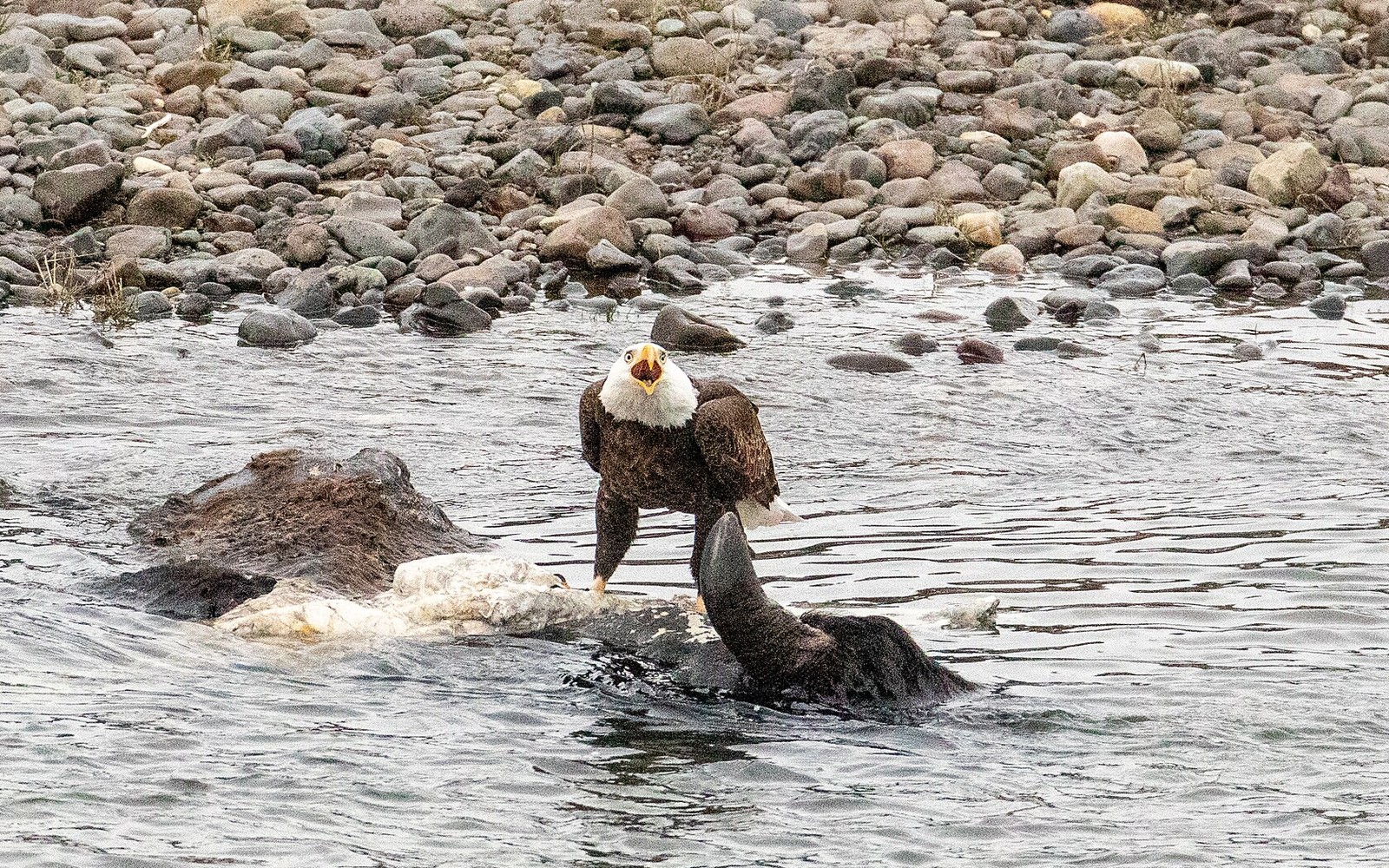
Hero photograph: National Park Service / Jim Peaco, "Bald Eagle on bison carcass" (Soda Butte Creek, Yellowstone National Park, 6 May 2020), Wikimedia Commons, public domain (work of the US federal government). Cropped for the Field Journal hero.

Questions people ask
Is deer meat shot with lead bullets safe to eat?
It can carry lead too. The University of Minnesota's Raptor Center notes that hunting with lead ammunition has been shown to contaminate venison meant for people, so switching to non-lead ammunition also gives hunters a safer food source (The Raptor Center). X-rays of deer shot with lead-core bullets found fragments in most samples (Hunt et al. 2006).
How common is lead poisoning in golden eagles?
About as common as in bald eagles. The 2022 national study found chronic lead poisoning in 47% of golden eagles sampled, compared with 46% of bald eagles (Slabe et al. 2022). Golden eagles also scavenge carcasses, especially in winter (USGS).
How many bald eagle nesting pairs are there in the US?
More than 71,400 nesting pairs in the lower 48 states, according to the US Fish and Wildlife Service's 2020 update. That's up from an all-time low of just 417 known nesting pairs in 1963 (USFWS). See the Bald Eagle card.
Who counts how many bald eagles there are?
The US Fish and Wildlife Service. Its pilot biologists flew aerial surveys over high-density nesting areas in 2018 and 2019. For areas too sparse to fly, the agency used eBird relative-abundance data from the Cornell Lab of Ornithology, so birdwatchers' sightings helped produce the estimate (USFWS).
Sources
- Slabe et al. (2022) Demographic implications of lead poisoning for eagles across North America, Science
- U.S. Geological Survey (17 February 2022): Groundbreaking Study Finds Widespread Lead Poisoning in Bald and Golden Eagles
- The Raptor Center, University of Minnesota: Lead poisoning
- Hunt et al. (2006) Bullet fragments in deer remains: implications for lead exposure in avian scavengers, Wildlife Society Bulletin 34: 167–170
- SDPB (30 October 2026): Officials say beloved Black Hills bald eagle died from lead poisoning
- U.S. Fish and Wildlife Service (24 March 2021): America's Bald Eagle Population Continues to Soar