Cordyceps Spider: The Spider That Dresses as a Zombie Fungus
Species deep dive · cordyceps spider
*The cordyceps spider (Taczanowskia waska) is not infected by a fungus. It only looks like it is. This spider from Ecuador's Amazon has a pale, fuzzy abdomen with two long, fungus-like horns, and it hangs perfectly still under a leaf, just like a spider that has been killed by a Gibellula fungus. When it was described in February 2026, it became the first reported case of a spider mimicking a fungus that kills spiders (Díaz-Guevara et al. 2026).*
Halloween is full of zombies, but this one is real, and it is wearing a costume. Here is how the disguise works, how a night hike and an iNaturalist post led to a new species, and why researchers think the trick pays off twice.
Found on a night hike, mistaken for a dead spider
On 8 August 2025, at 20:34, a group on a nighttime nature walk at the Waska Amazonía reserve in Mera, Pastaza province, Ecuador, spotted what they took to be a spider killed by a "cordyceps" fungus. It was sitting under an arum-family leaf about 145 cm above the forest floor, with a brown egg sac hanging in an irregular web about 10 cm away (Díaz-Guevara et al. 2026).
Co-author Alexander Griffin Bentley and the other observers collected it because they had never seen a living "cordyceps" before. When they flipped the leaf over, the "fungus" did not move at all. Only when it was touched did it turn out to be a living spider (Díaz-Guevara et al. 2026).
The photos went onto iNaturalist, where other users soon recognised the animal as a Taczanowskia, a rare genus of orb-weaver spiders, and encouraged the team to study it properly. Arachnologist David R. Díaz-Guevara of Ecuador's national biodiversity institute (INABIO) photographed the live spider and confirmed it was a species new to science (INABIO 2026).
A second specimen, waiting since 1903
The Ecuadorian female was not the only one. While working on the description, co-author Nadine Dupérré found a second female in the arachnology collection of the Museum of Nature Hamburg in Germany. It had been collected in Bolivia on 23 July 1903 and had sat in the collection, unrecognised, for more than a century (Díaz-Guevara et al. 2026). So the species is known from two places, Ecuador and Bolivia, and from just two females.
The genus itself is one of the least understood in the orb-weaver family Araneidae. Only a few specimens have been collected since it was named in 1879, and its natural history is known mainly from a single paper from 1981 (Díaz-Guevara et al. 2026).
How the disguise works
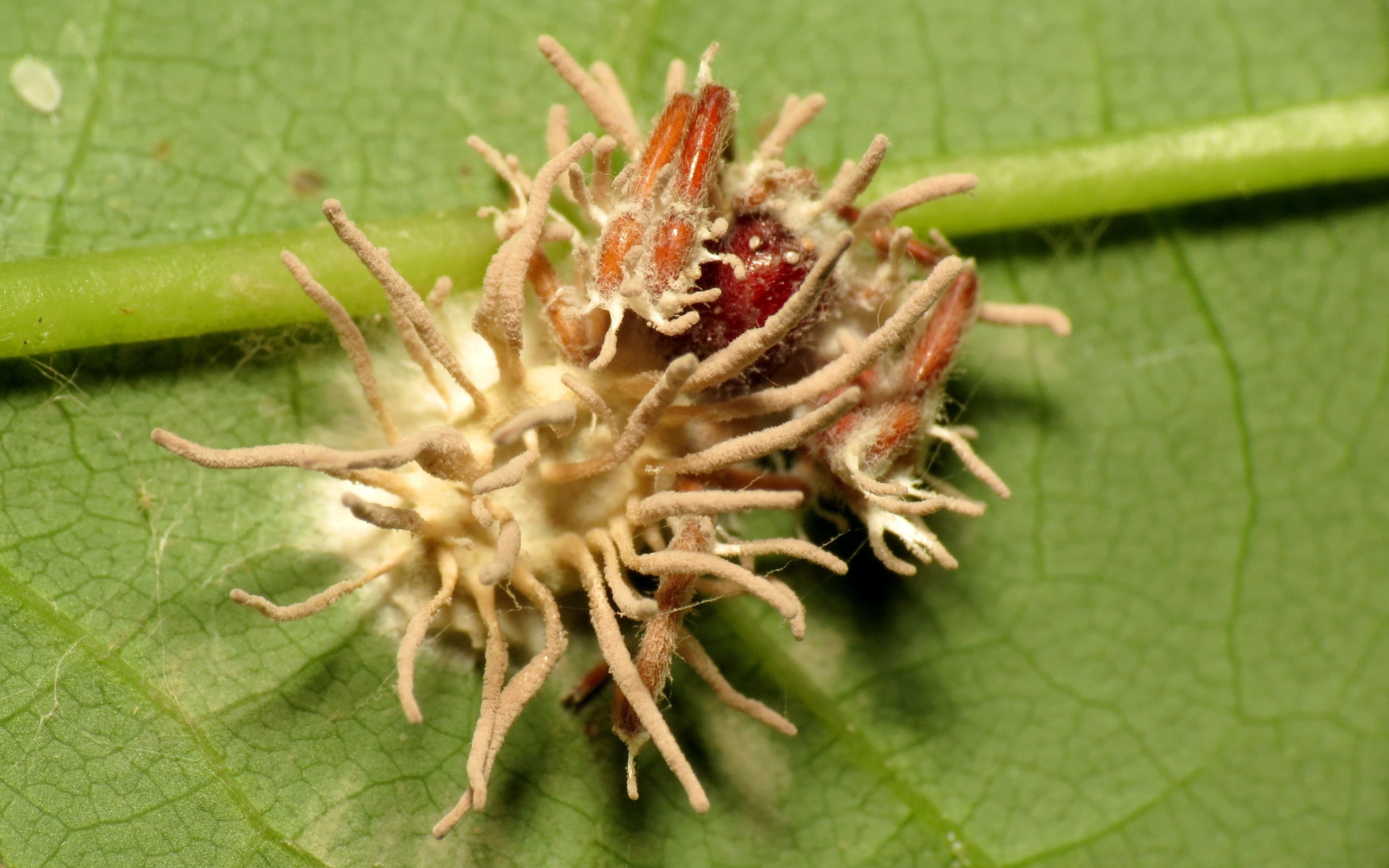
The fungus being copied is Gibellula, a genus in the Cordycipitaceae family that infects spiders and other arachnids. At Waska, where more than 25 species of Cordycipitaceae and Ophiocordycipitaceae fungi have been found, Gibellula is common on a range of arachnid hosts. At least one local form covers its victim in white mycelium and grows one or more cream-yellow projections, usually from the abdomen (Díaz-Guevara et al. 2026).
Taczanowskia waska copies that look in several ways, according to its describers (Díaz-Guevara et al. 2026):
- The white "mould": its pale abdomen is covered in small white spikes that imitate fungal mycelium.
- The fruiting bodies: two long, slender tubercles on the abdomen, almost as long as the abdomen itself, look like the fungus's stroma-like structures. Yellow, hairy patches at their bases look like more mycelium.
- The hidden legs: its almost translucent legs disappear when tucked in.
- The pose: dead Gibellula victims are almost always found on the underside of a leaf, sheltered from rain. T. waska sat in exactly that position, upside down, with its tubercles pointing at the ground.
- The stillness: it stayed motionless even when the leaf was turned over.
The authors point out that this is mimicry rather than masquerade. Many animals disguise themselves as something inanimate, such as a twig, a leaf or a bird dropping. This spider imitates another living thing: a fungus that kills its own kind.
Why look like a zombie?
Spider-killing fungi in this family have a grim reputation. In 2025, scientists described Gibellula attenboroughii from caves in Northern Ireland and the Republic of Ireland. Spiders infected by it had left their usual hiding places and webs to die out in the open on cave roofs and walls, behaviour that echoes the famous "zombie-ant" fungi (CABI 2025; Evans et al. 2025).
For a predator such as a bird, a fungus-riddled spider corpse is not an appealing meal. The researchers think the disguise may work in two directions at once (Díaz-Guevara et al. 2026):
- Protection (Batesian mimicry): predators may skip what looks like an undesirable, infected corpse.
- Hunting (aggressive mimicry): prey insects may not feel threatened by something that looks like a dead spider.
That second point matters because Taczanowskia does not hunt like a typical orb-weaver. It builds no web to catch prey. Instead it stays very still and grabs small invertebrates that pass by, using an enlarged claw on its front legs (Díaz-Guevara et al. 2026; INABIO 2026). The paper presents both benefits as hypotheses for now.
A spider named after the forest that found it
The name waska honours the Waska Amazonía foundation, which runs the reserve where the spider was found, and in Kichwa the word means "root" or "vine" (Díaz-Guevara et al. 2026). The reserve lies in the Llanganates-Sangay Connectivity Corridor, where the Andes meet the Amazon Basin and where dozens of new species, from frogs to beetles and spiders, have been described in recent years (Díaz-Guevara et al. 2026).
The discovery is also a reminder of what community science can do. The species came to light because people on a guided walk posted photos online, and the authors go on to suggest that several other orb-weavers may wear similar fungus costumes: they flagged look-alikes from Vietnam, Uganda, coastal Brazil and Madagascar in iNaturalist records and on a blog (Díaz-Guevara et al. 2026).
On the Wilder card
In Wilder the Cordyceps Spider (Taczanowskia waska) is an Uncommon Arachnida card in the Forest element. It costs just 1 Energy, with Attack 1 and Health 2, and has Camouflage and Toxin. Camouflage fits a spider that hides in plain sight as a fungus-covered corpse, and its flavour text says it all: "Still as a zombie fungus until the claws strike." For more spooky-but-real arachnids, meet the southern black widow and find out why scorpions glow under UV light.
Wilder is a free browser collectible card game about real animals, and you can play it free in your browser with no signup.
Photo credit
Hero photograph: Katja Schulz, "Spider-killing Fungus" (a spider killed by Gibellula leiopus, the anamorph of Torrubiella arachnophila, photographed in Rock Creek Park, Washington, DC, in August 2015). This is the kind of fungus-infected spider the cordyceps spider imitates, not Taczanowskia waska itself. Wikimedia Commons, CC BY 2.0. Cropped for the Field Journal hero.

Questions people ask
How big is the cordyceps spider?
Small. The female holotype of Taczanowskia waska measures 9.03 mm in total length. Its abdomen is wider than it is long, about 6.51 mm long and 10.82 mm wide, and the two fungus-like tubercles on its back are almost as long as the abdomen (Díaz-Guevara et al. 2026). Only females are known so far.
Why is it called the cordyceps spider if the fungus it copies is Gibellula?
Because "cordyceps" is the popular name people use for zombie-like fungi that kill insects and spiders. Gibellula belongs to the Cordycipitaceae, the same family as Cordyceps, and the people who found the spider thought they had found a living "cordyceps". The describers kept the nickname in the title of their paper: "The Cordyceps spider" (Díaz-Guevara et al. 2026).
Do any other spiders mimic zombie fungi?
Possibly. The scientists who described the cordyceps spider found photos of four other orb-weavers with similar fungus-like abdomens: an unidentified species from Vietnam, an undescribed Acantharachne from Uganda, Mastophora leucacantha from coastal Brazil and Exechocentrus lancearius from Madagascar. Gibellula fungi occur in all four places, but fungal mimicry in those spiders has not yet been formally studied (Díaz-Guevara et al. 2026).
What is the zombie fungus that kills spiders?
Mostly fungi in the genus Gibellula, which infect spiders and other arachnids. In 2025 scientists named Gibellula attenboroughii from caves in Ireland and Northern Ireland, after Sir David Attenborough. Infected cave spiders left their webs and lairs to die in exposed spots on cave roofs and walls (CABI 2025; Evans et al. 2025).
Sources
- Díaz-Guevara, Bentley & Dupérré (2026) "The Cordyceps spider": Taczanowskia waska sp. nov. (Araneae: Araneidae), a new spider species and a novel case of mimicry of an araneopathogenic fungus (Cordycipitaceae: Gibellula), Zootaxa 5760(5): 563–576
- INABIO (30 March 2026): Se describe nueva especie de araña que imita a un hongo como estrategia de sobrevivencia
- Evans et al. (2025) The araneopathogenic genus Gibellula (Cordycipitaceae: Hypocreales) in the British Isles, including a new zombie species on orb-weaving cave spiders, Fungal Systematics and Evolution 15: 153–178
- CABI (29 January 2025): New fungal species named in honour of Sir David Attenborough making zombies of cave spiders on the island of Ireland