Cheetah: Why the Fastest Land Animal Rarely Runs Flat Out
Species deep dive · cheetah, african lion, african wild dog
Why does the fastest land animal rarely run flat out? Because top speed is not what wins a cheetah its dinner. GPS collars on five wild cheetahs in Botswana clocked a top speed of 93 km/h (58 mph), but across 367 runs the average top speed was only about 54 km/h, usually held for just one or two seconds. Most hunts are decided by acceleration, braking and sharp turns, not by a straight-line sprint (Wilson et al. 2013, Nature).

The collar study that timed wild cheetahs
Before 2013, the best-known cheetah speed record came from a tame adult cheetah timed on a measured course: 29 m/s (about 104 km/h), the average of three runs over 201.2 m with a running start (Sharp 1997, Journal of Zoology). Nobody knew what wild cheetahs actually did on a real hunt.
A team from the Royal Veterinary College in London and the Botswana Predator Conservation Trust built their own tracking collar, about 340 g, packed with GPS and motion sensors (accelerometers, gyroscopes and magnetometers). They fitted it to three female and two male adult cheetahs and recorded 367 runs over 17 months (Wilson et al. 2013; ScienceDaily summary). Here is what they found:
- Top speed: 25.9 m/s, or 93 km/h (58 mph), by a cheetah the team called Ferrari. The other four topped out at 25.4, 22.0, 21.1 and 20.1 m/s.
- Typical top speed: 14.9 m/s, about 54 km/h, and usually only for 1–2 seconds.
- Typical run: 173 m on average. The longest run by each cheetah was between 407 and 559 m.
- How often: about 1.3 runs a day. High-speed running was a tiny part of the roughly 6 km each cheetah covered in an average day.
- Prey: mostly impala, which made up 75% of their diet.
Why cheetahs don't run flat out
A cheetah chasing an impala is chasing an animal that can turn. On a tight turn, the faster you go, the more grip you need, so the cheetah has to slow down to follow the prey. The collars showed cheetahs pulling sideways (centripetal) accelerations of more than 13 m/s² at speeds below about 17 m/s (61 km/h). Polo horses manage about 6 m/s². At their very highest speeds, the cheetahs did not make tight turns at all (Wilson et al. 2013).
That kind of turn needs a lot of grip. The team worked out that it takes a friction coefficient of at least 1.3, and says the cheetah's ridged footpads and claws work like the cleats on a football boot.
A follow-up study compared cheetahs with impala, and lions with zebra, in the same part of Botswana. The predators had about 20% more muscle power, 37% more acceleration and 72% more braking capacity than their prey. Computer models of the chases showed that slower hunts favour the prey, because at lower speeds an impala can use its full ability to dodge. So a cheetah has to be much more athletic than its prey just to keep a workable success rate (Wilson et al. 2018, Nature).
Acceleration and braking: the real superpower
In a single stride, a wild cheetah could speed up by up to 3 m/s or slow down by up to 4 m/s. Its best strides delivered more than 100 watts per kilogram of body weight. For comparison, the researchers worked out about 25 W/kg for Usain Bolt's 9.58-second 100 m world record, about 30 W/kg for polo horses and about 60 W/kg for racing greyhounds (Wilson et al. 2013).
Braking turned out to be the giveaway. Successful hunts involved harder braking on average (7.5 m/s² versus 5.5 m/s²). Peak acceleration, distance run and number of turns were about the same whether or not the cheetah made a kill. The researchers concluded that the outcome was settled in the last few seconds, not by giving up early to save energy (Wilson et al. 2013).
How often do cheetah hunts succeed?
In the Botswana collar study, 94 of 367 runs (26%) ended in a kill. Adding 530 more runs picked up only by the motion sensors gave the same answer, 25%. The authors note this is lower than earlier estimates, partly because some runs may have been play or escapes rather than hunts. These cheetahs did a little better in dense cover (31%) than on open grassland (20%), though the difference was not statistically significant, and they ran by day and by night (Wilson et al. 2013).
Other sources give higher figures. The Smithsonian's National Zoo says about half of a cheetah's chases succeed, and that cheetahs usually creep to within about 100 yards (91 m) of their target before the final sprint (Smithsonian's National Zoo). In the Serengeti, a long-term study found that the cheetah's age and the size of the prey mattered most for whether a chase succeeded, while hunger, having cubs and habitat type made no difference (Hilborn et al. 2012, Animal Behaviour).
The same Botswana team compared cheetahs with a collared pack of African wild dogs. The dogs made many short, high-speed chases, most of them unsuccessful, while the cheetahs made even shorter, faster hunts. The individual kill rate was 26% for cheetahs against 15.5% for wild dogs, but the dogs make up for it by hunting and feeding as a group, which the authors say more than covers the energy cost of all those chases (Hubel et al. 2016, Nature Communications).
The overheating myth
You have probably heard that cheetahs give up a chase because they overheat. The idea goes back to treadmill experiments on captive cheetahs in the 1970s (Taylor & Rowntree 1973, American Journal of Physiology). Wild cheetahs tell a different story.
Researchers led by the University of the Witwatersrand in South Africa logged the body temperature of four free-living cheetahs every minute while they hunted naturally. The cheetahs did abandon some hunts, but not because they overheated. Their body temperature averaged 38.4 °C when a chase ended. The bigger rise came afterwards: about 1.3 °C after a successful hunt against 0.5 °C after a failed one, even though the chases were equally hard. The authors think this is stress hyperthermia, the excitement of guarding a fresh kill, rather than heat from running (Hetem et al. 2013, Biology Letters).
Lions, hyenas and stolen meals
Speed comes at a price. A light, slim body and small teeth mean a cheetah can't fight off bigger predators. The Smithsonian notes that lions easily overwhelm cheetahs, and that lions, hyenas and sometimes groups of vultures can bully them off their kills, so cheetahs eat fast. It estimates they lose about half their food this way (Smithsonian's National Zoo).
Losing meals hurts less than you might think. Measuring the daily energy use of wild cheetahs, researchers found that losing a quarter of their kills would cost them only about 1.1 extra hours of hunting a day, raising daily energy use by just 12%. Their energy use rose with the distance they travelled, so the authors suggest that anything forcing cheetahs to travel more may matter more than theft (Scantlebury et al. 2014, Science).
Cubs face a harder time. On the Serengeti Plains, only about 4.8% of cheetah cubs were estimated to survive from birth to independence. Predation caused 73.2% of cub deaths, and lions were blamed for most of those (Laurenson 1994, Journal of Zoology). That isn't true everywhere, though. In South Africa's Kgalagadi Transfrontier Park, cub survival was about seven times higher, and lions were not found to kill any of the cubs (Mills & Mills 2014, Journal of Zoology).
On the Wilder card
In Wilder, the free browser collectible card game, the Cheetah is a Rare Grassland predator: Cost 4, Attack 5, Health 3, with Ambush, so it can attack the turn it is played. That is the real cheetah in one line: a fast, hard first strike from a body that can't take much punishment. Its flavour text even quotes the Botswana collar study: "A wild cheetah's collar clocked 93 km/h, yet most hunts are won by sharp turns, not top speed."
Its rivals are on the board too. The African Lion is a Mythic (Cost 5, Attack 6, Health 5, Ambush and Herd), and the African Wild Dog is an Uncommon (Cost 4, Attack 5, Health 4, Herd). Herd gives +1/+1 while you control three or more creatures of the same family, so the lion and the wild dog get stronger in groups, while the solitary cheetah has to win on its own. For more on how the cheetah compares with other big cats, see Biggest Cats in the World, Ranked and why cheetahs purr instead of roaring.
Photo credit
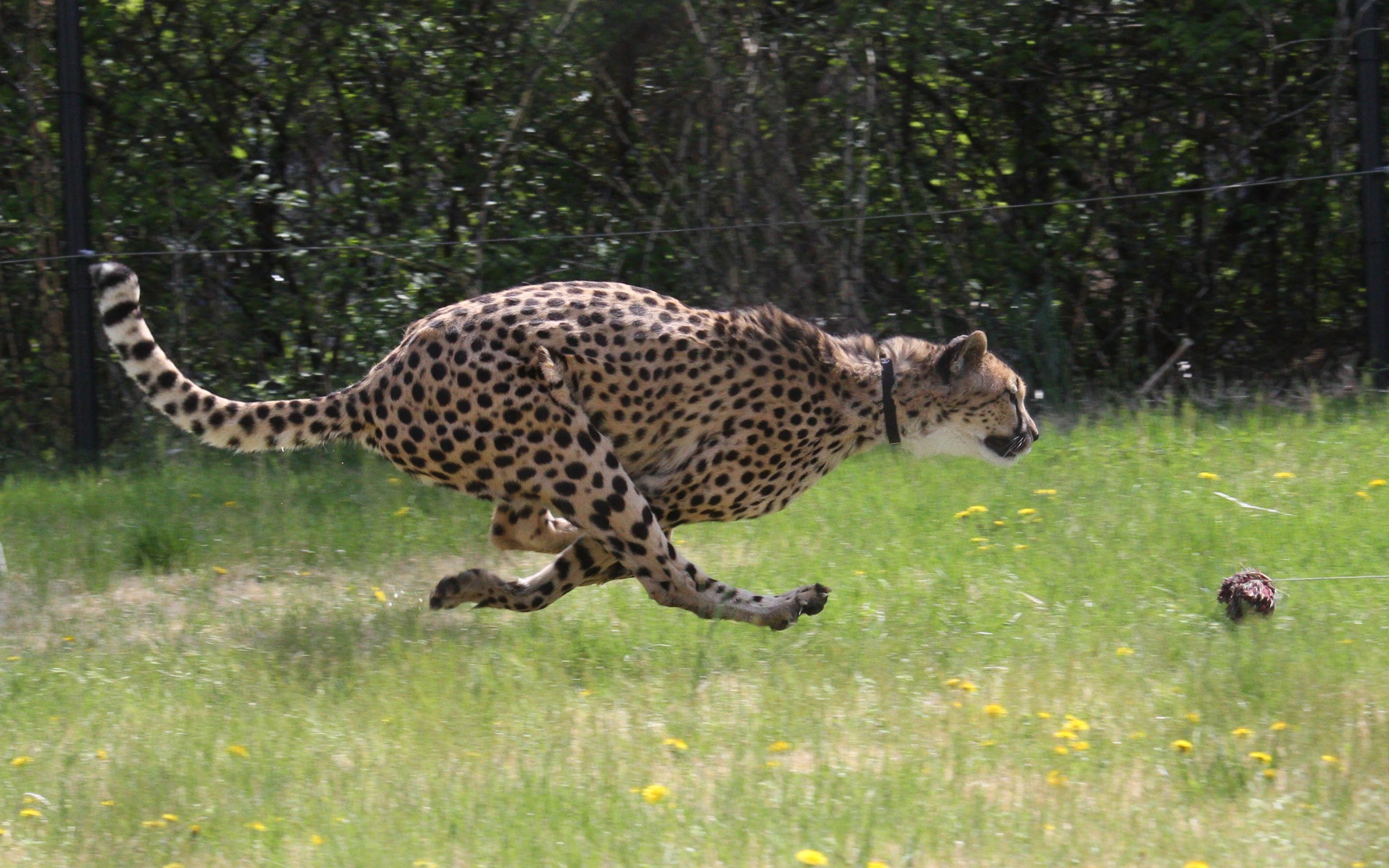
Hero photograph: Mark Dumont, "Cheetah Run", a cheetah sprinting after a lure at the Cincinnati Zoo (Wikimedia Commons), CC BY 2.0. Cropped for the Field Journal hero.

Questions people ask
How long can a cheetah keep up its top speed?
Only for a few seconds. Collared wild cheetahs in Botswana usually held their top speed for just 1–2 seconds, and the average run was 173 m (Wilson et al. 2013). The Smithsonian's National Zoo says full sprints last about 20 seconds (Smithsonian).
How often do cheetah hunts succeed?
Roughly one run in four in the wild. In Botswana, 94 of 367 collared runs (26%) ended in a kill (Wilson et al. 2013). The Smithsonian's National Zoo puts it at about half of all chases (Smithsonian). The collar figure may include some play or escape runs.
Do cheetahs give up chases because they overheat?
No. Wild cheetahs fitted with temperature loggers averaged 38.4 °C when a chase ended. Their temperature rose more after a successful hunt (1.3 °C) than a failed one (0.5 °C), which the researchers think is stress, not heat from running (Hetem et al. 2013).
What do cheetahs mostly eat?
Small and medium antelope. The Smithsonian lists springbok, steenbok, duikers, impala and gazelles, plus the young of larger animals, game birds and rabbits (Smithsonian). In the Botswana collar study, impala made up 75% of the diet (Wilson et al. 2013).
Do lions steal food from cheetahs?
Yes. Lions, hyenas and sometimes groups of vultures can drive cheetahs off their kills, and the Smithsonian estimates cheetahs lose about half their food this way (Smithsonian). Losing a quarter of kills costs only about 1.1 extra hours of hunting a day (Scantlebury et al. 2014).
Sources
- Wilson et al. (2013) Locomotion dynamics of hunting in wild cheetahs, Nature
- Wilson et al. (2018) Biomechanics of predator–prey arms race in lion, zebra, cheetah and impala, Nature
- Hubel et al. (2016) Energy cost and return for hunting in African wild dogs and cheetahs, Nature Communications
- Hetem et al. (2013) Cheetah do not abandon hunts because they overheat, Biology Letters
- Taylor & Rowntree (1973) Temperature regulation and heat balance in running cheetahs: a strategy for sprinters?, American Journal of Physiology
- Scantlebury et al. (2014) Flexible energetics of cheetah hunting strategies provide resistance against kleptoparasitism, Science
- Hilborn et al. (2012) Stalk and chase: how hunt stages affect hunting success in Serengeti cheetah, Animal Behaviour
- Sharp (1997) Timed running speed of a cheetah (Acinonyx jubatus), Journal of Zoology
- Laurenson (1994) High juvenile mortality in cheetahs (Acinonyx jubatus) and its consequences for maternal care, Journal of Zoology
- Mills & Mills (2014) Cheetah cub survival revisited, Journal of Zoology
- Smithsonian's National Zoo & Conservation Biology Institute: Cheetah
- ScienceDaily (2013) Wild cheetah accelerate fast and reach speeds of up to 58 miles per hour during a hunt