Emperor Penguin: One Iceberg Cost a Colony 14,500 Chicks
Species deep dive · emperor penguin
In 2025, one iceberg cut the number of emperor penguin chicks at Coulman Island, one of the largest colonies in Antarctica, by about 69%. Researchers counted 6,658 chicks, down from 21,242 the year before, which is roughly 14,500 fewer (Park et al. 2026). The iceberg ran aground just north of the colony in late July 2025, just as the chicks were starting to hatch. It left the adults a long detour, a 20-metre ice wall and one narrow gap between their chicks and the sea.
The study, by a team from the Korea Polar Research Institute (KOPRI) and partners, was published in Communications Earth & Environment on 23 July 2026. Here is what happened and why a single block of ice can matter so much to a bird that already lives on the edge.
A colony on a fixed timetable
Emperor penguins breed on the sea ice in the middle of the Antarctic winter, and their year runs on a strict schedule. Eggs are laid in May and June, males incubate them through the winter, chicks hatch in July and August, and the chicks are raised through spring until they fledge in December or January (Park et al. 2026).
Once a chick hatches, the parents take turns walking out to open water to feed and back again to feed it. A newly hatched chick can survive only a short time on the "penguin milk" (a secretion from the gullet) that its father produces, so the mother needs to get back on time (Park et al. 2026). Anything that makes that commute longer can tip chicks into starvation.
Our earlier piece explains how emperor penguins survive winter on fast ice. This story is about what happens when the path to the sea gets blocked.
How the iceberg reached Coulman Island
Coulman Island lies off the North Victoria Land coast in the western Ross Sea, inside the Ross Sea Marine Protected Area. It has one of the longest census records of any emperor penguin colony, and KOPRI has run standard aerial counts there every year since 2017 by helicopter from Jang Bogo Station, about 220 km away (Park et al. 2026).
Using satellite images, the researchers traced the iceberg back to its source:
- March 2025: it broke off the Nansen Ice Shelf in Terra Nova Bay. A MODIS image from 12 March shows the iceberg had already separated.
- March to July: it drifted north past Cape Washington and rotated along the way.
- About 28 July: it ran aground 3–5 km north of the colony.
- 2 January 2026: once the surrounding sea ice was gone, it began drifting away.
The iceberg measured about 13.9 km long and 4.0 km wide, an area of roughly 42.7 km². It sat right across the main route between the colony and the feeding grounds to the north and northeast (Park et al. 2026).
The ice wall, the detour and the one gap
The shape of the iceberg was the real problem. Its seaward side sloped gently, so penguins coming back from the sea could climb onto it. But the side facing the colony was a near-vertical cliff of more than 20 metres. One measured section was about 21.7 m high, which no penguin can climb down (Park et al. 2026).
Researchers saw adult penguins gathered along the iceberg's southern ice walls for long periods, apparently unable to get past. A passage about 1 km wide stayed open along the iceberg's eastern edge, but it was narrow and probably hard to find. Even on the most direct route, the distance from the colony to open water grew from about 9.3 km in 2024 to 14.9 km in 2025, and real routes were likely much longer (Park et al. 2026).
What the counts showed
The November 2025 aerial survey found 6,081 chicks. A follow-up survey in December found a few more small groups, bringing the total to 6,658. That is about 69% below the 2024 count of 21,242 and below the 2017–2024 average of 21,202. It is the lowest count in a record that goes back to 1983. The highest count on record was 34,735 chicks in 1992 (Park et al. 2026).
The adults did show up. The team counted 15,242 adults, which gives a ratio of about 0.44 chicks per adult, below the 0.46–0.99 range reported before for this colony. That pattern suggests that many pairs did start breeding but lost their chicks early on. Several chick carcasses were seen in the colony during the November survey, but no dead adults. The 37 surviving chicks that were measured in December were normal in size and weight compared with chicks at nearby Cape Washington, so the ones that made it through the early weeks were being fed well (Park et al. 2026).
The authors are careful about what this shows. They present it as an observational case study: the evidence points clearly to the iceberg, but the counts alone can't prove cause. They also call it a "localized, event-driven disturbance", not a sign of a sea-wide collapse (Park et al. 2026).
It has happened before
Icebergs have blocked emperor penguins in the Ross Sea before. In 2001 the giant icebergs B15A and C16 grounded near Cape Crozier and Beaufort Island (Kooyman et al. 2007). At Cape Crozier, the colony had two years in a row of complete breeding failure. At Beaufort Island, the icebergs formed a barrier of about 150 km between the island and the open water of the Ross Sea polynya that lasted until late 2003 (Park et al. 2026).
The Coulman Island iceberg was much smaller and left after about five months. It still shows that a colony does not need to lose its sea ice to fail. It only needs to lose its way to the sea at the wrong time.
Icebergs are not always the enemy
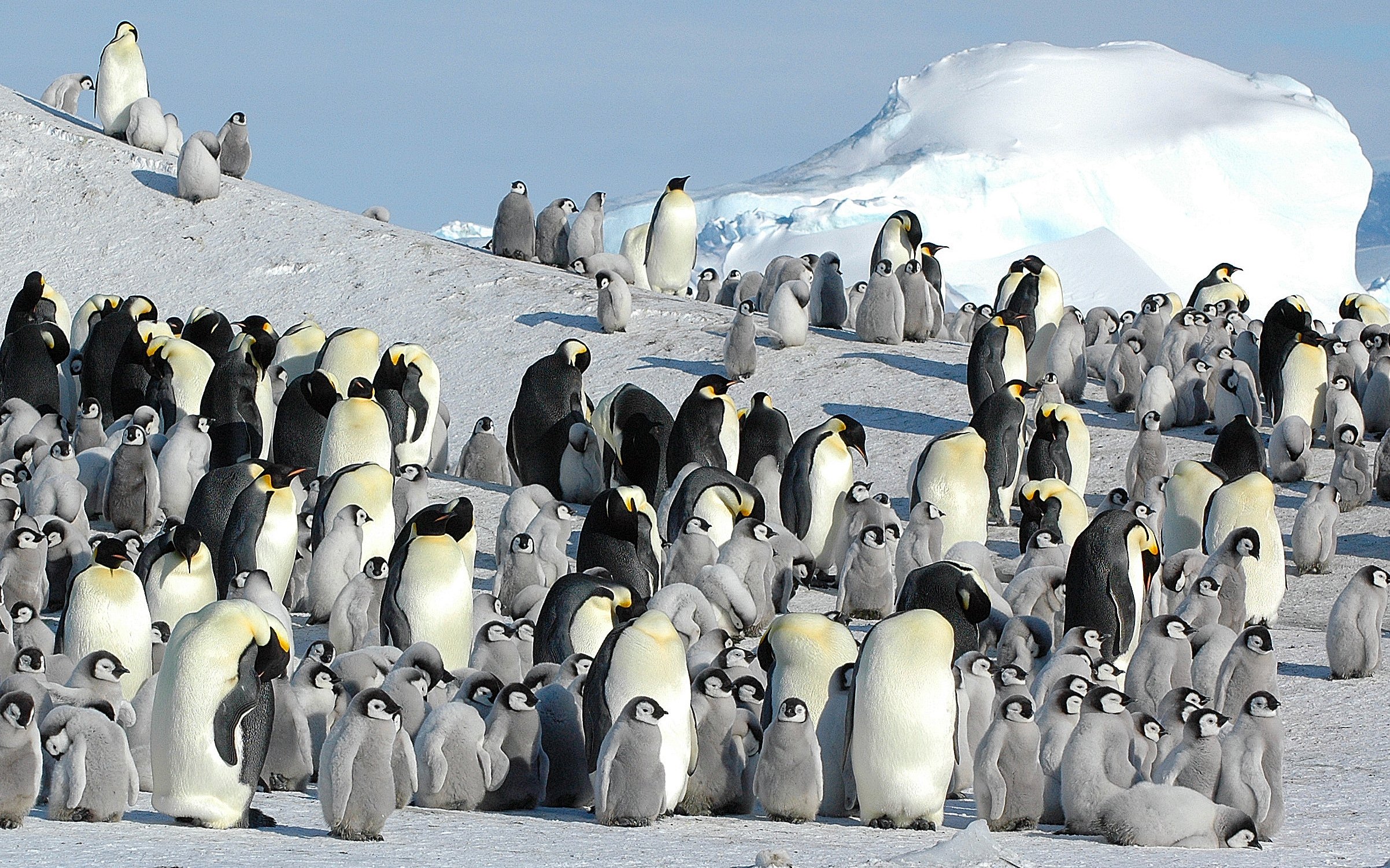
Icebergs are not only obstacles. A separate 2026 study tracked breeding emperor penguins from Snow Hill Island in the Weddell Sea, the colony shown in the photo above. In the 2025–26 season, at least three tracked birds circled closely around two large icebergs, A81 and D33A. The researchers suggest the iceberg edges may have been used as feeding spots (Guímaro et al. 2026). Whether an iceberg helps or harms seems to depend on where it ends up and what shape it has.
What it means for an Endangered bird
In April 2026, the IUCN moved the emperor penguin from Near Threatened to Endangered. Its population is projected to halve by the 2080s, mainly because sea ice is breaking up earlier. Satellite images suggest about 10% of the population, more than 20,000 adults, was lost between 2009 and 2018 alone (IUCN). In 2022, record-low sea ice caused breeding to fail at colonies in the Bellingshausen Sea (Fretwell et al. 2023).
A grounded iceberg is a different kind of threat from melting sea ice, but it hits the same weak spot. Emperor penguins need a reliable path between their chicks and the sea for months at a time. With colonies already under pressure, a single bad year at one of the biggest colonies matters.
How the Emperor Penguin plays in Wilder
In Wilder the Emperor Penguin (Aptenodytes forsteri) is an Uncommon Aves card in the Tundra element. It costs 4 Energy, with Attack 3 and Health 5, and has Herd and Resilient. Herd fits a bird that survives winter in tightly packed huddles, and Resilient fits a species that raises chicks in the coldest place on Earth. Its flavour text reads: "Fathers trade tuxedos for egg cradles through the polar night." For more cold-water wildlife, read about Antarctic krill, the food at the base of the Southern Ocean.
Wilder is a free browser collectible card game about real animals, and you can play it free in your browser with no signup.
Photo credit
Hero photograph: Jenny Varley, "Emperor penguins at Snow Hill Island" (adult emperor penguins with chicks in front of an iceberg frozen into the sea ice, Snow Hill Island, October 2009), Wikimedia Commons, CC BY-SA 2.0. Cropped for the Field Journal hero.

Questions people ask
How do scientists count emperor penguin chicks?
Mostly from the air and from space. At Coulman Island, KOPRI counts chicks from helicopter photos taken about 600 m above the colony, using the same method every year since 2017 so the numbers can be compared (Park et al. 2026). Very high-resolution satellite images also help, because guano stains on the ice show where penguins have been gathering. At Coulman Island in November 2025, those stains were largely missing from places that had been covered a year earlier (Park et al. 2026).
How far do emperor penguin parents travel to feed their chicks?
Often hundreds of kilometres per trip. Tracked parents from Snow Hill Island made trips that averaged 4.8 days in 2023–24 and 10.5 days in 2025–26. The longest trip lasted 34 days, covered 2,079.8 km and went 478 km from the colony (Guímaro et al. 2026).
Can emperor penguins move to a different colony?
Yes, sometimes. After the giant icebergs B15A and C16 blocked Ross Sea colonies in 2001, researchers recorded fewer breeding pairs and, in some cases, birds redistributing or relocating between colonies (Park et al. 2026; Kooyman et al. 2007).
Are emperor penguins a protected species under the Antarctic Treaty?
Not yet. As of a study published in October 2026, months after the IUCN listed the emperor penguin as Endangered, it was still not designated a Specially Protected Species under the Antarctic Treaty, and researchers have called for it to be considered (Guímaro et al. 2026).
Sources
- Park et al. (2026) Iceberg-driven constraints on colony–foraging connectivity result in severe decline in chick counts for the Coulman Island emperor penguin colony, Communications Earth & Environment
- Kooyman et al. (2007) Effects of giant icebergs on two emperor penguin colonies in the Ross Sea, Antarctica, Antarctic Science
- Fretwell, Boutet & Ratcliffe (2023) Record low 2022 Antarctic sea ice led to catastrophic breeding failure of emperor penguins, Communications Earth & Environment
- Guímaro et al. (2026) Breeding emperor penguins show interannual recurrence in shelf-break associated foraging areas across contrasting sea ice conditions in the northwestern Weddell Sea, Scientific Reports
- IUCN (9 April 2026): Emperor penguin and Antarctic fur seal now Endangered due to climate change