Largest Reptiles in the World, Ranked: The Saltwater Crocodile Is No. 1
Showdown · saltwater crocodile, komodo dragon, green anaconda
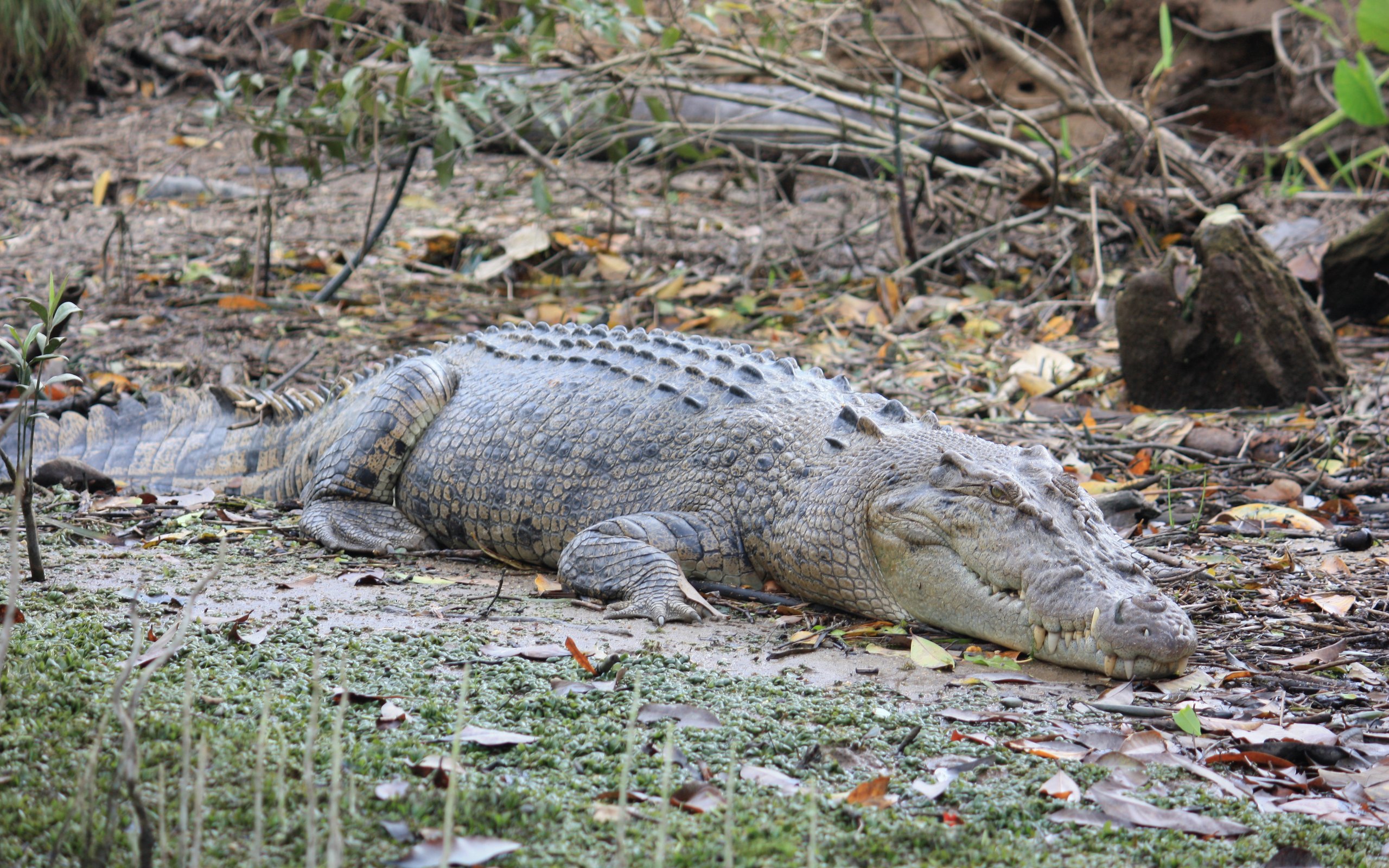
The saltwater crocodile is the largest reptile alive today. Big males can grow past 6 metres and weigh more than 1,000 kg (Queensland Museum). Next come the Nile crocodile and the leatherback sea turtle, both of which can top 900 kg. Then the American alligator and the giant tortoises of Galápagos and Aldabra. The Komodo dragon and the green anaconda, two reptiles famous for their size, rank lower than you might expect.
This is the Field Journal's weekly Thursday showdown, and this week it is all about bulk.
How we ranked them
We ranked by weight, not length. A long, thin snake and a short, heavy turtle are hard to compare by length, and weight is the best single measure of how big an animal really is. For each species we used the heaviest weight given by a museum, zoo, government agency or research source. We only count animals alive today, so prehistoric giants like Deinosuchus are out.
Two things to keep in mind:
- Records and typical adults are different. A record crocodile can weigh twice as much as an average adult male. Where a source gives both, we show both.
- Tape measures and campfire stories are different. Some reptile sizes, especially snakes, get repeated without anyone weighing the animal. Where a figure looks like a reach rather than a measurement, we say so and rank it more cautiously.
The largest reptiles, ranked by weight
| Rank | Reptile | Scientific name | Big-adult weight (source) | Wilder card |
|---|---|---|---|---|
| 1 | Saltwater crocodile | Crocodylus porosus | Large males over 1,000 kg and over 6 m (Queensland Museum) | Saltwater Crocodile |
| 2 | Nile crocodile | Crocodylus niloticus | Males typically 400–500 kg, up to 900 kg and 6.1 m (World Land Trust) | Not yet carded |
| 3 | Leatherback sea turtle | Dermochelys coriacea | Adults 340–450 kg (NOAA); range 250–900 kg (Animal Diversity Web) | Not yet carded |
| 4 | American alligator | Alligator mississippiensis | Exceptionally large males nearly 454 kg (Smithsonian's National Zoo) | Not yet carded |
| 5 | Galápagos giant tortoise | Chelonoidis spp. | Average 250 kg, up to 400 kg (Galapagos Conservation Trust) | Not yet carded |
| 6 | Aldabra giant tortoise | Aldabrachelys gigantea | Males up to 250 kg; record 305 kg (Smithsonian's National Zoo) | Not yet carded |
| 7 | Komodo dragon | Varanus komodoensis | Typically about 70 kg; largest verified 166 kg (Smithsonian's National Zoo) | Komodo Dragon |
| 8 | Green anaconda | Eunectes murinus | "Can weigh" up to 250 kg (Smithsonian's National Zoo), but field-measured giants are far lighter | Green Anaconda |
Weights are rounded and come from the sources linked in each section below. Several big reptiles were left out because we could not find consistent, sourced weights for them, including the gharial, whose males reach 5–6 metres long (Smithsonian's National Zoo).
1. Saltwater crocodile: the heaviest reptile on Earth
The saltwater crocodile, also called the estuarine crocodile, is the largest living reptile. Large males can exceed 6 metres and 1,000 kg. Females are much smaller, usually around 3 metres and up to 150 kg (Queensland Museum). Parks Australia's Kakadu National Park gives the same picture: males can reach 6 metres and more than 1,000 kg (Kakadu National Park). Most adults are smaller than the record holders, averaging 3–5 metres (Australian Museum).
That size gap between the sexes is huge. A big male saltie can weigh more than six large females put together. Their range runs from southwestern India and Sri Lanka through Southeast Asia to northern Australia, and some turn up on remote Pacific islands such as Fiji (Australian Museum). For the bite behind all that bulk, see our piece on the saltwater crocodile's record-breaking bite.
2. Nile crocodile: Africa's heavyweight
The Nile crocodile is the world's second-largest crocodilian and the largest of Africa's three crocodile species. Adult males average 5 metres long and typically weigh 400–500 kg, but can reach 6.1 metres and up to 900 kg (World Land Trust). That puts its record weight just below the saltwater crocodile's, and its typical male weight clearly ahead of every turtle and tortoise on this list. It is listed as Least Concern (World Land Trust).
3. Leatherback sea turtle: the largest turtle in the world
The leatherback is the largest turtle alive. NOAA Fisheries gives adult weights of 750–1,000 pounds (about 340–450 kg) and lengths of 5–6 feet (about 1.5–1.8 m) (NOAA Fisheries). Animal Diversity Web gives a wider range of 250–900 kg (Animal Diversity Web). Its record weight ties with the Nile crocodile's, but a typical adult leatherback is lighter than a typical male Nile crocodile, so it takes third.
Leatherbacks are the only sea turtles without scales or a hard shell. Their name comes from their tough, rubbery skin (NOAA Fisheries). They are also deep divers: the deepest recorded dive reached nearly 4,000 feet (about 1,200 m), and dives can last up to 85 minutes (NOAA Fisheries). The species is listed as Endangered under the US Endangered Species Act (NOAA Fisheries).
4. American alligator: big, but a step down from the crocs
Male American alligators are larger than females. Average adult males are about 3.4 metres (11.2 feet) long and average females about 2.6 metres (8.2 feet). Exceptionally large males can reach nearly 454 kg, or about half a ton (Smithsonian's National Zoo). That is a giant, but it is still only about half the weight of a record saltwater or Nile crocodile.
5. Galápagos giant tortoise: the heaviest land reptile here
Galápagos giant tortoises average about 250 kg and 1.5 metres long, with the biggest reaching 400 kg and 1.8 metres (Galapagos Conservation Trust). That makes them the heaviest reptiles on this list that never need to swim. They are listed as Endangered (Galapagos Conservation Trust).
6. Aldabra giant tortoise: the Indian Ocean's giant
The Aldabra tortoise comes from Aldabra Island in the Seychelles, northeast of Madagascar. Males can have a 1.22-metre carapace and weigh up to 250 kg, and females reach about 159 kg. One Aldabra tortoise weighing 305 kg is the largest free-roaming tortoise ever recorded (Smithsonian's National Zoo).
7. Komodo dragon: the largest lizard, but not a top-five reptile
The Komodo dragon is the largest living lizard. Wild dragons typically weigh about 70 kg, and the largest verified specimen was 3.13 metres long and weighed 166 kg (Smithsonian's National Zoo). That record is very real, but it is still lighter than a typical big tortoise. For how a Komodo dragon takes down prey much heavier than itself, read Komodo dragon: the largest lizard and its venom.
8. Green anaconda: a giant snake, with an asterisk
The green anaconda is one of the largest snakes in the world, and females are much bigger than males. Smithsonian's National Zoo says females can reach 9 metres and weigh 250 kg (Smithsonian's National Zoo). Those are maximum figures, though, not weighed record animals. In a seven-year field study of wild anacondas in the Venezuelan llanos, Jesús Rivas found that the largest snakes he measured were "well below the maximum reported in the literature" (Rivas 2000). Because of that gap, we rank the anaconda just below the Komodo dragon, whose 166 kg record is a verified weight. Our green anaconda piece explains why snake sizes get exaggerated so often.
How the top reptiles play in Wilder
All three reptiles on this list that have Wilder cards cost 6 Energy, so they all arrive late in a game as big threats.
- The Saltwater Crocodile (Crocodylus porosus) is an Uncommon Reptilia card in the Water element with Attack 5 and Health 10, the highest Health of the three. It has Basking, Guardian, Thorns and Relentless, plus the ability Death Roll: for 3 Energy, it deals 2 damage to an enemy creature. Flavour text: "Has the strongest bite on Earth. Acts like it."
- The Komodo Dragon (Varanus komodoensis) is a Rare Grassland card with Attack 6 and Health 8. It has Basking, Feast (Feast bonus +1 Attack / +1 Health) and Thorns, and the ability Septic Bite: for 3 Energy, it gains Venom. Flavour text: "One bite. Then patience."
- The Green Anaconda (Eunectes murinus) is a Rare Forest card with Attack 6 and Health 7, and has Ambush and Relentless. Flavour text: "Lurks like a living log until the river runs red."
The rest of the list doesn't have cards yet. For last week's showdown, see the biggest cats in the world, ranked, and for the mammal version of this list, see the heaviest land mammals, ranked.
Wilder is a free browser collectible card game about real animals, and you can play it free in your browser with no signup.
Photo credit
Hero photograph: Tisha Mukherjee, "Saltwater crocodile in Sundarbans National Park September 2024 by Tisha Mukherjee 02" (a saltwater crocodile resting in mud and grass in Sundarbans National Park, West Bengal, India), Wikimedia Commons, CC BY-SA 4.0. Cropped for the Field Journal hero.

Questions people ask
How long do giant tortoises live?
Often more than 100 years. Galapagos Conservation Trust gives Galápagos giant tortoises an average lifespan of 100+ years (Galapagos Conservation Trust), and Smithsonian's National Zoo says Aldabra tortoises can live more than 100 years, with ages of up to 150 years reported (Smithsonian's National Zoo).
What does a leatherback sea turtle eat?
Mostly jellyfish and salps. Leatherbacks lack the crushing beak of other sea turtles. Instead they have pointed, tooth-like cusps, sharp-edged jaws and backward-pointing spines in the mouth and throat that help them hold on to soft, slippery prey (NOAA Fisheries).
How far does a leatherback sea turtle travel in a year?
Some swim more than 10,000 miles (about 16,000 km) a year between their nesting beaches and foraging grounds. NOAA describes the species as highly migratory (NOAA Fisheries).
How long can a crocodile stay underwater?
It depends on what the crocodile is doing. In a study of Australian freshwater crocodiles, active dives were usually under a minute and resting dives around 12 minutes. When hiding from a threat they stayed down far longer: one 5 kg crocodile stayed submerged for 344 minutes and a 42 kg crocodile for 402 minutes (Queensland Museum).
Sources
- Queensland Museum: Crocodiles
- Parks Australia, Kakadu National Park: Crocodiles
- Australian Museum: Estuarine Crocodile
- World Land Trust: Nile crocodile
- NOAA Fisheries: Leatherback Turtle
- Animal Diversity Web: Dermochelys coriacea
- Smithsonian's National Zoo: American alligator
- Galapagos Conservation Trust: Galapagos giant tortoise
- Smithsonian's National Zoo: Aldabra tortoise
- Smithsonian's National Zoo: Komodo dragon
- Smithsonian's National Zoo: Green anaconda
- Rivas (2000) The life history of the green anaconda (Eunectes murinus), PhD dissertation, University of Tennessee
- Smithsonian's National Zoo: Gharial