Laranja Killifish: The Tiny Orange Fish Already at Risk
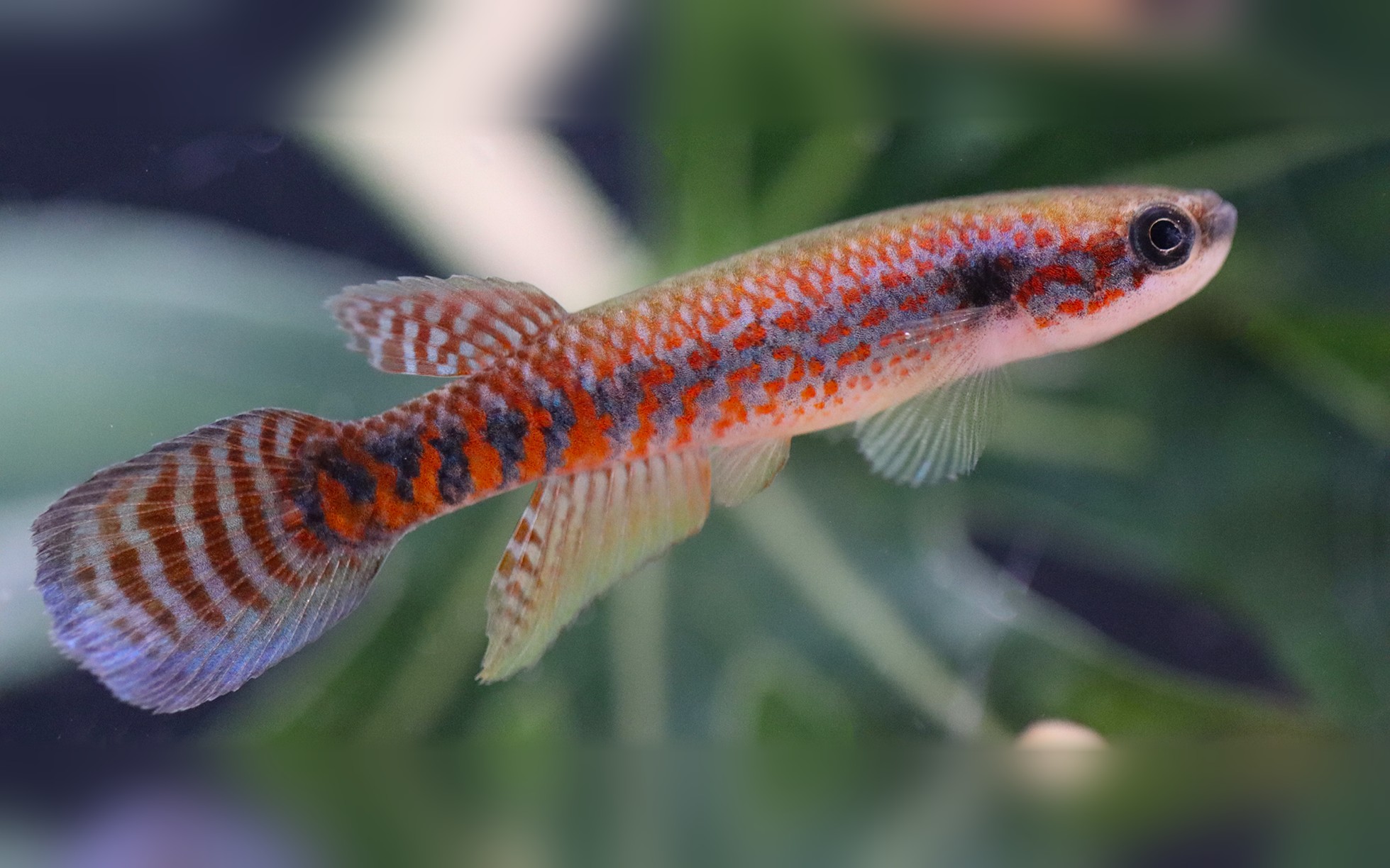
Species deep dive · laranja killifish
*The Laranja killifish (Laimosemion laranja) is not on the IUCN Red List yet, but the scientists who named it say it already qualifies as Endangered.* Described in August 2026, this orange-patterned fish is known from just three small pools beside streams near Laranjal do Jari in Amapá, Brazil. Its whole known range covers an estimated 25 km², and every one of those pools shows signs of deforestation, mining or urban pollution. That is why the authors recommend an Endangered listing under IUCN criteria B1ab(iii)+B2ab(iii) (Abrantes et al. 2026).
A fish that "immediately caught our attention"
The species was found by a team from the Universidade Federal do Rio Grande do Norte (UFRN) and the University of West Florida, with colleagues from other Brazilian institutions. They were sampling small forest streams, called igarapés locally, in the Rio Cajari region as part of a project on how life-history strategies evolve in killifishes of the family Rivulidae. "We found this fish with a very striking coloration, which immediately caught our attention," said lead author Yuri Abrantes (Pensoft blog).
The specimens behind the description were collected in March 2024 and June 2025. The holotype, the single specimen that officially defines the species, is a male of 26.8 mm standard length (Abrantes et al. 2026). The name laranja is Portuguese for both the colour orange and the fruit. It also honours the municipality of Laranjal do Jari, because the team wanted a name that would connect the fish with the people who live there (Pensoft blog).
How to recognise it
Males are the showy ones. The front of the flank is light grey with four to five rows of orange dots, and the rear has five to six orange, chevron-shaped oblique bars, with a dark blotch behind the gill cover. Females are more muted, with a light brown front half and dark brown chevron bars towards the tail (Abrantes et al. 2026).
That pattern of spots in front and chevrons behind marks it as a member of the Laimosemion geayi species group. The genus Laimosemion has 35 species, all endemic to the Amazon and spread across the Guiana Shield from French Guiana to Peru. In looks, the new fish is closest to L. dibaphus from the Rio Tapajós. In DNA it is closest to L. agilae and L. strigatus, differing from both by 5.3% in the mitochondrial cox1 gene, and it differs from L. geayi itself by 12.3% (Abrantes et al. 2026).
Life in a forest pool
The Laranja killifish lives in pools next to small streams. The pools have floating plants, clear water with a moderate current, sandy or muddy bottoms, and are about 0.5–1 m deep. It shares them with other small fishes, including the killifish Anablepsoides jari, the livebearer Poecilia waiapi, a trahira-like fish (Hoplerythrinus unitaeniatus) and a knifefish (Brachyhypopomus). The region averages 26.4 °C, with about 2,500 mm of rain a year and the heaviest rain from March to May (Abrantes et al. 2026).
Killifish are famous for living fast. Some South American and African species live in pools that dry out every year. They bury their eggs in the mud, the adults die, and the embryos wait until rain refills the pond (Britannica). Laimosemion represents one of five separate times this "annual" life cycle evolved within the family Rivulidae, according to Abrantes (Pensoft blog). The study doesn't say whether L. laranja itself is annual, and its pools sit beside flowing streams. The wider research project is exploring the genetics behind these different "life paces", because short-lived killifish may help answer questions about ageing (University of West Florida).
Three pools, three threats
Each of the three known sites has its own problem (Abrantes et al. 2026):
- On the edge of a reserve. One site lies just a few metres outside the Rio Cajari Extractive Reserve, but it still showed burned trees. Local residents said some nearby pools were left over from mining, and their water was intensely reddish with suspended sediment.
- Next to the power station. The type locality is only 180 m from the Laranjal do Jari electric power substation.
- Inside the city. The third site is a wetland in town, where urbanisation is causing habitat loss and plastic pollution.
Beyond the Endangered recommendation, the authors suggest extending the boundaries of the neighbouring Rio Cajari Extractive Reserve to protect the fish's habitat (Pensoft blog). "Finding a new species is a thrilling and humbling discovery," said co-author Waldir Miron Berbel-Filho. "It's a reality check about our place on Earth and how much is still out there to be explored" (University of West Florida).
How the Laranja Killifish plays in Wilder
In Wilder the Laranja Killifish (Laimosemion laranja) is a Common Pisces card in the Water element. It costs 1 Energy, with Attack 1 and Health 2, and has Camouflage and Ambush. Its card text says: "When this dies, shuffle a Laranja Killifish into your deck." That is a nod to the annual killifishes, whose eggs can wait in the mud for the next rain. Its flavour text reads: "Orange chevrons flash once, then the pool is empty again." It got that ability in the Den Keepers and Sun Rock design update. For more of 2026's new species, read about the Tilcayo tiger cat and the Várzea frog Adenomera varcena. For a much bigger Amazon fish, see the Red-bellied Piranha.
Wilder is a free browser collectible card game about real animals, and you can play it free in your browser with no signup.
Photo credit
Hero photograph: Y. Abrantes, "Laimosemion laranja new species, INPA–ICT 062600, Holotype, male, 26.8 mm SL" (Figure 2 in Abrantes et al. 2026, Zoosystematics and Evolution 102(4)), Pensoft via doi:10.3897/zse.102.187659, CC BY 4.0. Padded to fit the Field Journal hero.
Questions people ask
Who discovered the Laranja killifish?
A team led by Yuri Abrantes of the Universidade Federal do Rio Grande do Norte, with Waldir Miron Berbel-Filho of the University of West Florida and colleagues from other Brazilian institutions. They described it in Zoosystematics and Evolution on 20 August 2026 (Abrantes et al. 2026; UWF).
Where are the type specimens of Laimosemion laranja kept?
The holotype, a male catalogued as INPA-ICT 062600, is in the fish collection of the Instituto Nacional de Pesquisas da Amazônia (INPA) in Manaus. Paratypes are held at INPA, the Museu Nacional in Rio de Janeiro (MNRJ) and the UFRN collection (Abrantes et al. 2026).
What does "SL" mean in fish measurements?
SL is standard length: the distance from the tip of the snout to the end of the backbone (the rear edge of the hypural plate), not counting the tail fin. (FishBase glossary).
What is a killifish?
Killifish is a common name for a few hundred species of small, usually elongated egg-laying fishes found worldwide, especially in the tropics of Africa and the Americas. The largest reach about 15 cm, and many are much smaller. Unlike guppies and other livebearers, all killifish lay eggs (Britannica).
Sources
- Abrantes et al. (2026) A new killifish of the genus Laimosemion (Cyprinodontiformes, Rivulidae) from Rio Cajari in the Brazilian Amazon, Zoosystematics and Evolution 102(4)
- Pensoft blog (22 Sep 2026): Vivid orange killifish discovered in the Brazilian Amazon
- University of West Florida Newsroom: UWF researcher leads discovery of new killifish species
- Encyclopaedia Britannica: Killifish
- FishBase Glossary: Standard length