Pine Marten: The Predator That Helps Red Squirrels Beat Greys
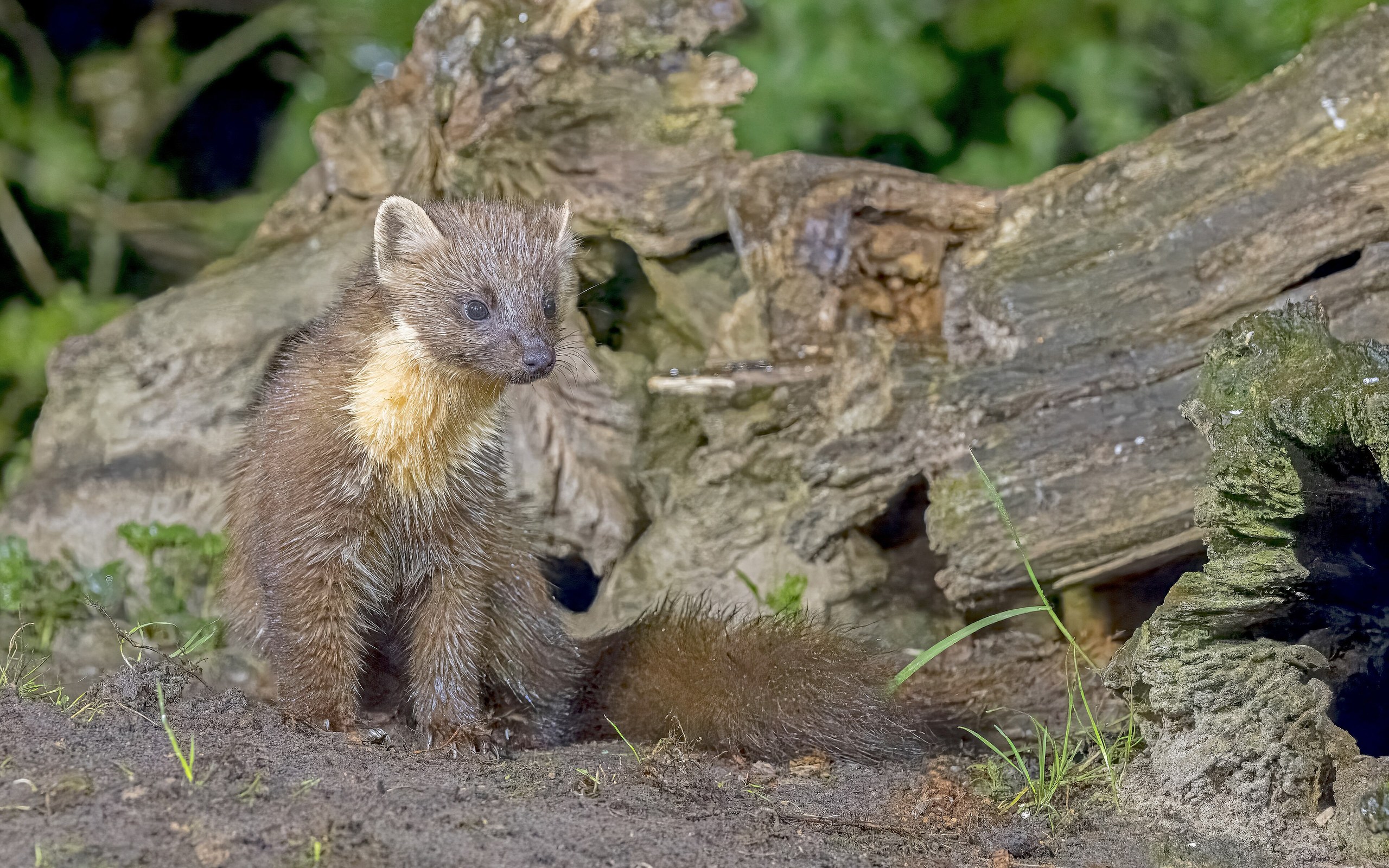
Species deep dive · pine marten
Yes, pine martens eat squirrels, but where they come back, red squirrels tend to win. In the Irish midlands, grey squirrels crashed across roughly 9,000 km² of their former range as pine martens recovered, and red squirrels became common again after an absence of up to 30 years (Sheehy & Lawton 2014). A later study in Scotland found the same lopsided pattern: the more a site was exposed to pine martens, the less likely it was to hold grey squirrels, while red squirrels got an indirect boost (Sheehy et al. 2018). That is why every new marten sighting in England right now is good news for red squirrel fans.
Why the grey squirrel loses
Grey squirrels were brought to Britain and Ireland from North America, and where they spread, native red squirrels usually disappear. The pine marten seems to flip that result. The Scottish study found the marten's effect on the two squirrels was strongly lopsided: grey squirrel numbers fell where martens were present, while red squirrels benefited (Sheehy et al. 2018).
One clue is in how the squirrels react to a marten's smell. Researchers put pine marten scent at squirrel feeders and watched what happened. Red squirrels avoided the scented feeders, became more watchful and spent less time feeding. At some sites they didn't come back to the feeder for 48 hours. Grey squirrels showed no anti-predator behaviour at all and actually became less vigilant (Twining et al. 2020). Red squirrels and pine martens have lived alongside each other across Eurasia for a very long time. The grey squirrel never met this predator until it was shipped across the Atlantic, and it still seems not to recognise the danger.
The full story isn't settled. The Vincent Wildlife Trust points out that red squirrels turn up only rarely in pine marten diets in Britain and Ireland, and that scientists still don't fully understand how martens suppress the greys (Vincent Wildlife Trust). The pattern on the ground, though, keeps repeating.
The comeback making headlines this month
The pine marten was once thought to be the second most common carnivore in Mesolithic Britain. Woodland clearance and predator control left it confined to a few remote areas of Britain and Ireland by 1915. It got full legal protection in 1988. Today it is spreading naturally in Scotland and Ireland, and it was brought back to mid-Wales (with martens moved from Scotland), the Forest of Dean and Devon through translocation projects. On the Red List for Britain's mammals it is still Critically Endangered in England and Wales, though Least Concern in Scotland (Vincent Wildlife Trust).
October 2026 brought three pieces of news:
- South Devon. Camera traps confirmed a female pine marten living in South Devon after travelling at least 25 miles (about 40 km) to set up a territory. The sighting comes two years after the first releases of the Two Moors Pine Marten Project, led by Devon Wildlife Trust, which released 15 martens on Dartmoor in autumn 2024 and 19 on Exmoor in autumn 2025. Pine martens had been missing from the region for more than 100 years, after hunting and trapping drove the species close to extinction (The Moorlander).
- Suffolk. A camera trap at Benacre National Nature Reserve near Lowestoft filmed what is probably the county's first live pine marten. Natural England calls it a possible sighting for now, because a beech marten can look almost identical. The nearest earlier record was at Heacham in Norfolk in 2024 (Natural England).
- North Wales. The Magical Mammals project was extended. It will keep supporting red squirrels in Clocaenog Forest, northern Gwynedd and Anglesey, and will analyse pine marten genetics in Gwynedd (Natural Resources Wales).
A cat-sized climber with rotating ankles
A pine marten is about the size of a house cat. Females measure 46–54 cm with an 18–24 cm tail and weigh around 1.5 kg; males are 51–54 cm with a 26–27 cm tail and weigh around 2 kg. The fur is dark brown with a creamy-yellow throat patch called the bib, and every bib is unique, so researchers can tell individual martens apart from photos (Vincent Wildlife Trust).
Its real trick is in the trees. Pine martens have sharp, semi-retractable claws and ankles that can rotate through 180°, which lets them climb down trunks as well as up. A long bushy tail helps them balance on branches, and muscular legs let them leap from branch to branch (Vincent Wildlife Trust).
They are carnivores on paper but opportunists in practice. Meat makes up 30–70% of the diet, and the rest is fruit, nuts, eggs, invertebrates and fungi. In Britain, voles are a particularly important prey (Vincent Wildlife Trust).
Slow breeders with a pause button
Pine martens mate in midsummer but give birth the following spring. Fertilised eggs wait for around 230 days before implanting in the uterus, a trick called delayed implantation, so the kits arrive in early spring when food is easier to find. Females don't breed until they are two or three years old, breed only once a year and usually have one to three kits, born in March or April. The kits stay in a den, ideally a high tree hole, for six or seven weeks (Vincent Wildlife Trust). Old trees with big enough cavities are scarce in modern British woods, which is why conservation groups in Devon and elsewhere put up pine marten den boxes (The Moorlander).
Across its whole range, from Ireland and Spain to Scandinavia and western Siberia, the pine marten is listed as Least Concern (IUCN Red List). Its story in Britain shows how fast a woodland can change when a missing predator comes back.
How the Pine Marten plays in Wilder
In Wilder the Pine Marten (Martes martes) is a Common Mammalia card in the Forest element. It costs 2 Energy, with Attack 2 and Health 2, and has Camouflage and Feast (Feast bonus +1 Attack / +2 Health). Camouflage fits a mostly nocturnal tree-dweller that is famously hard to spot, and Feast fits an opportunist that eats whatever is plentiful. Its flavour text reads: "A tree-top bandit that caches tomorrow's meal in yesterday's hollow." For the squirrel side of the story, the Eastern Gray Squirrel has its own card and a Field Journal piece on its nut caches. Fellow mustelids include the European Badger, the Wolverine and the Honey Badger.
Wilder is a free browser collectible card game about real animals, and you can play it free in your browser with no signup.
Photo credit
Hero photograph: Charles J. Sharp, "European pine marten (Martes martes) Drenthe 4" (a pine marten showing its creamy-yellow bib beside a fallen log, Drenthe, Netherlands), Wikimedia Commons, CC BY-SA 4.0. Cropped for the Field Journal hero.

Questions people ask
How can you tell a pine marten from a beech marten?
Look at the bib, nose and coat. A pine marten's throat patch is usually yellowish with a reddish tinge, its nose is dark brown and its fur is a fairly even brown. A beech (stone) marten usually has a white bib that is often forked and can run down the forelegs, a pale pink nose and greyer fur with whitish underfur showing through (waldwissen.net).
Will a pine marten attack pets or chickens?
It can take small pets or hens if it can get in. Martens visit gardens looking for easy food and move on when there is none. The Vincent Wildlife Trust advises making hutches and hen houses secure with no gaps larger than 45 mm, which a marten could squeeze through.
How long do pine martens live?
Usually 7 to 10 years in the wild, and up to about 20 years in captivity. Only a small share of young martens survive to become breeding adults (Vincent Wildlife Trust).
Where can you see pine martens in Britain?
Scotland has the strongest populations, and martens are spreading in Ireland too. In Wales there is a viable population in mid-Wales, and in England they live in the Forest of Dean, Devon, Shropshire, the New Forest and the far north, where martens are moving in from southern Scotland (Vincent Wildlife Trust).
Sources
- Sheehy & Lawton (2014) Population crash in an invasive species following the recovery of a native predator, Biodiversity and Conservation
- Sheehy et al. (2018) The enemy of my enemy is my friend: native pine marten recovery reverses the decline of the red squirrel, Proceedings of the Royal Society B
- Twining et al. (2020) Native and invasive squirrels show different behavioural responses to scent of a shared native predator, Royal Society Open Science
- Vincent Wildlife Trust: Pine marten
- The Moorlander (27 Oct 2026): Pine marten confirmed living in South Devon
- Natural England (7 Oct 2026): Pine marten caught on camera in Suffolk nature reserve 'first'
- Natural Resources Wales (12 Oct 2026): Boost for North Wales red squirrels as recovery project continues
- IUCN Red List: Martes martes (Least Concern)
- waldwissen.net: Pine marten or stone marten?