Polar Bear: Why Churchill's Bears Wait on Shore for Hudson Bay Ice
Species deep dive · polar bear
Polar bears gather near Churchill, Manitoba, every October and November because that is where Hudson Bay freezes first. The bay's ice melts completely each summer, so every bear in the region has to come ashore and live off its fat. When autumn comes, the bears walk to the stretch of coast where new ice forms earliest, and they wait there to get back out to the seals as soon as they can (Churchill Northern Studies Centre; Polar Bears International).
That's why Churchill swells from about 900 people to several thousand every October and November, and why the bears of Western Hudson Bay are among the best studied polar bears in the world (Polar Bears International).
Why the ice forms near Churchill first
Hudson Bay is one of the few places in the polar bear's range where the sea ice disappears entirely in summer. Polar Bears International's Geoff York puts the Churchill effect down to "a combination of physical oceanography and geography." The bay's currents run counterclockwise. In summer they push the last melting ice toward the southern coast, which is where most bears come ashore. In autumn the same currents pile new ice floes against the point of land that Churchill sits on. Three rivers, the Churchill, Nelson and Hayes, also pour fresh water into the shallow coastal sea, and fresh water freezes at a higher temperature than salt water (Polar Bears International).
The Churchill Northern Studies Centre adds that the ice first forms along the western coast and usually spreads north from Cape Churchill (CNSC). Manitoba's wildlife service describes the same pattern from the bears' side: as autumn approaches, they move north along the coast and gather where the first winter ice forms, which brings many of them into Churchill itself (Province of Manitoba).
Four months without seals
Polar bears hunt from the ice, mainly ringed seals. Once the ice is gone, they can't hunt seals at all. In Hudson Bay, the whole population is forced ashore from about mid-July to mid-November, and most bears fast for around four months. Pregnant females stay ashore for about eight months, because they also den and give birth on land (Province of Manitoba).
The bears do eat on land, but it barely helps. Researchers fitted 20 polar bears near Churchill with video cameras and GPS collars for about three weeks in late summer. Almost all of them ate grasses or kelp, and many ate berries, bird carcasses, bones and even caribou antlers. One fed on a seal and one on beluga remains. Still, 19 of the 20 lost weight, about 1 kg a day on average, and the adult males lost about 1.5 kg a day. Some bears rested in a hibernation-like state, while others roamed, and three made long swims totalling 54 to 175 km each. The food covered the extra energy the active bears burned, but it didn't slow their weight loss or push back their predicted date of starvation (Pagano et al. 2024, Nature Communications).
So when you see a polar bear lying still on the tundra in October, it isn't being lazy. It's saving energy. Polar Bears International describes bears sheltering from the wind with their heads tucked into willow bushes, and adult males standing up on their hind legs to spar (Polar Bears International).
The wait is getting longer
From the bears' point of view, the ice-free season in western Hudson Bay grew by about three weeks between 1979 and 2015. In 2005–2015, satellite-collared bears came ashore about two weeks earlier, and went back onto the ice about a week later, than in the 1980s (Castro de la Guardia et al. 2017, Marine Ecology Progress Series). Manitoba notes that for every week earlier the ice breaks up, bears come ashore about 10 kg lighter (Province of Manitoba).
Aerial surveys in 2011, 2016 and 2021 estimated 949, 842 and 618 bears in Western Hudson Bay. The differences between surveys weren't statistically significant on their own, but each estimate was lower than the last. The drop was among adult females and young bears, while the number of adult males stayed the same (Atkinson et al. 2021 aerial survey report). The survey team found evidence for two explanations: fewer births and lower survival, and some bears moving into neighbouring Southern Hudson Bay. A later Environment and Climate Change Canada genetic study found more movement between the two populations than previously known. In 2021, when the last sea ice melted off Ontario, a quarter of the bears sampled in Southern Hudson Bay turned out to be Western Hudson Bay bears, most of them adult males, and many moved back west the following year (McGeachy et al. 2023, ECCC). Manitoba also reports that the bears' autumn weights and cub survival fell over the same period (Province of Manitoba). Whatever the exact mix, the underlying pressure is the same: less time on the ice to hunt.
A new risk this month: bird flu
In October 2026, researchers reported the first evidence that polar bears in East Greenland have been exposed to bird flu. In blood samples from bears taken by Inuit subsistence hunters, influenza A antibodies turned up in 3 of 14 bears in 2024 and 6 of 14 in 2025. None had been found in samples going back to 2016. Four of the 2025 bears carried antibodies to the highly pathogenic H5 clade 2.3.4.4b virus. Hunters didn't report any sick bears, so the antibodies point to bears that were exposed and survived, not to active infections (Buhler et al. 2026, Emerging Infectious Diseases; Cornell Chronicle). The researchers link the arrival of the virus to migratory birds, a reminder that bears spending more time ashore, raiding nests and scavenging bird carcasses, have new ways to meet disease.
How the polar bear plays in Wilder
In Wilder, the Polar Bear is a Rare Mammalia card in the Tundra element. It's a heavyweight: Cost 6, Attack 7, Health 7, with Ambush and Feast (Feast bonus +1 Attack / +1 Health). Ambush fits a hunter that waits motionless at a seal's breathing hole, and Feast fits a bear that has to bulk up on blubber while the ice lasts. Its flavour text: "Its fur only looks white: each hair is clear and unpigmented, and the skin beneath is black." For the polar bear's closest living relative, see the Grizzly Bear and our piece on the silver-tipped omnivore.
Wilder is a free browser collectible card game, and you can play it free in your browser with no signup.
Photo credit
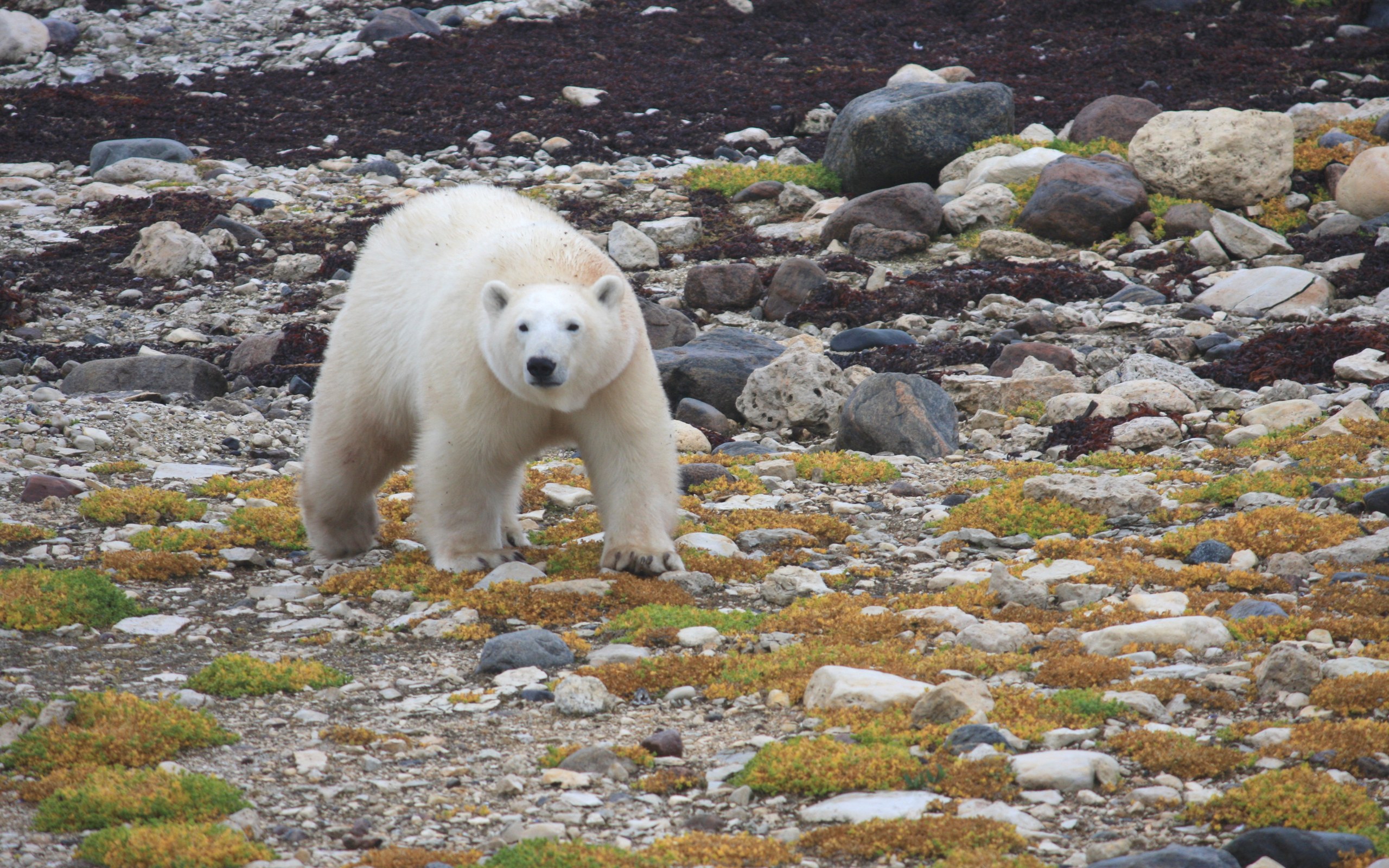
Hero photograph: TravelingOtter from Houston, Texas, USA, "Polar Bear - Churchill, Manitoba" (a polar bear walking along the Hudson Bay shore near Churchill, August 2014), Wikimedia Commons, CC BY 2.0. Cropped for the Field Journal hero.

Questions people ask
When does Hudson Bay freeze over for the polar bears?
Usually in late November. Manitoba says the bears stay on land "until the bay freezes over in late November" (Province of Manitoba). Measured by satellite, freeze-up in the Western Hudson Bay management zone averaged 30 November from 2013 to 2022 (Pagano et al. 2024). Ice usually forms first off Cape Churchill (CNSC).
Do polar bears walk into the town of Churchill?
Some do, so Manitoba runs a Polar Bear Alert Program. Bears aren't allowed in a control zone around town. Officers first try to scare them off, then trap or dart them and keep them in a holding facility. Some are flown away by helicopter, and the rest are released onto the ice once the bay freezes (Province of Manitoba). Bears handled fell from 173 in 2003 to 24 in 2023, helped by the 2005 dump closure (PBI).
Do polar bears hibernate while they wait on land?
Not in the usual sense. Only pregnant females den for the winter. In Hudson Bay they stay in maternity dens on land from about mid-November to March, then take their cubs out onto the ice (Province of Manitoba). Other bears stay awake on land in summer and autumn, though collar data show two adult males using energy at or below the rate of hibernating bears (Pagano et al. 2024).
Can polar bears starve before the ice comes back?
Yes, especially young bears. In a Churchill study, two of 20 bears, both subadult females, were on track to run out of energy reserves before the average freeze-up date (Pagano et al. 2024). A global model found that the fasting season sets limits on survival. With high emissions, falling reproduction and survival would put all but a few high-Arctic populations at risk by 2100 (Molnár et al. 2020).
Sources
- Why do polar bears gather near Churchill? (Polar Bears International, 2024)
- Polar bears (Churchill Northern Studies Centre)
- Polar bears (Province of Manitoba)
- Western Hudson Bay polar bears (Polar Bears International)
- Pagano et al. 2024, Polar bear energetic and behavioral strategies on land (Nature Communications)
- Castro de la Guardia et al. 2017, Sea ice cycle in western Hudson Bay from a polar bear perspective (MEPS)
- Atkinson et al. 2021 Western Hudson Bay aerial survey report
- McGeachy et al. 2023, Distributional shifts of polar bears in Hudson Bay (ECCC)
- Molnár et al. 2020, Fasting season length sets temporal limits for global polar bear persistence (Nature Climate Change)
- Buhler et al. 2026, Evidence of exposure to HPAI H5 viruses in East Greenland polar bears (Emerging Infectious Diseases)
- Migratory birds spread avian influenza to Greenland's polar bears (Cornell Chronicle, Oct 2026)