Partula Snail: The Tree Snail That Came Back From Extinction in the Wild
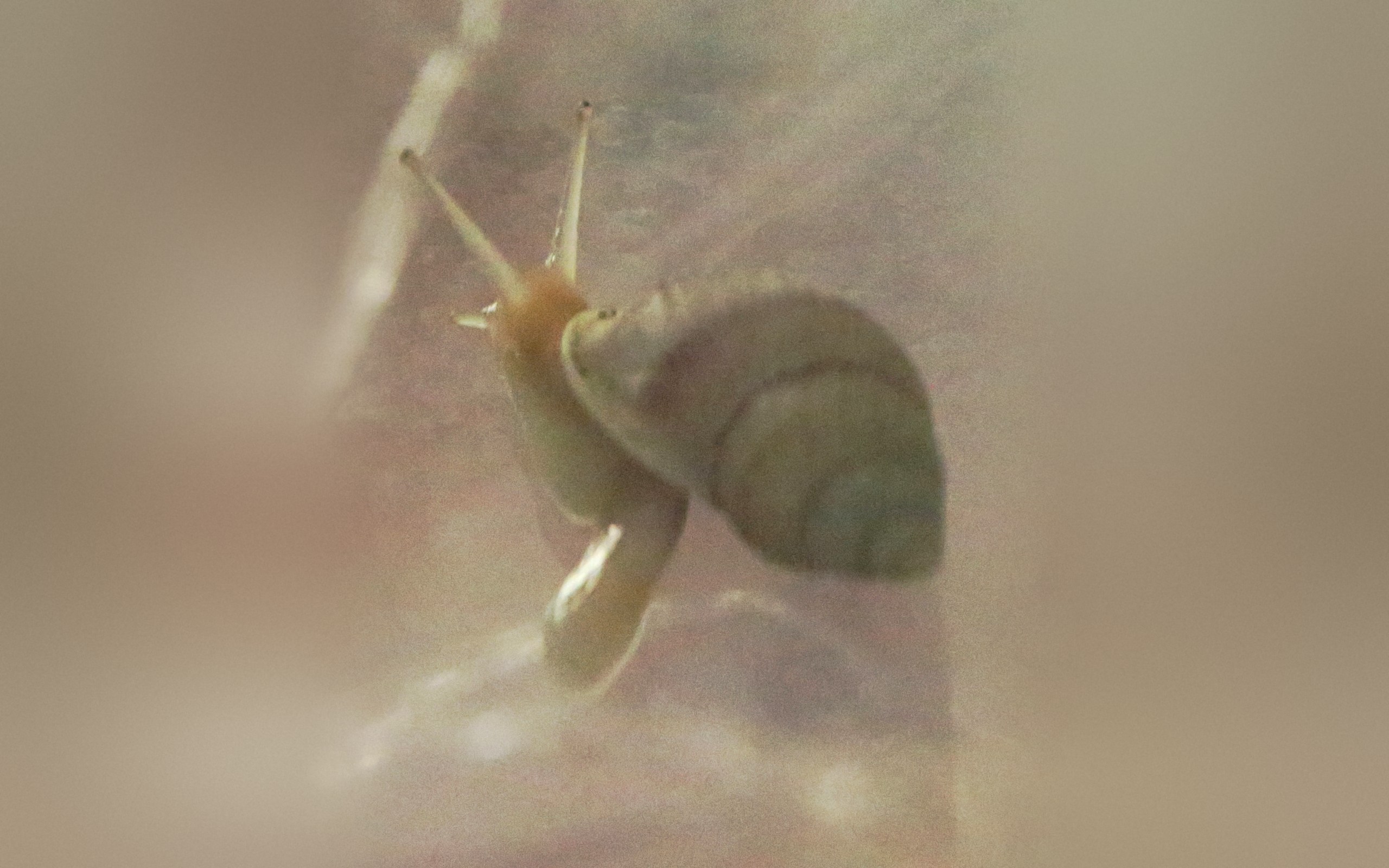
Species deep dive · partula snail
*The Partula snail Partula tohiveana is the first invertebrate known to have been re-established in the wild after being declared Extinct in the Wild. For about four decades it survived only as zoo-bred snails. Zoo-bred snails have been released on its home island of Moorea, in French Polynesia, since 2016. In September 2024, researchers found what they had been hoping for: a population of unmarked, wild-born snails, made up of 4 adults and 13 juveniles (Gerlach et al. 2025, Oryx*; London Zoo).
It's a small snail, and a big result. Of the 51 Partula species in the Society Islands, at least 29 are extinct. Of the 17 still alive, 10 survive only in captivity (Gerlach et al. 2025).
How a whole genus ended up in boxes
Between 1982 and 1995, almost every wild Partula population on Tahiti, Moorea and nearby islands was wiped out by the predatory rosy wolfsnail Euglandina. It had been brought in to control the invasive giant African land snail, and it ate the native tree snails instead. In fact, two members of the Euglandina species complex were introduced under a single name (Gerlach et al. 2025).
The rescue had started by accident. Scientists had set up captive colonies of nine Partula species in the 1960s for genetics research, and they kept adding snails until 1984. Once the wild populations were gone, those lab colonies became a conservation breeding programme (Gerlach et al. 2025). P. tohiveana came close to being lost even there. Its captive line last received wild snails in 1984, and in 1988 it went through a bottleneck of just four individuals. Since then it has bred well enough in zoos to be used as a "starter species" for new breeding collections (Gerlach et al. 2025). London Zoo calls the Partula work its longest-running conservation project (London Zoo).
The fence that failed
The first plan was to keep the predators out. In 1995, captive-bred P. tohiveana and two other species went into a protected Partula reserve on Moorea, an enclosure designed to keep Euglandina out. All three species settled in and bred. But the barriers were hard to maintain, the wolfsnails kept getting in, and the releases failed (Gerlach et al. 2025).
The clue in the chestnut trees
A better idea came from Tahiti. While an exclosure was being built there, workers found surviving wild Partula clara living on Tahitian chestnut trees (Inocarpus fragifer, called mape locally). Their tall, bare, dry trunks seemed to put off foraging wolfsnails. That led to the "mape hypothesis": that tall trees could act as refuges, with the predators near the ground and the snails high above them. Since 2015, releases have focused on trees, and they've gone ahead every year except 2020–2022, when Covid-19 stopped fieldwork (Gerlach et al. 2025).
On Moorea, the team went back to the valley where the captive stock had been collected, the Afareaito valley. In the wild, P. tohiveana had lived in the upper valleys of the island's eastern ridge, on the 'ie'ie, or climbing pandanus (Freycinetia demissa), up to about 4 m above the ground. So the release points were chestnut trees with that pandanus growing on them. The snails travelled in plastic plant pots, up to 100 per pot, a third filled with damp sphagnum moss and covered in cling film. Each one carried a tiny painted mark, so released snails could be told apart from any born in the wild (Gerlach et al. 2025).
The first wild-born snails
The snails bred almost straight away. Researchers found the first wild-born newborn on 29 September 2016, the year of the first release. They found the first half-grown juvenile on 9 August 2017, and the first wild-born adult on 24 September 2018. From 2023 onwards, they found more and more unmarked shells. Then came the September 2024 survey of 4 adults and 13 juveniles, all born in the wild. In September 2025, one snail turned up 10 m outside the release site, a first sign the population might be spreading (Gerlach et al. 2025).
There was one surprise. Instead of living high in the trees, almost the whole new population lives in low, dense vegetation, with all but one snail found less than 1 m above the ground. The authors note that the snails have adapted well to the wild even after about 20 generations in stable, artificial conditions, and even though they all descend from that bottleneck of four (Gerlach et al. 2025). In 2025, the IUCN moved the species from Extinct in the Wild to Critically Endangered (London Zoo).
The releases keep coming
The programme has grown well beyond one species. In September 2026, the Detroit Zoo sent 500 adult Partula nodosa, another species still listed as Extinct in the Wild, to Tahiti for release. Each snail had a dot of orange paint that glows under ultraviolet light, and every year's release gets a new colour (Detroit Zoo). French Polynesia's environment agency (Diren) and ZSL released more than 3,000 Partula snails this year. Each island gets back its own species: Tahiti's snails go to Tahiti, Moorea's to Moorea, and others to Huahine and Raiatea (TNTV, 29 Sept 2026).
For another animal that came back from Extinct in the Wild, read our pieces on the Guam kingfisher and Przewalski's horse.
How the Partula snail plays in Wilder
The Partula Snail is Wilder's first card in the new Mollusca class. It's a Rare Forest card that costs 1 Energy, with Attack 0 and Health 2, so it won't win fights. Its strength is its text: "When this dies, shuffle 2 Partula Snails into your deck." Lose one and you get two more back later, much like the zoo-bred snails that keep returning to the forest. Its flavour text tells the whole story in three lines: "Lost to the wild. Kept alive in a box of leaves. Sent home again."
Wilder is a free browser collectible card game, and you can play it free in your browser with no signup.
Photo credit
Hero photograph: Geni, "Partula tohiveana" (a zoo-bred Partula tohiveana at Marwell Wildlife, 2015), Wikimedia Commons, CC BY-SA 4.0. Contrast lightly adjusted and padded to fit the Field Journal hero.

Questions people ask
How big is a Partula tohiveana snail?
Tiny: its shell grows to at most 13.7 mm long, a bit over a centimetre, though that's large for a partulid. The shell is sinistral, coiling to the left, unlike most snails. The species was naturally restricted to the upper valleys of Moorea's eastern ridge (Gerlach et al. 2025, Oryx).
Why are Partula snails important to science?
They were among the first animals used to test Mendelian genetics in the wild. Henry Crampton did the pioneering work, and later Bryan Clarke, James Murray and Michael Johnson studied how their shell traits are inherited. The snails also mattered culturally, being used in hei necklaces, crowns and other ornaments in the Society Islands (Gerlach et al. 2025, Oryx).
How do researchers track released Partula snails?
With paint. Each released snail gets a small mark on its shell. At first this was enamel paint, but since 2023 the team has used UV-reflective paint, so they can spot marked snails with an ultraviolet torch up to about 5 m above the ground (Gerlach et al. 2025). Unmarked snails must be wild-born. Detroit Zoo uses a new paint colour for each year's release (Detroit Zoo).
What threatens Partula snails now?
Mainly the New Guinea flatworm (Platydemus manokwari), another invasive predator. It's now the main predator of tree snails on the Society Islands, while the rosy wolfsnail is declining on all of them. Flatworms are sometimes caught eating the re-established P. tohiveana, which live mostly less than 1 m above the ground (Gerlach et al. 2025, Oryx).
Sources
- Gerlach et al. 2025, Re-establishment of Partula tohiveana tree snails in French Polynesia after 40 years of extinction in the wild (Oryx 59(5): 617-625)
- Once thought lost, rare snail returns (London Zoo, March 2025)
- "Extinct in the Wild" Partula snails begin journey to Tahiti (Detroit Zoo, 3 Sept 2026)
- Des milliers de Partula retrouvent les forets polynesiennes (TNTV, 29 Sept 2026)