How Much Krill Does a Blue Whale Eat? Inside Earth's Biggest Swarm
Species deep dive · antarctic krill, blue whale
How much krill does a blue whale eat? A lot more than anyone used to think. According to NOAA Fisheries, the biggest blue whales may eat up to 6 tons of krill a day during the feeding season. They feed almost entirely on these small crustaceans, lunging into dense swarms with their mouths open and straining the water out through their baleen plates.
A 2021 study in Nature put tags on 321 feeding baleen whales of seven species and measured the krill swarms they fed on with sonar. It found that earlier estimates of how much baleen whales eat were often three times too low or more (Savoca et al. 2021). The whales' main food in the Southern Ocean is the Antarctic Krill (Euphausia superba).
Is krill the biggest biomass on Earth?
Antarctic krill have one of the largest total weights of any wild animal species. A 2009 re-analysis of decades of net surveys estimated the total stock at about 379 million tonnes (Atkinson et al. 2009), and the Australian Antarctic Division gives a figure of about 400 million tonnes. Each krill is only about 6 cm long, so that is an almost unimaginable number of animals.
The same 2021 study estimated that before industrial whaling, the Southern Ocean's baleen whales ate about 430 million tonnes of krill every year, roughly twice the krill thought to be there today (Savoca et al. 2021). The authors argue that whales once helped keep krill abundant, because whale dung returns iron to the surface water, fertilising the algae that krill eat.
How dense is a krill swarm?
Krill live in swarms where the density can reach 10,000 to 30,000 animals per cubic metre of water (Hamner et al. 1983; Australian Antarctic Division). Swarms can be big and dense enough to colour the sea reddish brown. That concentration is what makes the blue whale's strategy work: one huge gulp in the right patch can take in a vast number of krill at once.
What does a krill look like and eat?
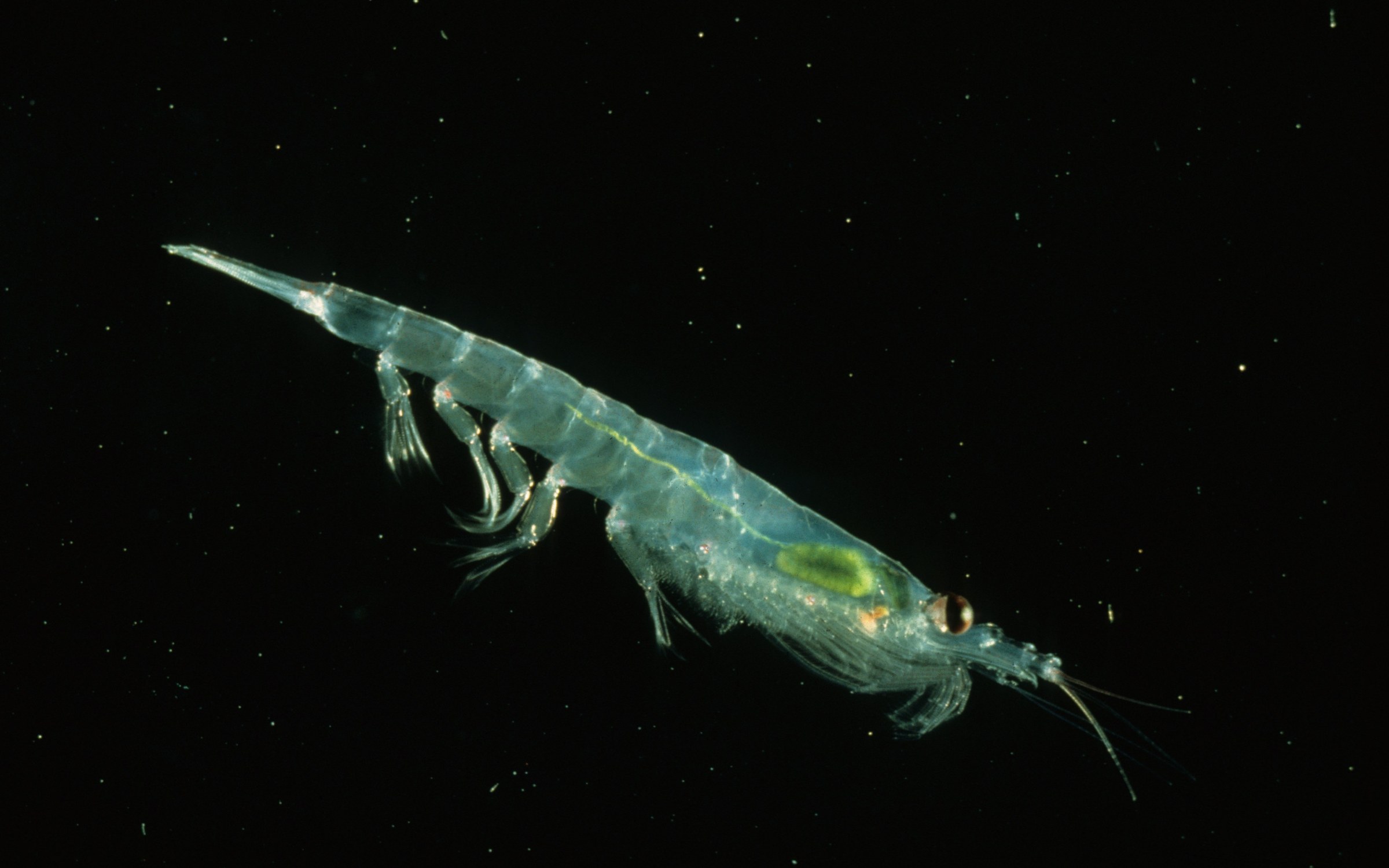
An adult Antarctic krill is mostly transparent, with a red tinge from tiny pigment spots, large black eyes and no claws. Its gut often shows vivid green through the body, coloured by the algae it has eaten (Australian Antarctic Division).
Krill are filter feeders. Their feathery front legs form a feeding basket that sieves microscopic algae, mostly diatoms, out of the water, and in winter they graze the algae growing under sea ice. They can survive up to about 200 days without food, shrinking a little with each moult, and are thought to live for 5 to 10 years (Australian Antarctic Division).
Who else eats krill?
Almost everything large in the Antarctic depends on krill, directly or through the animals that eat them: whales, seals, penguins and other seabirds, fish and squid (Australian Antarctic Division). Read how the emperor penguin survives the Antarctic winter, and how the blue whale lunge-feeds.
Is Antarctic krill endangered?
No. The IUCN Red List lists Antarctic krill as Least Concern. People catch krill too, and the commercial fishery is managed by CCAMLR. The main long-term worries are warming water and shrinking sea ice, since young krill shelter and feed under the ice in winter.
Antarctic Krill in Wilder
In Wilder, the free browser collectible card game, the Antarctic Krill is a Common 1-Energy 0/1 Tundra creature with Swarm 2: play it and two 1/1 Drones join it on the board. The Blue Whale is the card that eats it.
The short version: the biggest blue whales may eat up to 6 tons of krill a day, and new measurements suggest whales eat far more than older estimates said. Antarctic krill make up one of the largest animal biomasses on Earth, around 379 to 400 million tonnes.
Photo credit
Hero photograph: Dr. Wayne Trivelpiece, NOAA, Euphausia superba, Wikimedia Commons, public domain. Cropped for the Field Journal hero.

Questions people ask
How many krill does a blue whale eat in one gulp?
It varies with the swarm, but it can be a huge number. Krill swarms can hold 10,000 to 30,000 animals per cubic metre (Australian Antarctic Division), and a blue whale engulfs a vast volume of water in each lunge (NOAA Fisheries).
How much do all whales eat in krill per year?
Before whaling, Southern Ocean baleen whales are estimated to have eaten about 430 million tonnes of Antarctic krill a year (Savoca et al. 2021). Today's whale populations are much smaller.
How big is an Antarctic krill?
Adults are about 6 cm long. They are mostly transparent with red pigment spots and large black eyes (Australian Antarctic Division).
What do krill eat?
Mostly microscopic algae such as diatoms, which they filter from the water with feathery legs; in winter they graze algae under the sea ice (Australian Antarctic Division).
How long do Antarctic krill live?
About 5 to 10 years, scientists estimate, although ageing krill is difficult (Australian Antarctic Division).
Sources
- NOAA Fisheries - Blue Whale
- Savoca M.S. et al. (2021) Baleen whale prey consumption based on high-resolution foraging measurements. Nature 599: 85-90
- Atkinson A., Siegel V., Pakhomov E.A., Jessopp M.J. & Loeb V. (2009) A re-appraisal of the total biomass and annual production of Antarctic krill. Deep-Sea Research I 56: 727-740
- Australian Antarctic Division - Krill
- Hamner W.M. et al. (1983) Behavior of Antarctic krill, Euphausia superba: chemoreception, feeding, schooling, and molting. Science 220: 433-435
- IUCN Red List - Euphausia superba
- CCAMLR - Krill fisheries