How Strong Is a Coconut Crab? The Pinch That Opens Coconuts
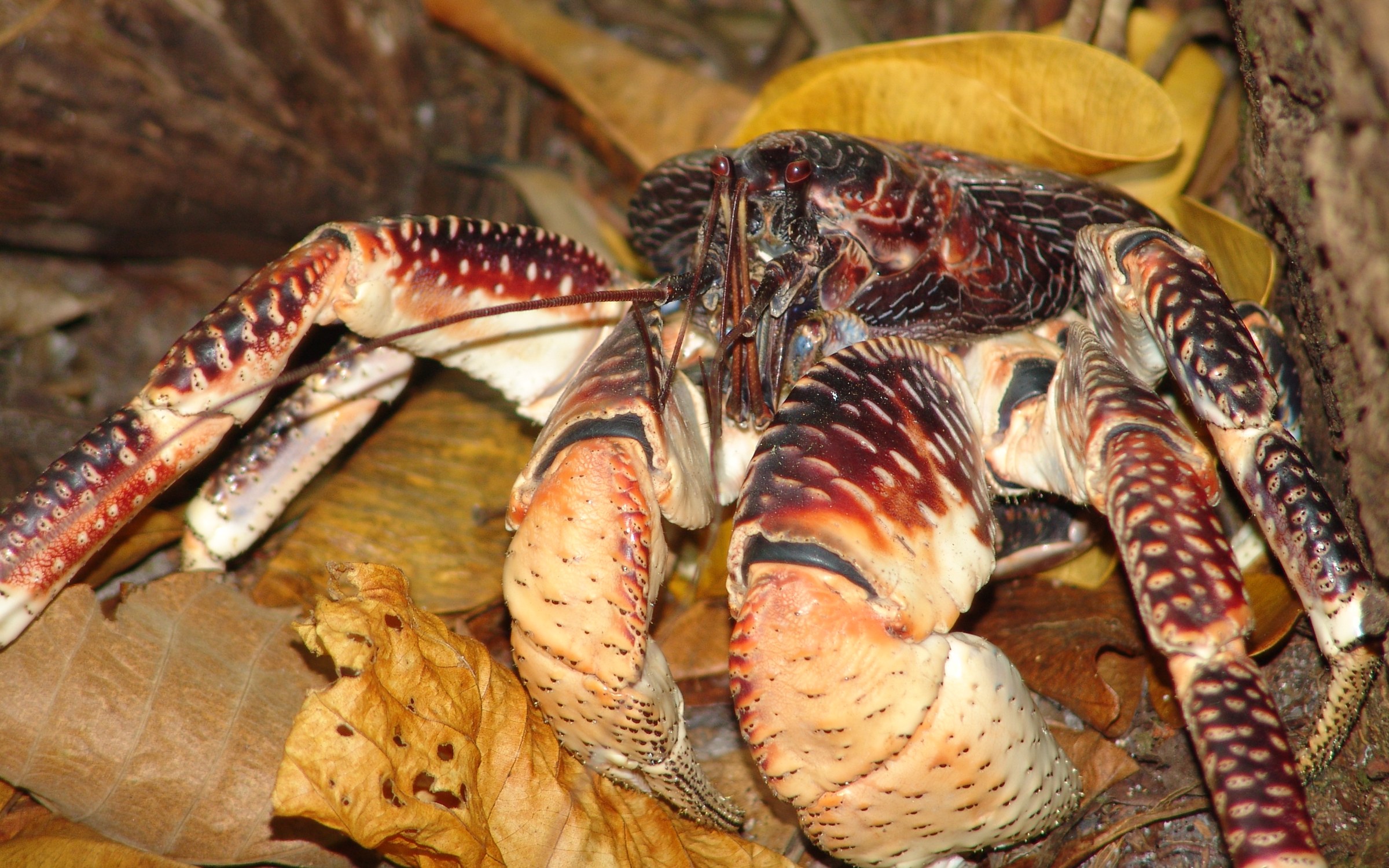
Species deep dive · coconut crab
How strong is a coconut crab's pinch? Stronger than almost any animal's. In 2016, Japanese researchers measured the claws of 29 wild coconut crabs on Okinawa with a bite-force meter. The strongest pinch, from a 2.1 kg crab, was 1,765 newtons. Pinch force rose steeply with body size, and the team estimated that the largest coconut crabs on record, about 4 kg, could pinch with about 3,300 newtons (Oka et al. 2016). That beats every other crustacean measured and the bite force of most land predators; in the authors' comparison only alligators came out clearly ahead.
The Coconut Crab (Birgus latro) is the largest arthropod living on land, with a leg span of up to about 1 m (Natural History Museum). It is a giant land hermit crab of tropical Indian and Pacific Ocean islands, and its claw is its tool, weapon and lever all at once.
How big is 3,300 newtons?
A newton is the force needed to speed up 1 kg by 1 metre per second every second. Holding a 1 kg bag of sugar against gravity takes about 10 newtons, so 3,300 newtons is roughly the downward force of a 336 kg weight, squeezed onto the tip of a claw.
Relative to body weight, the coconut crab's grip is extraordinary. The 2016 study found that its pinch force per kilogram of body mass was higher than that of any animal above about 140 g that has been measured, and it noted the crab can lift objects of up to about 28 to 30 kg (Oka et al. 2016). The researchers also wrote that the crabs pinched them "on multiple occasions" during fieldwork.
For a bite in a different league, read about the saltwater crocodile, the strongest bite ever measured.
Can a coconut crab really open a coconut?
Yes, though it takes work. The crab strips away the tough fibrous husk with its claws, strand by strand, and then breaks into the hard shell to reach the flesh (Drew et al. 2010). Its pinching power is what lets it get at a food that almost no other island animal can use (Oka et al. 2016).
Despite the name, coconuts are only part of the menu. Coconut crabs are omnivores and scavengers that eat fallen fruit, nuts, seeds, tree pith and carrion, and they also catch live animals (Drew et al. 2010).
Can a coconut crab kill a cat?
There is no scientific record of a coconut crab killing a cat. Stories of crabs dragging off kittens circulate widely, but they are anecdotes. What is documented is predation on birds. On the Chagos Archipelago in 2016, ecologist Mark Laidre watched a large coconut crab climb up to a red-footed booby at night, grab it and break its wing, then eat it (Laidre 2017). Coconut crabs have also been seen killing rats and hunting other crabs.
So a coconut crab is capable of killing an animal around the size of a seabird. It is not a danger to people who leave it alone, but its pinch is painful and hard to release, so it should never be handled.
Built for land, born at sea
Young coconut crabs start out like other hermit crabs, carrying a borrowed snail shell. They soon outgrow it, and adults rely instead on a hardened body with the abdomen tucked underneath (Oka et al. 2016). Adults breathe air with modified gill chambers and cannot swim: they drown if they are kept underwater too long. Only the larvae live in the sea (Natural History Museum).
They grow slowly, reach maturity at about five years and can live up to 60 years. That slow life is why harvesting hits them hard: the IUCN Red List lists the species as Vulnerable, and many Pacific islands now set minimum sizes, protect egg-carrying females or limit catches.
Coconut Crab in Wilder
In Wilder, the free browser collectible card game, the Coconut Crab is a Rare 4-Energy 4/5 Forest creature with Thorns and the ability Crushing Claw, which deals 2 damage to an enemy. Its claw-wielding cousin, the Pistol Shrimp, fights with a very different weapon; read how its snap fires a shockwave.
The short version: a coconut crab's claw has been measured at 1,765 newtons, and the biggest crabs are estimated to reach about 3,300, among the strongest grips of any animal. It really can open a coconut, and it has been seen killing a seabird, but there is no evidence it kills cats.
Photo credit
Hero photograph: Drew Avery, Coconut Crab - Birgus latro, Wikimedia Commons.jpg), CC BY 2.0. Cropped for the Field Journal hero.
Questions people ask
What is the strongest pinch of any animal?
Among animals measured, the coconut crab's claw is one of the strongest for its size. Its pinch per kilogram of body weight beat every animal above about 140 g in the comparison by Oka et al. 2016, and the largest crabs are estimated to reach about 3,300 newtons.
Can a coconut crab break a human finger?
No study has tested it, so we can't say for sure. What is known is that its claw can exceed 1,700 newtons and that researchers were pinched several times while measuring them (Oka et al. 2016). Don't handle one.
Do coconut crabs eat birds?
Yes, sometimes. On the Chagos Archipelago a coconut crab was seen climbing to a sleeping red-footed booby, breaking its wing and eating it (Laidre 2017).
How long do coconut crabs live?
Up to about 60 years. They mature at about five years and grow slowly (Natural History Museum).
Can coconut crabs swim?
No. Adults breathe air and drown if kept underwater for too long; only their larvae live in the sea (Natural History Museum).
Sources
- Oka S., Tomita T. & Miyamoto K. (2016) A Mighty Claw: Pinching Force of the Coconut Crab, the Largest Terrestrial Crustacean. PLOS ONE 11: e0166108
- Drew M.M., Harzsch S., Stensmyr M., Erland S. & Hansson B.S. (2010) A review of the biology and ecology of the Robber Crab, Birgus latro. Zoologischer Anzeiger 249: 45-67
- Laidre M.E. (2017) Ruler of the atoll: the world's largest land invertebrate. Frontiers in Ecology and the Environment 15: 527-528
- Natural History Museum, London - Coconut crabs: the bird-eating behemoths thriving on isolated tropical islands
- IUCN Red List - Birgus latro