Gray Wolf: Do Wolves Really Howl at the Moon?
Species deep dive · gray wolf
No. Gray wolves do not howl at the moon. Howling is how wolves talk over long distances: to rally the pack, find a lost packmate and tell other wolves to stay out of their territory. The moon has nothing to do with it, and the Smithsonian's National Zoo calls the idea a myth (Smithsonian's National Zoo; International Wolf Center).
So where does the werewolf picture come from? Wolves often howl at night, and they howl with their muzzles pointed at the sky. Put the two together on a moonlit evening and you get one of the most famous images in Halloween folklore. Here is what wolves are really saying, and when they say it.
Why the moon myth sticks
Wolves can call at any time of day. They are simply easiest to hear in the evening, when the wind dies down and the wolves themselves are most active, according to the International Wolf Center. So a still evening is simply when people are most likely to hear them.
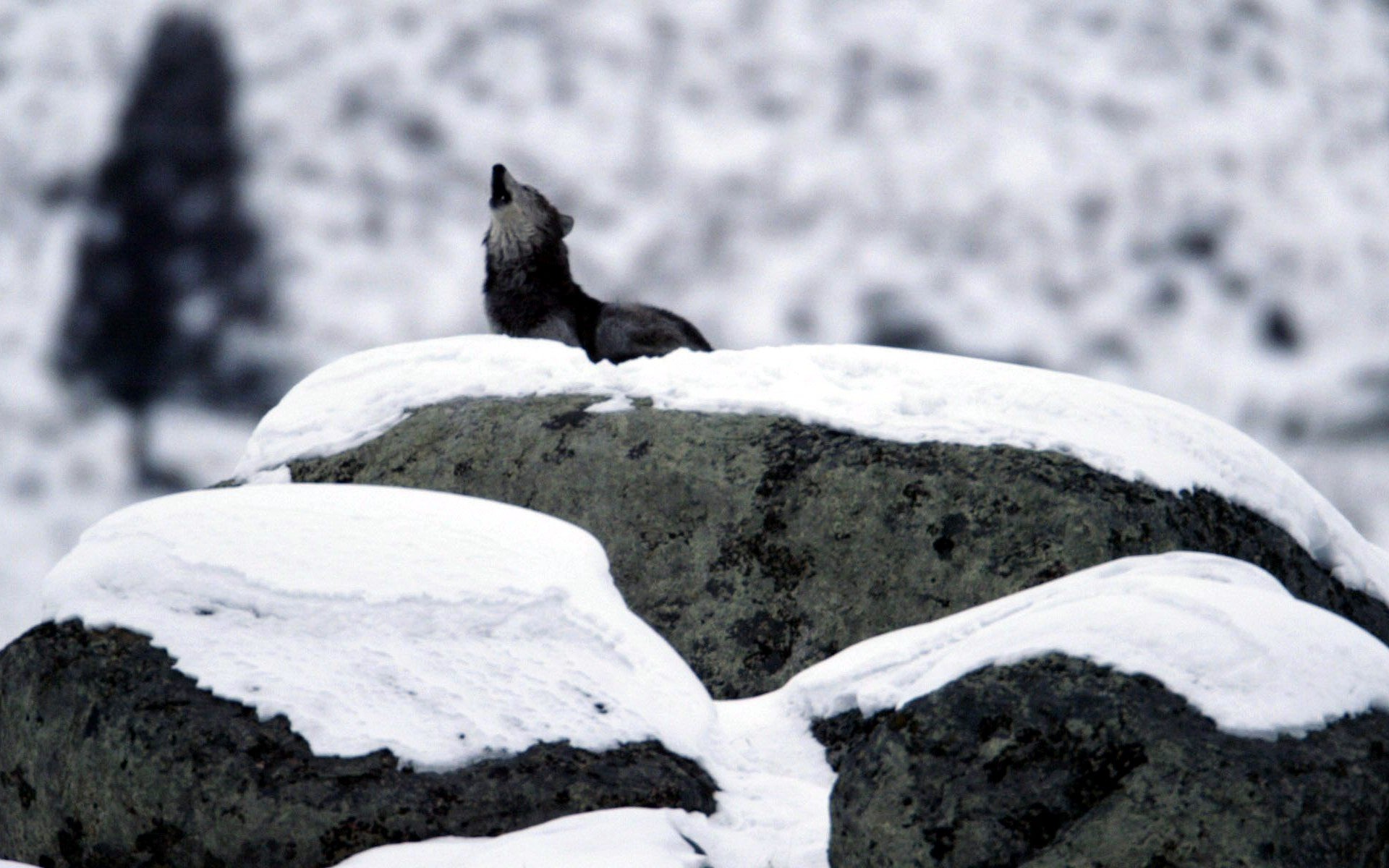
The posture helps too. A howling wolf throws its head back and points its nose upward, so to anyone watching, it looks as if the wolf is calling to the sky. But the audience is other wolves, not the moon.
What a howl actually says
Wolves make four main kinds of sound: barks, whimpers, growls and howls. Howling is the only one meant for long distances (International Wolf Center). The International Wolf Center describes two broad jobs:
- Defensive howls keep the pack together and strangers away. Wolves use them to hold their ground, protect pups that are too young to travel and guard kill sites.
- Social howls help pack members find each other and gather together, and possibly they are just for fun.
A wolf that gets separated from its pack has its own call, too. The "lonesome howl" is a shortened howl that rises in pitch. If another wolf answers, the lost wolf replies with deep, even howls that tell the pack where it is (Smithsonian's National Zoo).
When wolves howl most
Recording devices have made it possible to listen to wolves around the clock. In one study, researchers left automatic recorders running 24 hours a day at the International Wolf Center in Minnesota (spring 2019 and winter 2020) and at a wolf centre in Spain (winter 2020). They logged 412 solo howl series and 403 chorus howls (Palacios et al. 2022).
The results did not point to the moon. The Minnesota wolves howled most before sunrise, while the Iberian wolves in Spain peaked at sunset. The Minnesota wolves chorus-howled about 7.8 times a day in spring and 4.8 times a day in winter, compared with 3.8 times a day for the Spanish wolves in winter. The weather had little influence on how much they howled (Palacios et al. 2022). The authors note that these captive howling rates were higher than those reported for wild wolves.
A chorus that sounds bigger than it is
When a whole pack howls together, the result can sound like a crowd. That may be the point. In a classic study of wolf choruses recorded in Superior National Forest, Minnesota, Fred Harrington found that choruses lasted about 60 seconds on average. Packs answered simulated howls after an average of 40 seconds, often cutting into the stimulus howls. Each chorus started with simple howls that became more and more modulated as it went on (Harrington 1989).
The surprise was that chorus structure gave away very little about pack size. A chorus from a single adult pair did not differ from one by a larger pack with pups, and pairs were often perceived as bigger groups. Harrington suggested that wolf choruses may have evolved to exaggerate how many wolves are present. This is known as the "Beau Geste effect", named after a novel in which a few soldiers prop up dead comrades on the walls of a fort to make the garrison look bigger (Harrington 1989).
Howling back: how biologists find wolf packs
Because wolves answer howls, biologists use that habit to survey them. A study of howling surveys of gray wolves found that group size, the age of the pups, time of day, wind and how many howls were given all affected whether and how wolves responded (Ausband et al. 2020).
The researchers also asked whether hunting makes wolves go quiet, since a howling wolf is easier to locate. It did not seem to. Response rates were nearly identical where wolves were hunted (2.2%) and where they were not (2.3%). The authors suggest that the year-round benefits of long-distance calls may outweigh the extra risk (Ausband et al. 2020).
So if you hear wolves on a full-moon night this Halloween, they are not serenading the moon. They are checking in with the family and warning the neighbours, the same as on any other night.
On the Wilder card
In Wilder the Gray Wolf (Canis lupus) is a Common Mammalia card in the Forest element. It costs 5 Energy, with Attack 5 and Health 6, and has Feast and Ambush, plus the activated ability Pack Howl: spend 2 Energy to give another friendly creature +1/+1. That is a fair game version of a rallying howl that brings the pack together. Its flavour text reads: "The pack is the power." For more on the wolf's return to the American West, read Gray Wolf: California Comeback, Pack Howls, and Yellowstone's Cascade, and for another canid that hunts by ear, see how the red fox pounces on mice.
Wilder is a free browser collectible card game about real animals, and you can play it free in your browser with no signup.
Photo credit
Hero photograph: Jim Peaco, National Park Service, "Wolf howling on glacial erratic at Little America Flats" (a wild gray wolf howling from a snow-covered boulder in Yellowstone National Park, 2 February 2004), Wikimedia Commons, public domain (U.S. National Park Service). Cropped for the Field Journal hero.

Questions people ask
How far away can you hear a wolf howl?
Several miles. According to Smithsonian's National Zoo, other wolves can hear an individual's howl from about 6 to 7 miles (roughly 10 to 11 km) away. That range is why howling is the wolf's main way of keeping in touch across a large territory.
Can wolves recognise each other by their howls?
Very likely, because each wolf's howl is distinctive. In a study of wild Eastern wolves, researchers matched solo howls to the right individual with 100% accuracy and chorus howls with up to 97.4% accuracy, using pitch and amplitude alone (Root-Gutteridge et al. 2014). The Smithsonian also notes that individuals have different howls (Smithsonian's National Zoo).
Do coyotes howl at the moon?
No. Coyotes don't howl more often during a full moon. Research suggests that groups of coyotes actually howl more on nights with less moonlight, to defend their territory or keep in touch with family members (MassWildlife). Like wolves, coyotes howl mainly to communicate with other coyotes.
Sources
- Smithsonian's National Zoo and Conservation Biology Institute: Why Do Wolves Howl? And Other Top Wolf Questions Answered
- International Wolf Center: How do wolves communicate?
- Palacios, Barber-Meyer, Martí-Domken & Schmidt (2022) Assessing spontaneous howling rates in captive wolves using automatic passive recorders, Bioacoustics 31: 562–574
- Harrington (1989) Chorus howling by wolves: acoustic structure, pack size and the Beau Geste effect, Bioacoustics 2: 117–136
- Ausband, Bassing & Mitchell (2020) Environmental and social factors influencing wolf (Canis lupus) howling behavior, Ethology 126: 890–899
- Root-Gutteridge et al. (2014) Identifying individual wild Eastern grey wolves (Canis lupus lycaon) using fundamental frequency and amplitude of howls, Bioacoustics 23: 55–66
- MassWildlife (1 November 2023): Do coyotes howl at the moon?