European Bison: Why Europe Is Bringing Back the Wisent
Species deep dive · european bison
Europe is bringing back the European bison, or wisent, for two reasons. The first is to secure a species that was down to 54 animals in 1924 and still depends on active management. The second is that bison do work in forests that no other living European animal does: they strip bark, browse, fell young trees, trample paths and dust-bathe, which opens the canopy and creates a patchwork of glades, deadwood and bare ground that other wildlife uses (Kent Wildlife Trust; WWF Germany).
The European Bison (Bison bonasus) is Europe's largest land mammal. Its former range stretched from France to Russia, north into southern Scandinavia and south into Italy, but hunting and the spread of farmland wiped it out in the wild. Every wisent alive today descends from just 12 founder animals that survived in zoos and private parks, and the purebred lowland line goes back to only seven of them (WWF Germany). In 2020 the IUCN moved it from Vulnerable to Near Threatened, but only 8 of 47 free-ranging herds were large enough to be genetically viable (IUCN). Releasing more bison into more places is how that number goes up.
What a bison does to a forest
The Wilder Blean project near Canterbury released European bison into West Blean and Thornden Woods in 2022 to restore jobs that were missing from the woodland. Kent Wildlife Trust lists what makes bison different from cattle and horses:
- Bark. Bison target bark as well as grasses and sedges, and their feeding can ring-bark and kill selected trees, leaving room for others and adding standing deadwood.
- Rubbing. They rub against trees to shed their thick winter coat, which has a similar effect.
- Dust baths. They make "bull pits" or sand baths by dust-bathing to get rid of parasites, creating patches of bare ground.
- Corridors. Their size and strength push paths through dense vegetation, linking up small habitats.
Together these let more light reach the woodland floor and give the forest trees of different ages, clearings and more deadwood (Kent Wildlife Trust). In September 2026 the UK's first bison bridges opened in the Blean, doubling the herd's range from 50 to 100 hectares, with 200 hectares planned. The rangers report fresh paths, stripped bark and dung that enriches the soil and feeds insects in the new area (Kent Wildlife Trust).
Two new studies this autumn
Romania. A study published in Biological Conservation in October 2026 looked at the first decade of releases in the southwestern Romanian Carpathians. Survival improved after better selection of animals, GPS-tracked bison stayed close to their release area while slowly expanding their range to 127.5 km², and genetic capture-recapture showed the population rising from 91 surviving released animals to an estimated 211 in 2024 while keeping its genetic diversity. The catch: monitoring cost about €800,000, three-quarters of it for field staff (Retez et al. 2026).
Switzerland. In the Solothurn Jura, a small herd lives in a 100-hectare enclosure ahead of a gradual release. Over two and a half years, the bison stripped bark from around 10% of the trees, mostly slender ones under 12 cm across, and few by more than half their circumference. They favoured sycamore, elm, ash and service tree and largely ignored conifers. Surprisingly, fewer young trees were browsed than before the bison arrived, because roe deer and chamois changed their feeding. The researchers note that the enclosure holds far more bison per hectare than a wild population (WSL).
Not everyone is convinced
Bison are also spreading to places where they may never have lived. In January 2026 Rewilding Spain released nine bison in the Iberian Highlands for a study of how bison can restore Mediterranean ecosystems (Rewilding Europe). Spain now has about 180 European bison, legally classed as livestock or zoo animals. A coalition of scientists objects: researchers are not sure Bison bonasus ever roamed Spain, and critics warn that a hot, dry climate stresses the animals and that a heavy non-native herbivore could damage plants and collapse rabbit burrows (The Local Spain).
Farther east, the return is a homecoming. The last wild bison in the Caucasus was shot in 1927. Since 2021, captive-bred bison have been released into Azerbaijan's Shahdag National Park, where the herd now numbers around 90, with 100 animals planned to be released by 2029 (WWF).
On the Wilder card
In Wilder the European Bison is a Rare Mammalia card in the Forest element: Cost 5, Attack 4, Health 7, with Herd and Resilient. Herd fits an animal that lives in groups led by a lead cow, and Resilient survives one lethal hit, a nod to a species that came back from 54 survivors. Its flavour text reads: "Fifty-four survivors behind fences. Now thousands roam the forest again." For its prairie cousin, read American Bison: National Mammal, Prairie Keystone, and Near-Extinction Recovery.
Wilder is a free browser collectible card game about real animals, and you can play it free in your browser with no signup.
Photo credit
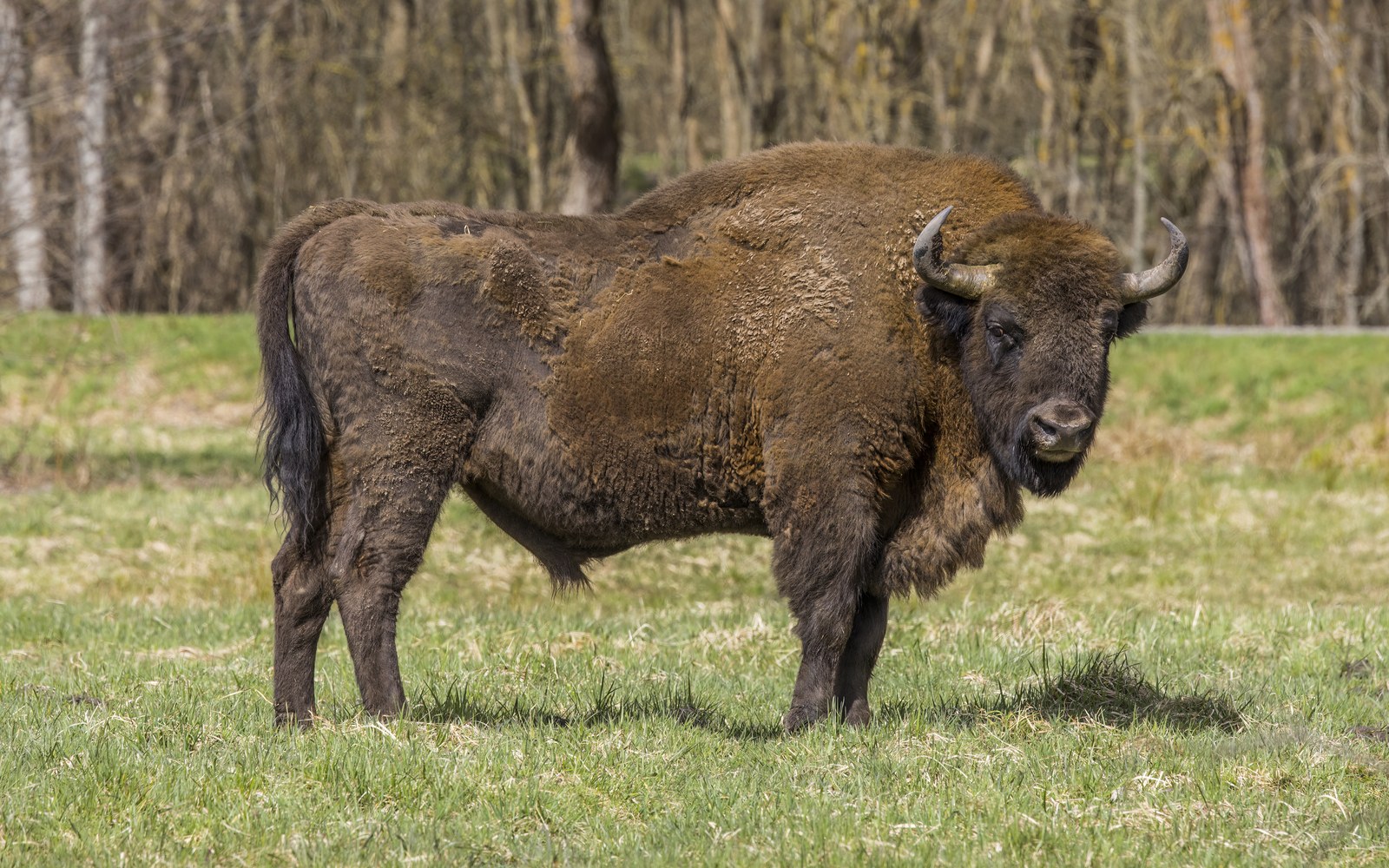
Hero photograph: Charles J. Sharp, "European bison (Bison bonasus) male, Białowieża Forest, Poland" (5 April 2023), via Wikimedia Commons, licensed CC BY-SA 4.0. Cropped for the Field Journal hero.

Questions people ask
How heavy is a European bison?
Big bulls can weigh up to 1,000 kg and cows up to 650 kg, with a shoulder height of 1.5 to 1.9 m, which makes the wisent Europe's largest land mammal (WWF Germany).
How much does a European bison eat in a day?
Studies put it at 30 to 60 kg of fresh plants a day, depending on age, habitat and food supply, mostly grasses and herbs plus shoots, leaves and bark (WWF Germany).
Do European bison live in herds?
Yes. Cows live with their calves and young in herds of up to about 20 led by a lead cow. Young bulls form bachelor groups, and old bulls live alone, joining the cows for the August to October rut. In winter up to 120 can gather at the same feeding sites (WWF Germany).
Did European bison ever live in Britain?
There is no confirmed record of European bison in the UK, but fossils of its close relative, the extinct steppe bison, have been found off the British coast, and large herbivores like bison and aurochs once lived in British woodlands (Kent Wildlife Trust).
Did European bison ever live in Scandinavia?
Yes. WWF Germany says the wisent's former range reached north into southern Scandinavia, as well as south into Italy and east to Russia, before hunting and farmland expansion wiped it out in the wild (WWF Germany).
Sources
- Retez et al. (2026): Monitoring reintroduction success: a decade of restoring European bison in the southwestern Carpathians, Biological Conservation 324
- WSL (23 Oct 2026): Bison prefer the bark of valuable hardwood species
- Kent Wildlife Trust: Why European bison? (Wilder Blean FAQ)
- Kent Wildlife Trust (17 Sep 2026): UK's first bison bridges open in Kent, doubling the herd's range
- WWF Germany: Wisent (Europäisches Bison) im Artenlexikon
- IUCN (2020): European bison recovering, 31 species declared extinct
- WWF: European bison return to the Caucasus after 94 years
- Rewilding Europe (21 Jan 2026): European bison arrive in the Iberian Highlands for the first time
- The Local Spain (11 Sep 2026): Why bison are being introduced to Spain (and not everyone's happy about it)