European Bison
Bison bonasus
European Bison (Bison bonasus): The Wisent Zoos Brought Back
The European bison, or wisent, is Europe's heaviest land animal. It was wiped out in the wild by the 1920s and survived only as 54 animals in zoos and private parks. A pedigree book, careful breeding and releases from 1952 brought it back, and today more than 12,000 live in Europe and western Asia, most of them free-ranging.
- Habitat
- Mixed and deciduous forest with meadows, glades and river valleys
- Size
- Bulls 800-900 kg, cows 500-600 kg; 1.8-1.95 m at the shoulder
- Diet
- Grasses, herbs, leaves, shoots, bark and acorns
- Range
- Largest herds in Poland, Belarus and Russia; reintroduced from Romania to the Caucasus
- Conservation
- Near Threatened (IUCN 2020), up from Vulnerable
- Bottleneck
- 54 animals in 1924, descended from 12 founders
Habitat & range
The wisent once roamed most of Europe, but hunting and the loss of its forests pushed it back for centuries. The last natural population, in Białowieża Forest on today's Poland-Belarus border, preferred mixed and deciduous forest with alder woods and meadows along river valleys (IUCN Bison Specialist Group, 2020). Today the biggest herds live in Poland, Belarus and Russia (IUCN, 2020). Reintroduced herds also roam the mountains of Romania, Slovakia, Ukraine and the Caucasus, plus mixed forest-and-farmland in Lithuania and north-west Poland (IUCN Bison Specialist Group, 2020).
Europe's heaviest land animal
Adult bulls weigh about 800-900 kg and cows 500-600 kg, and they stand 1.8-1.95 m at the shoulder (Kolmården). The wisent belongs to the same genus as the [American bison](/animals/american-bison) but is a little smaller, with a longer tail and a shorter coat (Kolmården). Wisent graze grasses and herbs and browse leaves, shoots, bark and acorns. By stripping bark, trampling through undergrowth and wallowing in sand or dust, they keep forest glades open. They also spread the seeds of over 200 plant species, and birds line their nests with the shed winter fur (Rewilding Europe). Cows, calves and young animals live in herds, while adult bulls often wander alone (Kolmården).
Gone from the wild
World War I finished off the Białowieża herd, which disappeared in 1919. The Caucasus mountains then held the last wild wisent in the world, until poachers killed the final animals in 1926 (IUCN Bison Specialist Group, 2020; many sources give 1927). In 1923 the International Society for the Protection of the European Bison was founded and began counting every surviving animal. At the end of 1924 there were just 54 pure-bred wisent with proven ancestry, 29 males and 25 females, kept in private herds such as the Duke of Bedford's at Woburn and in zoos including Stockholm, Berlin, Antwerp, Copenhagen, Frankfurt, Hamburg, London and St Petersburg (Olech, *European Bison Conservation Newsletter*).
The pedigree book that saved a species
Those survivors went into the first European Bison Pedigree Book, published in 1932 by Goerd von der Groeben. It was history's first detailed register of a protected species and a model for later studbooks, such as the Przewalski's horse's. Every wisent gets a unique number, and every animal alive today can be traced back to the founding herd (European Bison Pedigree Book). The book has been kept by Białowieża National Park since 1991. All living wisent descend from just 12 founders (Olech). They form two breeding lines: the pure Lowland or Białowieża line, and the Lowland-Caucasian line, which carries the genes of one Caucasian bull named Kaukasus (Olech; Białowieża National Park). Poland opened a breeding centre in Białowieża in 1929. On 13 September 1952 the first two bulls, Pomruk and Popas, walked out of an enclosure into Białowieża Forest, and the first calf was born in the wild in 1957 (Krzysiak, *European Bison Conservation Newsletter*). In 2020 the IUCN moved the wisent from Vulnerable to Near Threatened. The wild population had grown from about 1,800 in 2003 to over 6,200 in 2019, but only 8 of its 47 free-ranging herds were big enough to be genetically viable (IUCN). The Pedigree Book counted 12,209 wisent at the end of 2024: 9,762 free-living, 722 semi-wild and 1,725 in enclosures (EBPB data reported by Reform.news, 2025).
Kolmården's wisent
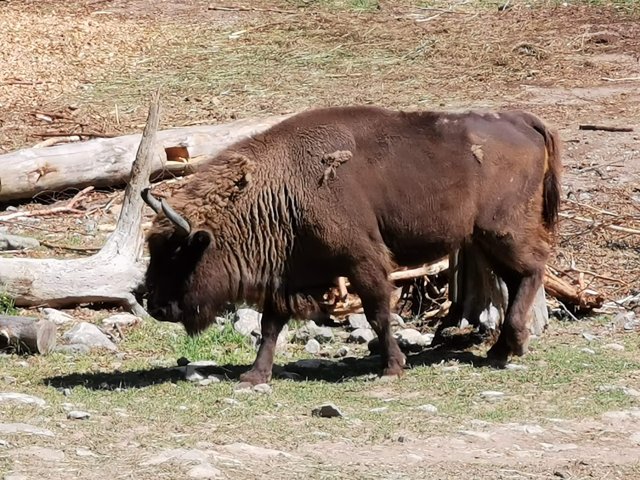
Kolmården Wildlife Park in Sweden keeps European bison. It works with the European zoo association EAZA and the European Bison Conservation Center, and the calves born there get studbook names starting with "KN". In May 2014 a bull and two heifers from Kolmården were among the 17 wisent released by Rewilding Europe and WWF Romania in Romania's Țarcu Mountains, the largest bison reintroduction in Europe at the time (Rewilding Europe; Kolmården). Knock, a bull born at Kolmården in 2018, joined a herd that was later released in Shahdag National Park in Azerbaijan, where wisent had been wiped out a century earlier (Kolmården). The photo on this page shows one of Kolmården's wisent.
Fun facts about European Bison
- Every European bison alive today descends from just 12 founder animals.
- In 1924 only 54 pure-bred European bison were left in the world, all in zoos and private parks, including the zoo in Stockholm.
- The European Bison Pedigree Book (1932) was history's first detailed register of a protected species.
- The first two bison released back into Białowieża Forest in 1952 were young bulls named Pomruk and Popas.
- Wisent born at Kolmården get studbook names beginning with "KN", for Kolmården Norrköping.
Field photos
European Bison vs American Bison (cousin comparison)
The wisent takes the comeback title: it came back from extinction in the wild, which the American bison never had to do.
This is a comparison of two cousins, not a fight. Both belong to the genus Bison. The wisent is a little smaller than the American bison, with a longer tail and a shorter coat, and it lives mainly in forest and forest glades rather than on open prairie (Kolmården). Both were nearly wiped out by people, but the wisent fell further: it vanished from the wild completely in the 1920s and had to be rebuilt from 54 captive animals and 12 founders (Olech). It is now Near Threatened, with more than 12,000 animals counted at the end of 2024 (IUCN; EBPB).
Read more about American Bison.
Common questions about European Bison
What is the difference between a European bison and an American bison?
They are close cousins in the same genus, Bison. The European bison, or wisent, is a little smaller than the American bison, with a longer tail and a shorter coat, and it lives mainly in forests and glades rather than on open prairie (Kolmården). See our American Bison card.
How many European bison are there in the world?
12,209 at the end of 2024, according to the European Bison Pedigree Book: 9,762 free-living, 722 semi-wild and 1,725 in enclosures (Reform.news). In 1924 there were only 54 (Olech).
Which zoos helped save the European bison?
In 1924 the last 54 wisent lived in private parks and in zoos including Stockholm, Berlin, Antwerp, Copenhagen, Frankfurt, Hamburg, London and St Petersburg (Olech). Today zoos still supply bison for releases. Sweden's Kolmården has sent bison to Romania and Azerbaijan (Kolmården).
Where can you see wild European bison?
The best-known place is Białowieża Forest on the Poland-Belarus border, where the first zoo-bred bison were released in 1952 (Krzysiak). The largest herds are in Poland, Belarus and Russia (IUCN), and over 100 roam Romania's Southern Carpathians (Rewilding Europe).
Is the European bison still endangered?
It is listed as Near Threatened. The IUCN upgraded it from Vulnerable in 2020 after the wild population grew from about 1,800 in 2003 to over 6,200 in 2019. However, only 8 of 47 free-ranging herds were large enough to be genetically viable (IUCN).
More Mammalia animals
Mammalia · Forest · Cost 5