Great Bustard: Is It Really the Heaviest Flying Bird?
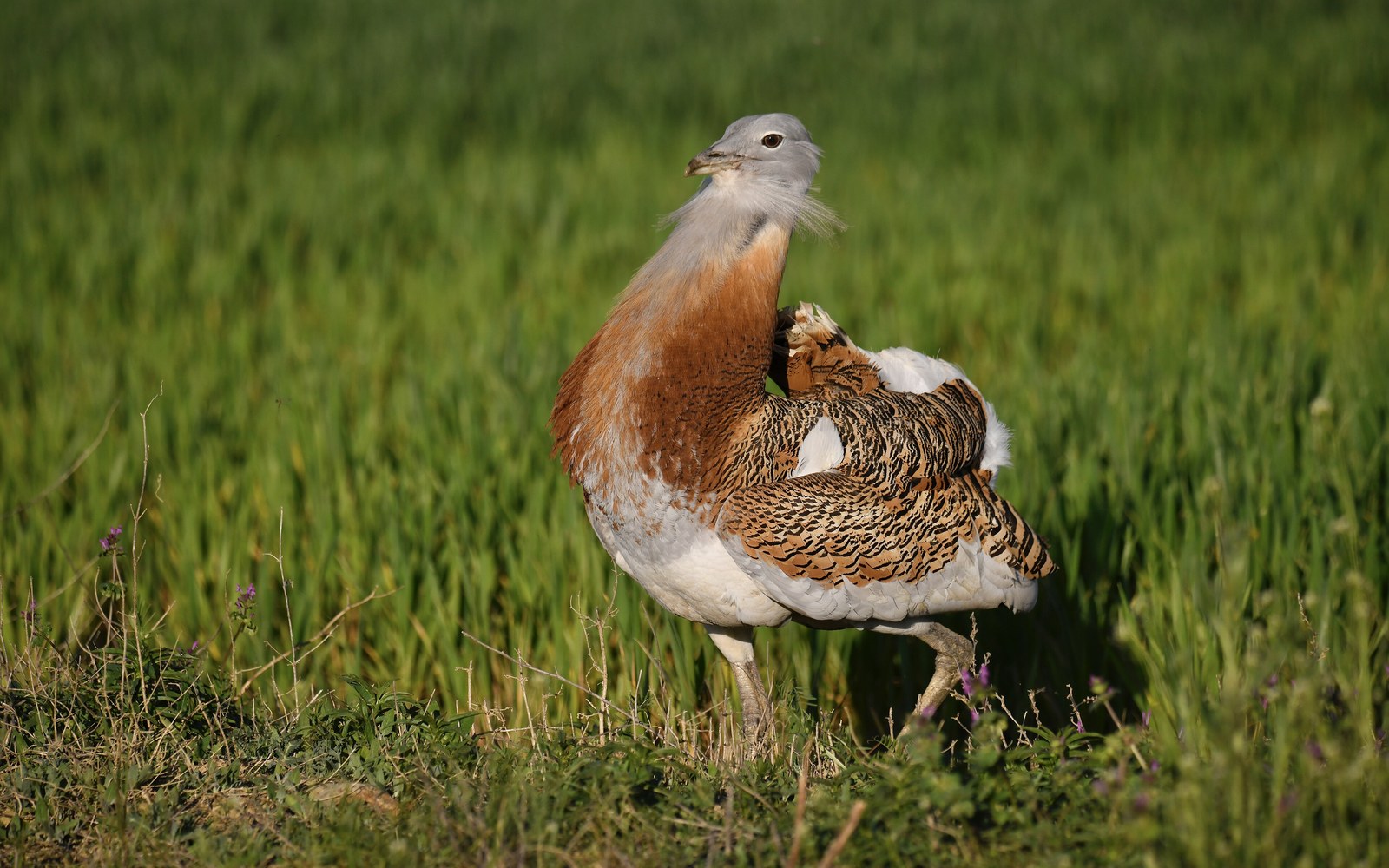
Species deep dive · great bustard
Yes, probably, but it shares the title with Africa's kori bustard. Male great bustards normally weigh 5.8–18 kg, and the heaviest verified bird, collected in Manchuria, weighed about 21 kg (Great Bustard Group). Guinness World Records gives the crown to the kori bustard instead, based on an 18.14 kg male shot in South Africa in 1936 (Guinness World Records). Big males of both species reach the high teens, so which one "wins" depends on which record you trust. Either way, the heaviest bird that can fly is a bustard.
Here's how the two heavyweights compare, why male great bustards got so heavy, and what that weight costs them.
The heavyweight contenders
| Bird | Scientific name | Heavy males | Source |
|---|---|---|---|
| Great bustard | Otis tarda | 5.8–18 kg; heaviest verified about 21 kg | Great Bustard Group |
| Kori bustard | Ardeotis kori | 11–19 kg; Guinness record 18.14 kg (1936) | Smithsonian's National Zoo; Guinness |
| Andean condor | Vultur gryphus | Up to 15 kg | San Diego Zoo Wildlife Alliance |
London's Natural History Museum also leans towards the kori, giving it up to 19 kg and the great bustard a peak of about 18 kg (Natural History Museum). The Spanish researchers who studied wild great bustards most closely simply call it "one of the heaviest flying birds" (Alonso et al. 2009). That's the fair way to put it.
Only one of these is heavy in both sexes. Female great bustards weigh just 3.5–5 kg (Great Bustard Group), so the record is held by the males alone.
Why male great bustards are so heavy
The great bustard has the biggest size difference between males and females of any living bird. In a study of wild birds in Spain, breeding males weighed 2.48 times as much as females, and male weight rose by about 20% between the pre-breeding and breeding seasons (Alonso et al. 2009).
The reason is competition. Males gather at traditional display grounds called leks, and fewer than half the males on a lek may get to mate. Weight and age strongly shape a male's rank. Rivals fight by gripping each other with their bills and shoving breast to breast, sometimes for more than an hour. The authors conclude that sexual selection has "likely pushed male weight close to the limit imposed by powered flight" (Alonso et al. 2009). In other words, if male great bustards got much heavier, they might not be able to fly at all.
The prize for winning is a chance to show off. In spring, a displaying male turns his wings and tail inside out into a mass of white feathers, the "foam bath" that shows up across open fields (Great Bustard Group).
Can something that heavy really fly?
It can, and it flies well. Great bustards fly with powerful, regular wingbeats, usually 30–100 m above the ground, at up to about 80 km/h (50 mph) (Great Bustard Group). But flight is expensive at that size. The Natural History Museum notes that both big bustards fly away from danger, but repeated escape flights exhaust them (Natural History Museum). The kori bustard is said to be reluctant to fly unless it's in serious danger (Smithsonian's National Zoo).
That's why these birds spend most of their lives walking. Flight is the emergency exit, not the daily commute.
An Endangered heavyweight
BirdLife International moved the great bustard from Vulnerable to Endangered in its 2023 Red List update (BirdLife International). The assessment estimates 29,600–33,000 mature birds and a decreasing population. It lists threats from farming changes, roads, power lines and renewable-energy infrastructure, hunting and climate extremes, and it records the species as extinct in the United Kingdom, Poland and Belarus (IUCN Red List).
Power lines are one threat that can be fixed. In the West-Pannonian population on the Austria–Hungary border, conservationists buried 43.1 km of power lines and marked 89.7 km more. Bustard deaths in the study area fell significantly between 2002 and 2011, mainly because fewer birds hit the lines, and the authors credit both measures with helping the population recover quickly (Raab et al. 2012).
Britain lost its great bustards in the 1800s. The Great Bustard Group's reintroduction in southern England has since built a self-sustaining population of around 100 birds, which the group calls the only successful great bustard reintroduction anywhere (Great Bustard Group).
To see how the bustard compares with the flightless giants (the ostrich, cassowary and emu), read the largest birds in the world, ranked. For a heavy bird that flies by soaring rather than flapping, see Andean condor: riding thermals over the Andes.
How the great bustard plays in Wilder
The Great Bustard (Otis tarda) is a Rare Aves card in the Grassland element. It costs 4 Energy, with Attack 3 and Health 5, and it has Flock and Camouflage, a nod to the single-sex flocks bustards live in and the barred, buff plumage that hides them in long grass. Flavour text: "A courting male turns his feathers inside out into a white 'foam bath' seen for kilometres."
Wilder is a free browser collectible card game about real animals, and you can play it free in your browser with no signup.
Photo credit
Hero photograph: Luiz Lapa, "Abetarda-comum, macho, Great Bustard, male", Wikimedia Commons, CC BY 2.0. Cropped for the Field Journal hero.

Questions people ask
Is the great bustard the heaviest bird in the world?
No. It's only a contender for heaviest flying bird. The ostrich is the heaviest bird of all, with males weighing 100–130 kg, several times more than any bustard (San Diego Zoo Wildlife Alliance). See the largest birds in the world, ranked.
Can great bustards perch in trees?
No. Bustards have only three toes, all pointing forward, and no hind toe. That lets them run fast but means they can't perch, so they live on the ground (Great Bustard Group).
What do great bustards eat?
They're omnivores. Adults eat mostly shoots, leaves, flowers and seeds, plus insects, worms, small lizards and even voles or mice. Young chicks eat mainly insects (Great Bustard Group).
Where does the name bustard come from?
From the Latin avis tarda, meaning "slow bird", after its slow, deliberate walk. The same word survives in its scientific name, Otis tarda (Great Bustard Group).
Where can you see great bustards in the UK?
On and around Salisbury Plain in Wiltshire, where the Great Bustard Group's reintroduced birds live. The group runs visits from Salisbury, and a great bustard even appears on the Wiltshire flag (Great Bustard Group).
Sources
- Alonso et al. (2009) The most extreme sexual size dimorphism among birds: allometry, selection, and early juvenile development in the Great Bustard (Otis tarda). The Auk 126(3):657–665
- Great Bustard Group: What is a Great Bustard?
- Guinness World Records: Heaviest flying bird
- Natural History Museum, London: What is the biggest bird in the world?
- Smithsonian's National Zoo: Kori bustard
- BirdLife International: The 2023 Red List update
- IUCN Red List: Great Bustard (Otis tarda), BirdLife International 2023
- Raab et al. (2012) Underground cabling and marking of power lines… West-Pannonian Great Bustards. Bird Conservation International
- San Diego Zoo Wildlife Alliance: Andean condor
- San Diego Zoo Wildlife Alliance: Ostrich