Komodo Dragon: How Many Are Left in the Wild?
Species deep dive · komodo dragon
Roughly 4,000 Komodo dragons live in the wild, and all of them are in Indonesia. The Komodo National Park office counted about 3,270 dragons (± 371) across the park's five islands in 2024, and a separate survey puts about 700 (± 131) on the coast of Flores (Indonesian Ministry of Forestry). Only a fraction of those are breeding adults: the IUCN Red List counts 1,383 mature individuals and lists the species as Endangered (IUCN Red List).
So the honest answer is "a few thousand lizards, but only about fourteen hundred grown-ups", and the two numbers mean different things. Here is where they come from, and why a population that looks stable is still on the Endangered list.
The yearly count in Komodo National Park
The park office and the Komodo Survival Program survey 11 monitoring sites across the five dragon islands every year, using camera traps and site-occupancy models rather than a head count of every animal (Indonesian Ministry of Forestry). These are the park-wide estimates (ANTARA News):
| Year | Komodo dragons in Komodo National Park |
|---|---|
| 2018 | 2,897 |
| 2019 | 3,022 |
| 2020 | 3,163 |
| 2021 | 3,303 |
| 2022 | 3,156 |
| 2023 | 3,396 |
| 2024 | 3,270 ± 371 |
The park describes the trend as relatively stable and slightly rising over seven years, with numbers going up and down with the deer, pigs and buffalo the dragons eat (ANTARA News).
Almost all of those dragons live on two islands. The 2023 count split like this: Komodo 1,694, Rinca 1,509, Nusa Kode 92, Gili Motang 70 and Padar 31 (VOI / ANTARA). Padar is a story of its own. Its dragons disappeared after poachers emptied the island of deer, and for decades they were thought gone: the Smithsonian's National Zoo reported that none were seen there from the 1970s onward (Smithsonian's National Zoo; Indonesian Ministry of Forestry). The 2023 park tally recorded them on Padar again, with 31 counted.
Flores: the dragons outside the park
Flores is by far the biggest island in the dragon's range, but there the lizards live mostly outside protected areas, among farms and villages. Over five years, researchers ran 346 camera stations along the Flores coast and detected dragons at just 85 of them, in three isolated pockets on the west, north-west and north coasts. Being close to farms and villages had the strongest negative effect on whether dragons used an area (Ariefiandy et al. 2021).
The government's action plan adds that feral dogs compete with dragons for prey: wherever cameras picked up lots of dogs, they picked up few or no dragons (Indonesian Ministry of Forestry).
Why "stable" still means Endangered
The IUCN assessment (assessed 2019, published 2021) lists the Komodo dragon as Endangered under criterion C1, which is about a small number of mature adults combined with an expected decline. It records 1,383 mature individuals in 8 locations, a generation length of 15 years, and a population trend of "stable" (IUCN Red List).
Three things make a few thousand island lizards fragile:
- They hardly move. Tracking, translocation and genetic studies show that Komodo dragons rarely leave the valley where they hatched, even though they are big and capable walkers (Jessop et al. 2018). A local loss isn't quickly refilled from next door.
- The islands are small and low. A climate model built on years of monitoring data projected that dragon habitat could shrink by 8–87% by 2050, with abundance falling by 27–99% depending on the emissions scenario. Komodo and Rinca came out as the safest refuges (Jones et al. 2020).
- Their food can be taken away. Padar shows what happens when the deer go.
What about zoos?
Zoos keep a backup population but nowhere near a second wild one. The Species360 ZIMS database listed 258 Komodo dragons in 102 facilities across 28 countries in 2024 (Indonesian Ministry of Forestry). Indonesia's plan treats them as a genetic reserve and wants future releases to wait until the genetics of wild and captive dragons are properly mapped, because the Komodo Island and north Flores populations are genetically distinct.
For more about the dragon itself (its venom glands, serrated teeth and the old "septic bite" myth), read Komodo dragon: the largest lizard and its venom. To see how it measures up against crocodiles and anacondas, see the largest reptiles in the world, ranked. And for another "how many are left?" story, there's the California condor's comeback from 27 birds.
How the Komodo dragon plays in Wilder
The Komodo Dragon (Varanus komodoensis) is a Rare Reptilia card in the Grassland element. It costs 6 Energy, with Attack 6 and Health 8, and it has Basking, Feast and Thorns. Its active ability gives it Venom for 3 Energy, a nod to the real venom glands in its lower jaw. Flavour text: "One bite. Then patience."
Wilder is a free browser collectible card game about real animals, and you can play it free in your browser with no signup.
Photo credit
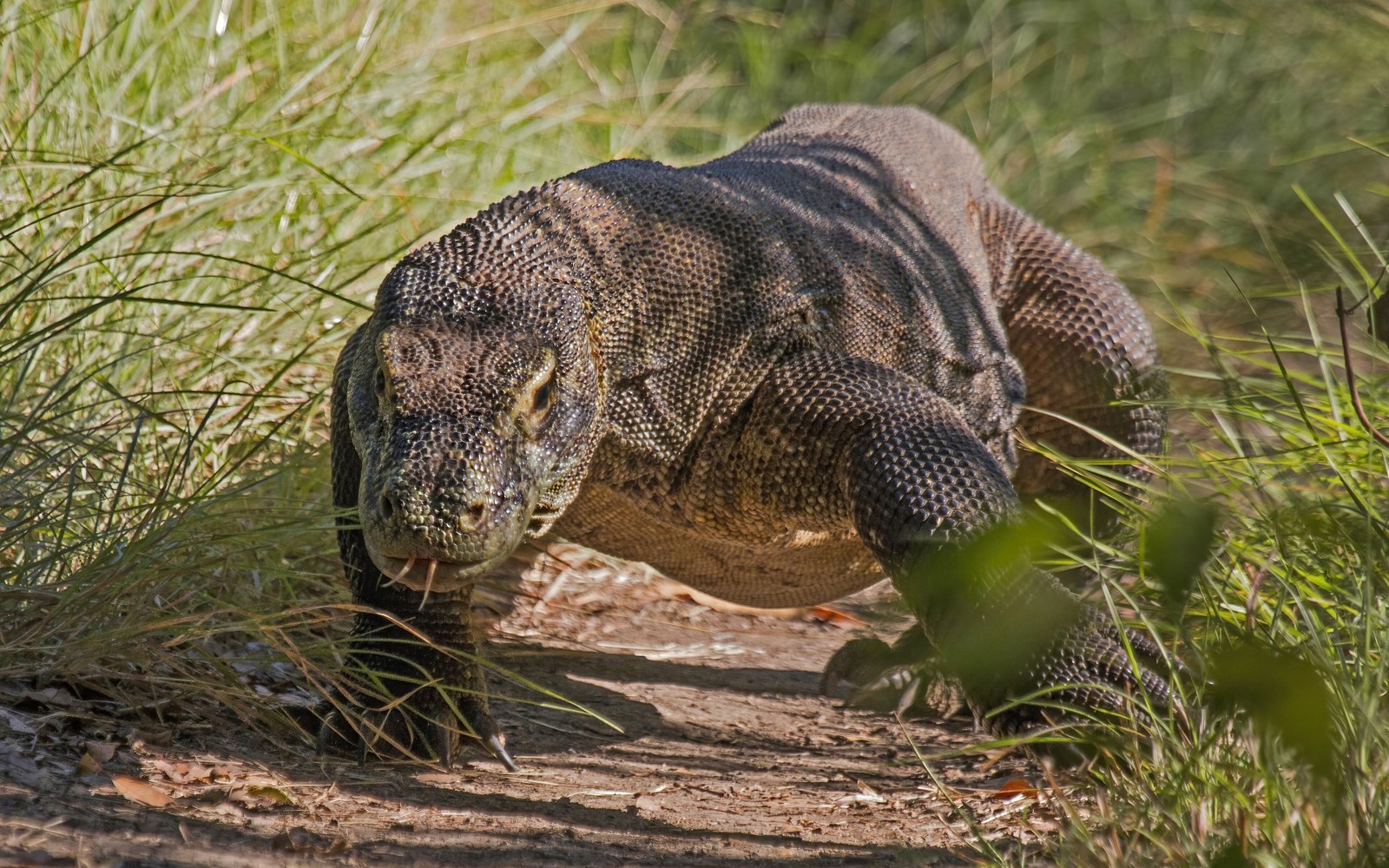
Hero photograph: Charles J. Sharp, "Komodo dragon (Varanus komodoensis) 4", Wikimedia Commons, CC BY-SA 4.0. Cropped for the Field Journal hero.

Questions people ask
How long do Komodo dragons live in the wild?
About 30 years, according to Smithsonian's National Zoo, which adds that scientists are still studying their lifespan (Smithsonian's National Zoo).
How big is a wild Komodo dragon?
Wild adults typically weigh about 70 kg. The largest verified specimen was 3.13 m long and weighed 166 kg, and males grow larger and bulkier than females (Smithsonian's National Zoo).
Do Komodo dragons attack people?
Rarely. Indonesia's conservation plan records three attacks on people in 2023 and one human–dragon conflict in 2024, and all the victims survived and were treated locally (Indonesian Ministry of Forestry).
Are Komodo dragons protected by law?
Yes. They are a protected species under Indonesian law (Law No. 5 of 1990, as amended), and they are listed on CITES Appendix I, which bars commercial international trade (Indonesian Ministry of Forestry).
Sources
- IUCN Red List: Komodo Dragon (Varanus komodoensis), Jessop et al. 2021
- Indonesian Ministry of Forestry (KSDAE): Conservation Strategy and Action Plan, Komodo Dragon
- ANTARA News: Balai TNK sebut populasi satwa Komodo relatif stabil
- VOI / ANTARA: 13 Komodo eggs hatching on Rinca Island (2024)
- Ariefiandy et al. (2021) Human activities associated with reduced Komodo dragon habitat use and range loss on Flores. Biodiversity and Conservation
- Jones et al. (2020) Identifying island safe havens to prevent the extinction of the World's largest lizard from global warming. Ecology and Evolution
- Jessop et al. (2018) Exploring mechanisms and origins of reduced dispersal in island Komodo dragons. Proc. R. Soc. B
- Smithsonian's National Zoo: Komodo dragon