Gorilla: How Many Western Lowland Gorillas Are Left?
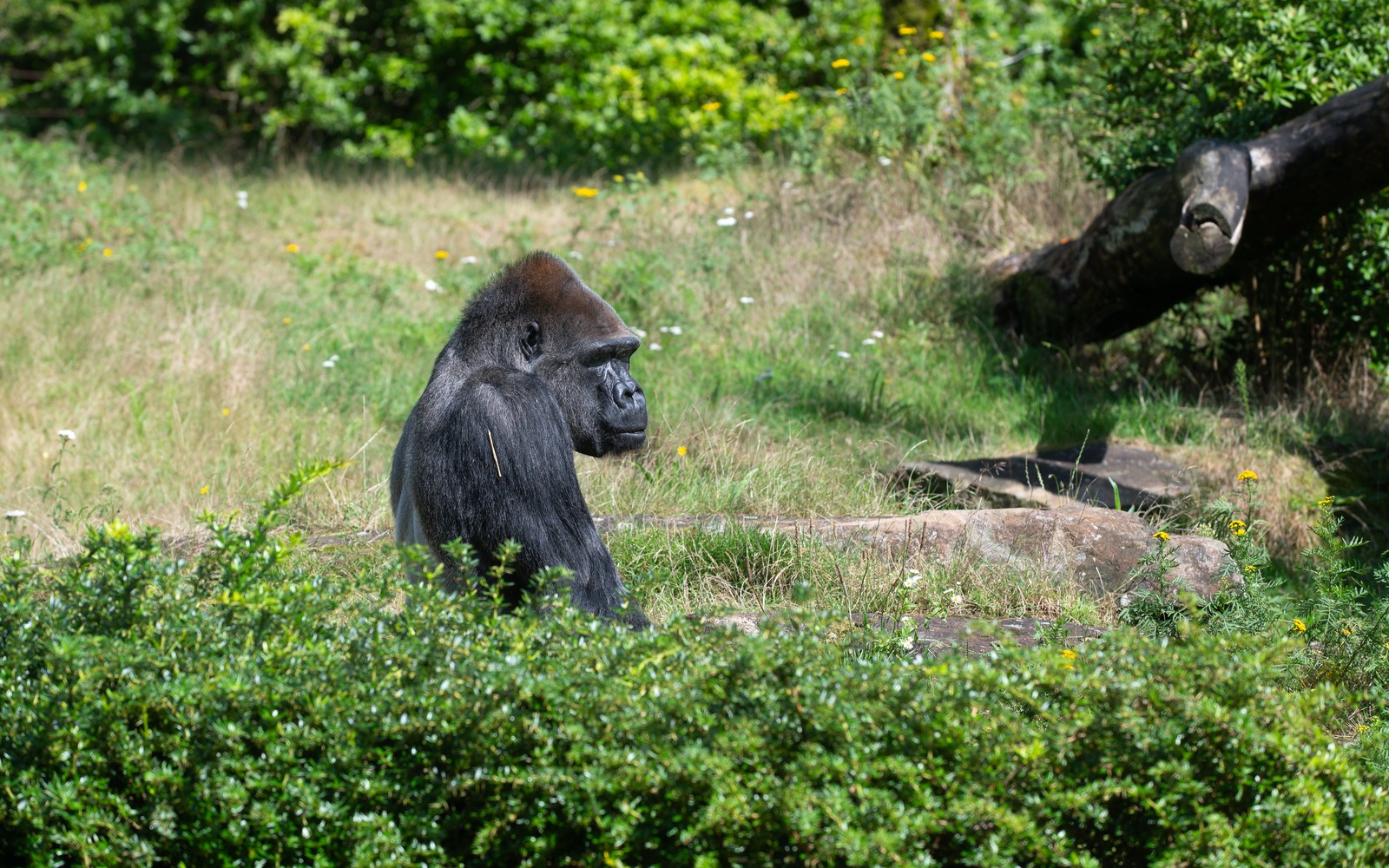
Species deep dive · gorilla
About 316,000 western lowland gorillas were projected to remain by the end of 2018 — and they are still Critically Endangered. That sounds like a contradiction until you see how the Red List works. The gorilla card in Wilder is the western lowland subspecies (Gorilla gorilla gorilla), the most numerous gorilla by far. A range-wide model put the 2013 population at 361,919 weaned individuals (95% CI 302,973–460,093). At the measured decline of about 2.7% per year, IUCN projected roughly 316,000 by the end of 2018. The listing is still Critically Endangered under criterion A4bcde, because that rate, held over three generations (~66 years), is expected to cut the population by more than 80% (IUCN Red List; Strindberg et al. 2018).
Why “hundreds of thousands” can still be CR
IUCN criterion A is about rate of loss, not a raw headcount. Criterion A4 covers an observed, estimated, inferred or suspected population reduction where the time window can include both the past and the future, and the letter codes flag the drivers IUCN used:
- b — an index of abundance
- c — a decline in area of occupancy, extent of occurrence and/or habitat quality
- d — actual or potential levels of exploitation
- e — effects of introduced taxa, hybridisation, pathogens, pollutants, competitors or parasites
For western lowland gorillas the generation length is about 22 years, so three generations span roughly 66 years (for example 2005–2071 in the assessment’s framing). Even the conservative 2.7%/year decline — lower than older Gabon-based rates near 4% — still pushes the modelled loss past the 80% CR threshold across that window (IUCN Red List).
The 2018 amended assessment updated the 2016 evaluation with Strindberg and colleagues’ first range-wide abundance model. Between 2005 and 2013 the modelled decline was about 19.4%, matching that ~2.7% annual rate (Strindberg et al. 2018; IUCN Red List).
Where they live, and what is cutting them down
Western lowland gorillas range across the forests of Western Equatorial Africa — Angola (Cabinda), Cameroon, Central African Republic, Republic of the Congo, Equatorial Guinea and Gabon. Most live in the Republic of the Congo (about 60% of the 2013 estimate), then Gabon (~27%) and south-western Cameroon (~11%). About 78% were outside formal protected areas in that analysis (IUCN Red List; Strindberg et al. 2018).
The main threats named in the assessment are poaching (bushmeat and the trade that follows new roads), Ebola virus disease outbreaks, and habitat loss or degradation from industrial agriculture, logging access and mining. Those pressures have not stopped; the Red List text notes that illegal hunting continues and that Zaire ebolavirus remains present in regional forests (IUCN Red List).
Western lowland versus the other gorillas
All gorillas are great apes in the genus Gorilla. Western lowland gorillas are one of two subspecies of the western gorilla (Gorilla gorilla); the other is the much rarer Cross River gorilla (G. g. diehli). Eastern gorillas (Gorilla beringei) include mountain and eastern lowland (Grauer’s) gorillas. Western lowland animals make up close to 99% of all living gorillas in the Strindberg range-wide picture — which is exactly why a large absolute number can still hide a catastrophic trend (Strindberg et al. 2018).
Nest surveys, not direct censuses of every ape, underpin these numbers: researchers count night nests and convert nest density into ape density with standard correction factors, then model density across the full geographic range (Strindberg et al. 2018).
For another “how many are left?” story where a tiny founding population rebounded with intensive care, see How many California condors are left?. For a fellow African great ape with a very different research fame — tools and culture — see chimpanzee tool use.
How the gorilla plays in Wilder
The Gorilla (Gorilla gorilla gorilla) is a Rare Mammalia card in the Forest element. It costs 5 Energy, with Attack 5 and Health 7, and it has Herd and Guardian. Flavour text: "A silverback's silver saddle marks the male who leads and defends the family."
Wilder is a free browser collectible card game about real animals, and you can play it free in your browser with no signup.
Photo credit
Hero photograph: Tuxyso, "Male Gorilla gorilla gorilla Apenheul 2023", Wikimedia Commons, CC BY-SA 4.0. Cropped for the Field Journal hero.

Questions people ask
How many western lowland gorillas are left?
IUCN’s 2018 amended assessment, using Strindberg et al. 2018, put the 2013 population at about 361,919 weaned individuals and projected roughly 316,000 by the end of 2018 at a ~2.7% annual decline (IUCN Red List; Strindberg et al. 2018).
Why are western lowland gorillas Critically Endangered?
Under criterion A4bcde: even with hundreds of thousands left, a sustained ~2.7%/year decline is projected to exceed an 80% loss over three generations (~66 years, generation length ~22 years), driven by poaching, disease (including Ebola) and habitat loss (IUCN Red List).
Which gorilla subspecies is on the Wilder card?
The Gorilla card is the western lowland gorilla (Gorilla gorilla gorilla), the most numerous gorilla subspecies and close to 99% of all living gorillas in the 2013 range-wide model (Strindberg et al. 2018).
Where do most western lowland gorillas live?
In the 2013 estimate, about 60% were in the Republic of the Congo, ~27% in Gabon and ~11% in south-western Cameroon, with roughly 78% outside protected areas (IUCN Red List; Strindberg et al. 2018).